The test
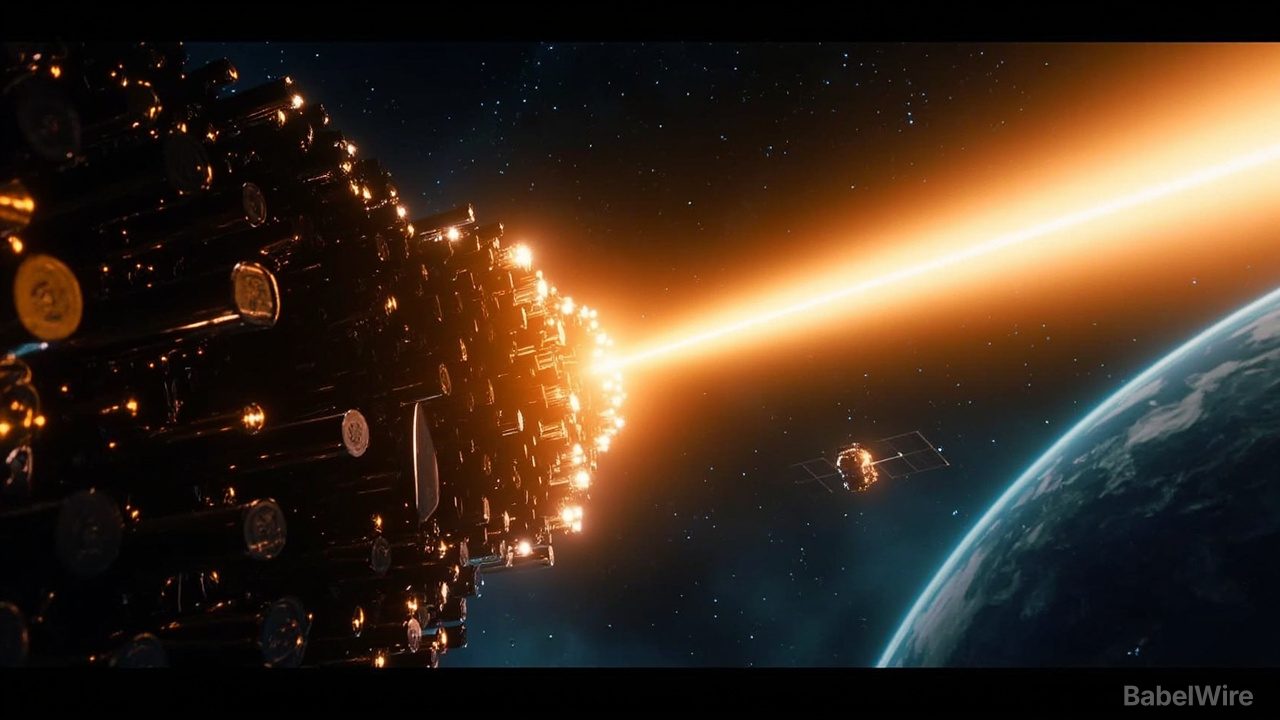
Star Catcher Industries is launching its Protostar prototype on a SpaceX flight this week. The plan: gather sunlight, concentrate it, convert it into a laser beam and deliver it to an untethered cubesat flying nearby. If it works, it would be the first time energy has been beamed between two separate, free-flying spacecraft.
Why now
Every spacecraft carries its own power budget, sized and paid for by the kilogram. Satellites spend most of their lives either in sunlight with surplus capacity or in eclipse draining a battery. A "power grid in space", as the company puts it, would let operators shrink batteries and add instruments — or, in the case of the orbiting data centres Google, SpaceX and others are sketching, add GPUs that would otherwise need batteries no launch vehicle wants to carry.
Star Catcher says its power nodes use lenses to concentrate sunlight into a narrow wavelength band that can deliver up to about ten times the power of diffuse sunlight, then beam it at a target satellite: "an ethereal transmission cable", in the company's words.
Traction and track record
- A $65 million funding round earlier this year and a $30 million US Space Force award. - 40 letters of intent from prospective buyers and, the company says, 10 power purchase agreements. - A ground record of more than 1 kilowatt delivered to off-the-shelf solar panels — enough for a microwave oven, and better than DARPA's previous mark. - A prior in-space test validated the tracking needed to hold a beam on a moving target.
The hard parts
Physics is not the only obstacle. The Naval Research Laboratory ran a space-laser power experiment for 100 days in 2023, but the beam travelled less than two metres inside a single unit and operated at about 11% efficiency. Researchers point to conversion efficiency, thermal management, precision tracking and surviving years of vacuum and thermal cycling as the open problems. The scale gap is also real: 1 kilowatt is a proof of concept, not a telecom satellite.
One more thing is riding on the same rocket: Google's first space-based data-centre experiment.