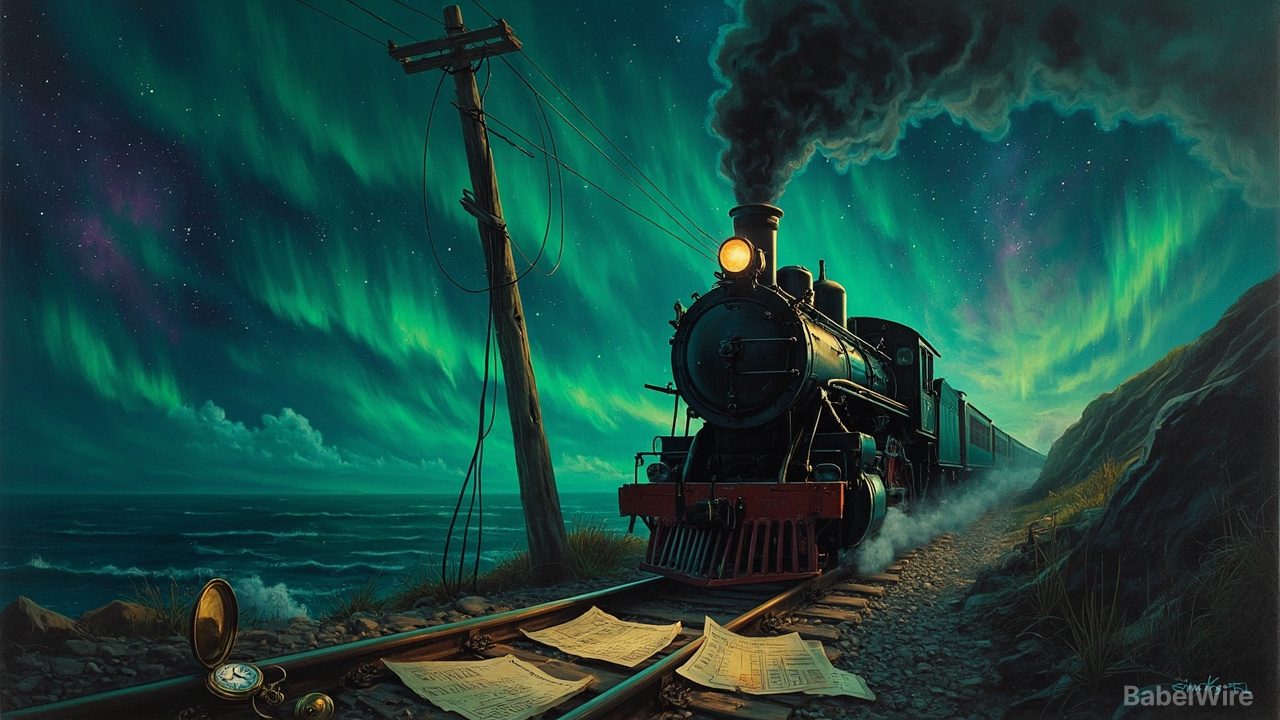
Few commuters expect their delay to be blamed on the Sun, but that is exactly the explanation offered for a train that supposedly left Exeter in south-west England at 10.05pm on 18 October 1841. An anonymous correspondent writing in Nature about thirty years later said the train was held up for 16 minutes because "a very intense magnetic disturbance" made it "impossible to ascertain if the line was clear". Such storms are now called space weather, and in 2013 Trey Cade, who leads the Space Weather Research Lab at Baylor University, suggested the incident might be the first recorded case of space weather disrupting human technology.
The answer, according to research published in the journal Space Weather, is no — and for a simple reason. The stretch of railway in that part of England did not open until 1846, five years after the supposed event.
That left a second question: was the Nature correspondent simply misremembering the date of a real storm? An unusually broad team set out to check. Led by Jim Wild of Lancaster University, it drew on the British Geological Survey, Natural Resources Canada, RMIT University, STFC RAL Space, the journal Nature itself, and Cade. The researchers combined railway timetables, historical newspapers, records of solar observations, aurora sightings and digitised geomagnetic measurements.
Their conclusion is that the correspondent — whom they tentatively identify as an electrical engineer named Nathaniel John Holmes — was probably thinking of a storm on 18 October 1848, not 1841. With the 1841 claim removed, the earliest known example of space weather affecting technology becomes an incident involving telegraph systems on England's Midland Railway in March 1847.
"Society has been experiencing the effects of space weather on technology for almost as long as electrical technologies have existed," Wild said. "The technologies affected have evolved from railway telegraphs to satellites… but the challenge remains the same: understanding the risk and ensuring society is resilient to its impacts."
Lasse Clausen of the University of Oslo, who studies space weather but was not involved in the study, told Physics World that the biggest barrier is a shortage of data about the ionosphere, where space weather plays out. Detection has improved since the 1840s, he said, but prediction is roughly where conventional weather forecasting stood in the 1920s: "Essentially, we can look out the window and say whether it's raining or not." He called the new study "a nice piece of detective work" that firmly belongs in the awareness-raising category.