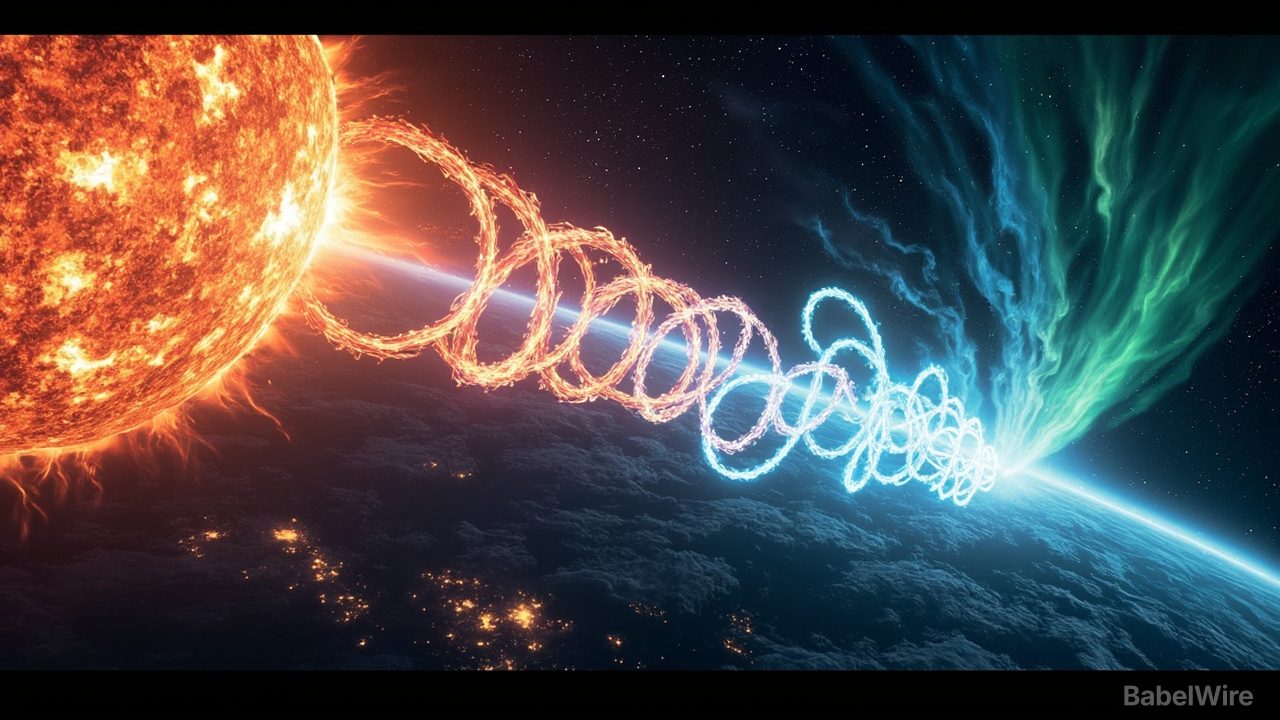
The most powerful geomagnetic storm in two decades — the Mother's Day weekend storm of May 2024, whose auroras may have been the strongest in 500 years — was caused not by one solar eruption but by a chain of ten, according to the most detailed analysis yet, published August 7 in the Astrophysical Journal.
Space physicists led by the University of Iowa reconstructed the event using plasma and magnetic field data from NASA's Wind spacecraft plus advanced modeling. They found that 10 coronal mass ejections erupted from the Sun over four days and merged into a gigantic magnetic cloud. The first seven eruptions' clouds combined; two more merged and caught up with the growing cloud; the final ejection traveled at nearly 1,000 miles per second before colliding with and shoving the entire structure toward Earth. When that supercharged cloud hit Earth's magnetosphere, it spawned the intense storm and auroras visible as far south as Mississippi, and from the Himalayas to Queensland.
"We haven't seen any case — at least with current observation and simulation techniques — where we have 10 coronal mass ejections that erupted and merged together," said corresponding author Shirsh Soni, a postdoctoral researcher at Iowa. "This was unique."
Most space weather models assume individual eruptions. The study, which used computational modeling from the University of Leuven, shows how interacting CMEs can combine into far more powerful events — a key step toward more accurate forecasts as the Sun heads into a declining phase of its 11-year cycle, and toward predicting storms that can threaten satellites, power grids and telecommunications.