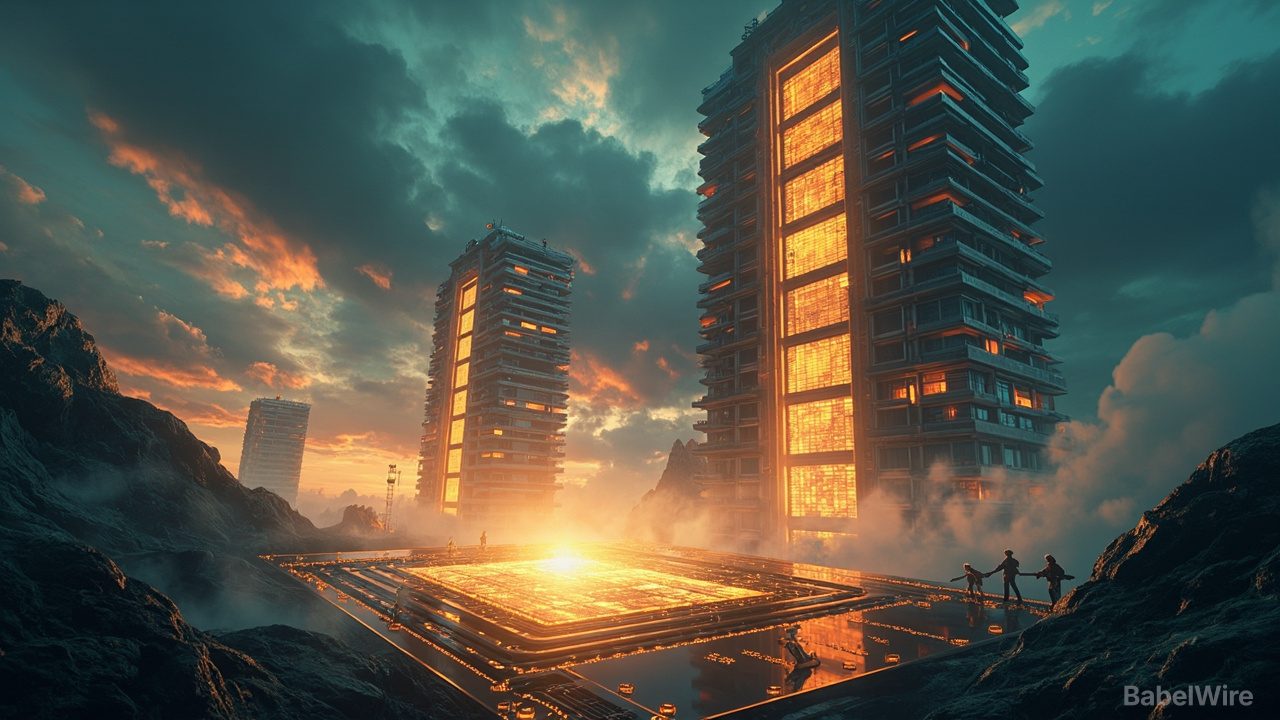
In the mountains of South Korea, the world's largest memory-fab buildout is taking shape. SK Hynix — the dominant maker of high-bandwidth memory (HBM), the chips that feed AI processors — is investing $720 billion in what it calls the biggest network of memory factories on Earth. CNBC received the first on-camera tour of the Yongin Cluster, where the initial fab will reach the height of a 50-story building with six stacked cleanrooms.
The bet is enormous — and so is the backdrop. SK Hynix's market cap has jumped more than fivefold in a year to top $1 trillion. It controls 58% of the HBM market, ahead of Samsung and Micron, which hold roughly 21% each. Demand is so intense that the industry's historic boom-bust cycle has inverted: AI giants like Nvidia are signing multi-year contracts to lock in supply.
"It's like a war," SK Group Chairman Chey Tae-won told CNBC in Seoul. "Everybody wants to buy the memory chips. Without that, they cannot produce their AI computing and AI chips." He showed CNBC a wafer carrying a message from Nvidia CEO Jensen Huang: "Please make more." Nvidia and SK Group recently announced a $500 billion deal covering stable HBM supply, co-development of next-generation memory, and new data centers with SK Telecom by 2027.
South Korean President Lee Jae Myung's June plan aims to double national memory output within five years, backed by a chip support package worth at least $22 billion. To fund its expansion, SK Hynix raised $26.5 billion in July by listing on the Nasdaq — the largest raise ever by a foreign company on U.S. markets — though U.S.-listed shares have since fallen about 21% from their July 14 peak amid broader AI-stock volatility.
Rivals are racing too: Micron is spending $50 billion in Boise and $100 billion in Clay, New York, while SK Hynix is building its first U.S. facility, a $4 billion packaging plant in Indiana due to be completed in 2028. Chey sees custom HBM as the industry's next turning point — chips co-designed with Nvidia, Google and others, turning a commodity into something far more strategic. As one analyst put it: "It's a race, and now the counterparty of the race is China."