For a while the autonomous-vehicle business looked like it had settled into a slow, expensive grind: a handful of well-funded players, years of validation, and a long wait for unit economics. Trucks VC's inbound pipeline says otherwise.
The early-stage firm has fielded pitches from 81 new AV startups so far in 2026 — two-thirds more than last year, and more than in the frothy 2016–2017 stretch that partner Puneeth Meruva had been using as the comparison. His explanation is technical rather than financial: "For a long time AV companies were trying to go from AV 1.0 to AV 2.0, which is kind of this holy grail end-to-end architecture. And I think the foundation models now provide a technical architecture that makes those end-to-end systems possible." Vision-language-action models generalise across environments, which is exactly the thing that used to require a bespoke perception stack and a city-by-city mapping campaign. Meruva says Trucks routinely sees teams deploy in a few months on less than $1 million raised.
The composition of the 81 surprised him. He expected construction, warehouse, agriculture and mining — and got them — but a growing share are pure-play robotaxis aimed at Waymo's territory. His read is that the market has room for regional players competing on specific routes rather than global coverage, which is a more plausible thesis when the software stack is a fine-tuned foundation model rather than a decade of proprietary engineering.
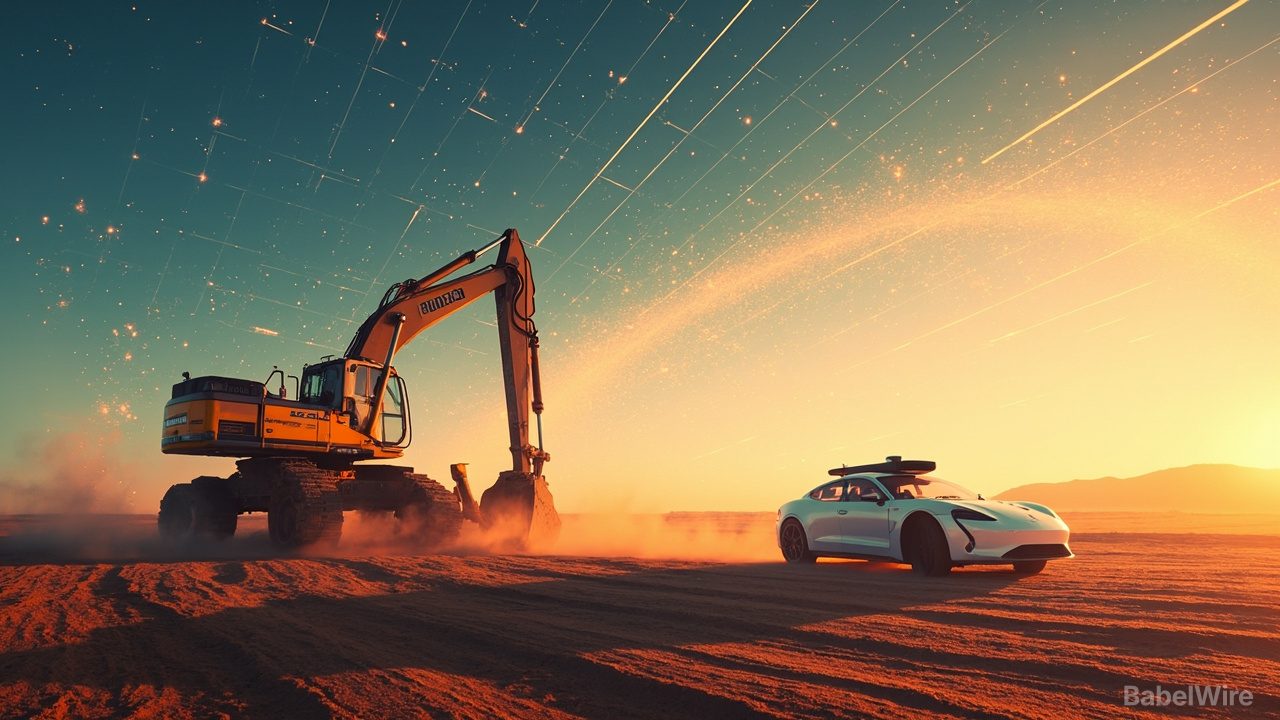
The money is already moving to match. Bedrock Robotics raised $600 million in a Series C at a $4.1 billion post-money valuation, co-led by CapitalG and Emergence Capital, with Bessemer, Temasek and Nvidia participating — for driverless excavators. Kodiak AI signed its first binding commercial deal for driverless big rigs on public highways: 75 self-driving trucks for DTL Transport starting in 2028. Waymo and Toyota moved past "we're talking" into a manufacturing partnership, with Toyota building AV-ready bZ4X vehicles in Japan and integrating Waymo's system for robotaxi service in Japan and the UK, plus a hint that licensing into personally owned cars is on the table. And Re:Build, the manufacturing accelerator co-founded by ex-Amazon executive Jeff Wilke, raised $2.1 billion to expand hard-tech production capacity — billing itself as "America's answer to Shenzhen".
There are reasons to keep the enthusiasm proportional. Eighty-one pitches is one VC's inbox, not a market census; it measures founder sentiment, and founder sentiment in AV has been wrong before. Cheap deployment is not the same as cheap operation — remote assistance, insurance and depot costs do not scale with a foundation model. And the most striking number in the same newsletter cuts the other way: DoorDash, which has agreed to buy Instacart for $17 billion, reported that it has received only a few hundred orders from AI agents so far. Agents that order groceries and cars that drive themselves are arriving on very different clocks.