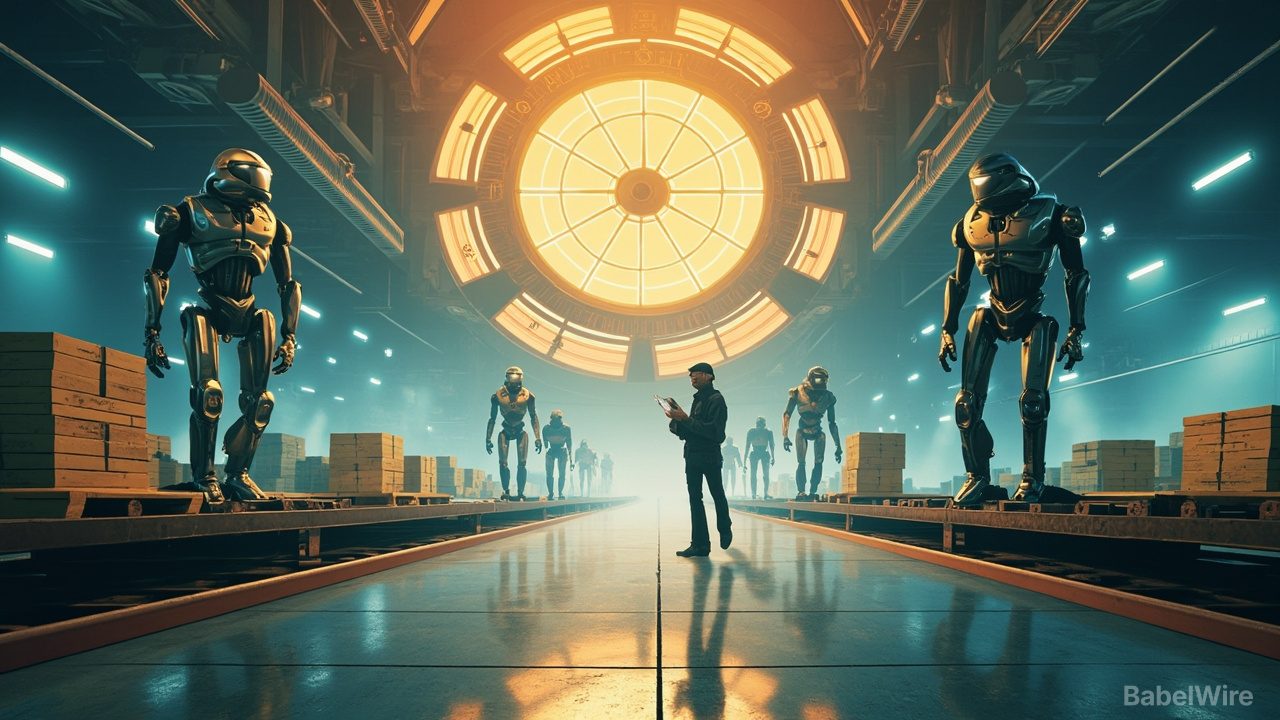
At its Innovation Day 2026 in Shanghai on 29 October, AgiBot proposed a metric meant to move the humanoid argument past unit counts: not how many robots you build, not how many you ship, but how much work they do.
Worken — from 'work' and 'token' — is defined as:
Worken = Number of Active Robots × Autonomous Working Hours × Output Efficiency Ratio
The first factor counts only robots actually performing tasks in real environments, not units manufactured or sitting in inventory. The second measures time spent working autonomously rather than total powered-on time. The third sets productive output against a reference benchmark for a defined task — for instance, the acceptable work a human worker completes under established operating standards.
'Over the past few years, the robotics industry has made remarkable progress in hardware, AI models, and large-scale manufacturing,' said Peng Zhihui, AgiBot's co-founder, president and CTO. 'But as robots begin working in factories, warehouses, and service environments, we need to answer a more practical question: How much productive work are they actually delivering?'
The implied criticism is pointed. 2026 has no shortage of announcements about production lines and pilots, and very little comparable data about how much work survives contact with a real shift — or how often a human has to step in. Worken is aimed at that gap, and at becoming a reference measure for physical AI.
Alongside it came a full stack. AHA3 is the third-generation humanoid architecture, unifying locomotion, interaction and manipulation intelligence, with a liquid-cooling system for continuous operation, IP67-rated joints, Wi-Fi 6 and 5G. GO-3 Preview is a new embodied foundation model built around a 'World Reasoning Action Model' meant to anticipate the consequences of actions and generalise beyond learned task sequences; AgiBot says it ranks first on RoboDojo for both task success rate and process score, takes the highest overall score on RoboTwin, and leads overall on RoboColiseum. WITA-Omni 1.0 bundles vision, speech, real-time dialogue, facial expression and movement into one interaction model with full-duplex conversation, and the company says it tops benchmarks including Daily-Omni.
For industry there is the G2 Max: 21 degrees of freedom, dual-arm handling up to 40 kilograms, working height from 0.1 to 2.5 metres. On the data side, the MEgo Glove (Air and Ultra) captures finger pose plus, in the Ultra, three-dimensional fingertip and palm force and torque data; the OmniHand 3 family and OmniPicker 3 tactile gripper round out the hands.
Link-U OS 1.0, which AgiBot calls the first operating system purpose-built for embodied intelligence, is in trials with selected partners and is due to become fully open source by the end of 2026. AgiBot has donated the project to the OpenAtom Foundation and taken a platinum sponsorship there.
The numbers the company offers: its 20,000th robot came off the line last month; IDC ranked AgiBot first in global humanoid shipments for the first half of 2026; the ecosystem spans 255 universities, 511 enterprises and more than 80,000 developers. Named deployments include tablet maker Longcheer, Guangzhou Metro and the Chimelong resort.
Scepticism is warranted. Every benchmark figure is self-reported and not independently replicated, and a metric proposed by a manufacturer is a marketing instrument first — even when it asks the right question. Worken only becomes useful when several vendors publish numbers under the same definition, and a benchmark whose denominator each vendor grades itself is a press release with arithmetic. AgiBot says the framework will be refined through deployments and operating data. The first honest test will be whether a competitor adopts it.