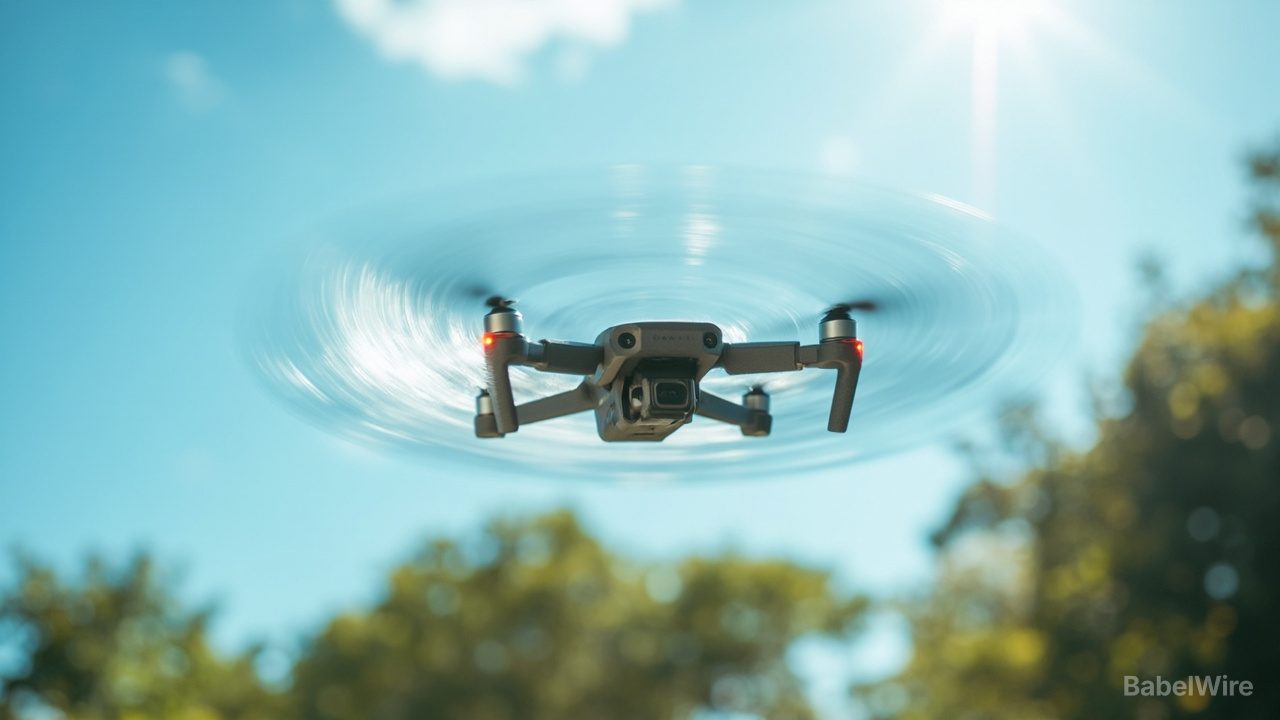
The Drone That Disappears
Stealth bombers use exotic materials to lower their radar signature. Spy satellites orbit Earth far outside human sight. But a new drone from Northwestern University avoids detection in an altogether simpler way: spinning so fast it blurs into the background.
Phantom Twist, created by Professor Emma Alexander and her team, spins at 25 revolutions per second — so fast that the human eye sees only a faint haze. Unlike a fan, where the central axle and stand remain clearly visible, every single part of Phantom Twist spins.
Designed by AI, Not Humans
The drone's unusual single-motor design emerged from a complex, entirely automated process: 1. A generative AI created millions of possible designs 2. A second AI filtered those down to ~20,000 that were theoretically able to fly 3. A third AI — modeling human vision — assessed each design's visibility against various backgrounds
The researchers only stepped in at the very end to build the winning design.
How Motion Blur Creates Invisibility
"The motion blur essentially turns all of the mechanical components into this slight haze," says Alexander. "And if you're not paying attention, you might really miss that slight change in the brightness of the environment."
The drone weighs just 30 grams and fits in the palm of a hand. Its components are spread out so that none visually overlap when spinning, maximizing the blur effect.
Limitations
Experts note this stealth has trade-offs. The spindly design cannot carry sensors or payloads without becoming visible. The gyroscopic effect of spinning makes quick directional changes difficult — Phantom Twist can currently only hold a steady hover. And while the eye cannot see it, the ears can still hear it easily.
The team believes transparent components and further AI refinements could improve visibility reduction even more.
Phantom Twist was presented at the Robotics: Science and Systems (RSS) conference in Sydney, Australia on July 16.