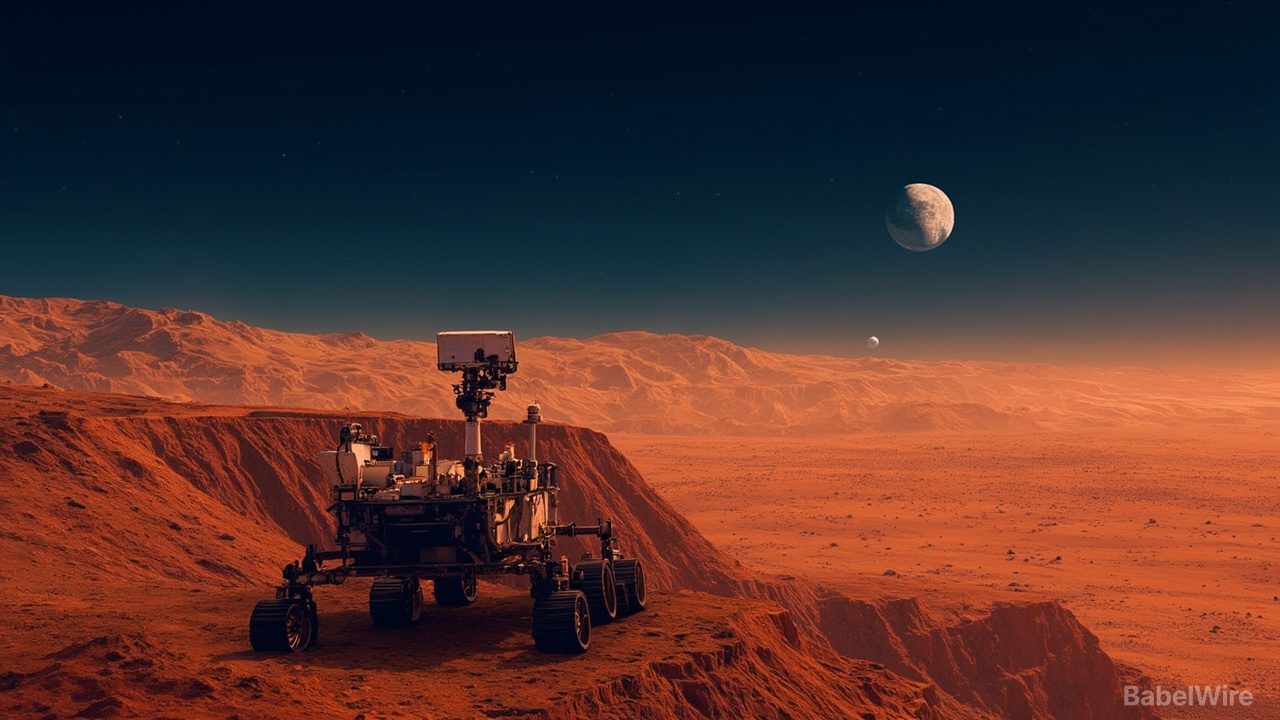
Earth and the Martian moon Phobos dance together in a series of images recently acquired by NASA's Perseverance Mars rover. Earth appears as a point of light in the Martian sky, disappearing behind the crescent of Phobos, the larger of Mars' two moons. It is the first time humanity has captured, from the surface of another planet, an observation of Earth disappearing behind an object.
The image sequence was taken by the rover's Mastcam-Z instrument at about 7 p.m. local solar time on July 2 — the 1,907th Martian day, or sol, of the mission. In the composite image, Earth travels from the upper left of the frame toward the lower right while Phobos, moving from lower left to upper right, sweeps across its path. In the third frame, the two meet, and our planet winks out behind the little moon's shadowed edge.
"The composite image makes for a unique Earth self-portrait, taken from the surface of another planet, with a Phobos photobomb," said Justin Maki, the Mastcam-Z deputy principal investigator and imaging scientist for Perseverance at NASA's Jet Propulsion Laboratory.
From Perseverance's perch on the rim of Mars' Jezero Crater, the two objects could hardly look more different. Phobos, a lumpy, potato-shaped moon about 17 miles (27 kilometers) across at its widest, orbits so close to Mars — just 4,850 miles (7,800 kilometers) away — that it appears roughly one-third the width of Earth's Moon as seen from our planet. Some 195 million miles (314 million kilometers) away at the time, Earth is reduced to a single, pixel-size dot.
"Phobos crosses the Martian sky three times a day, and Earth is visible for months at a stretch, but catching one directly behind the other takes planning and a little luck," said Mark Lemmon, a Mastcam-Z co-investigator at the Space Science Institute, who planned the observation and assembled the composite. Astronomers call the event an occultation: when a larger-appearing body completely blocks the one behind it. Perseverance has previously observed transits, when Phobos or Deimos crosses the disk of the Sun — sometimes described informally as "Martian solar eclipses" — but never before has Earth been seen passing behind a Martian moon.