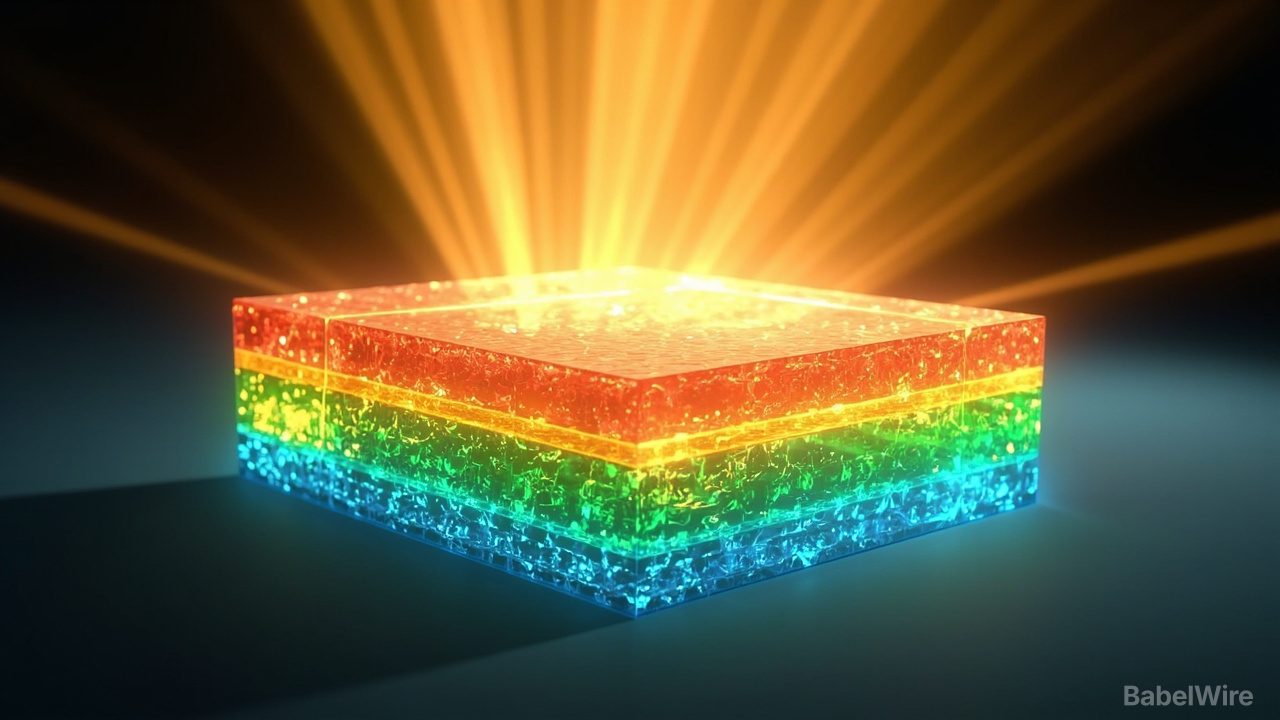
Researchers at Helmholtz-Zentrum Berlin (HZB) have overcome a long-standing barrier in next-generation photovoltaics by developing an all-perovskite triple-junction solar cell that achieves 27.3% power conversion efficiency. The team, led by Steve Albrecht, introduced a novel graphene oxide and self-assembled monolayer (SAM) bilayer strategy that suppresses optical and electrical losses at buried interfaces.
The main bottleneck in multi-junction all-perovskite architectures has been the narrow-band-gap tin-lead bottom sub-cell, which captures near-infrared light. The organic polymer PEDOT:PSS, long used as the hole-transport layer, suffers from parasitic light absorption and acidic degradation. When researchers tried replacing it with SAMs, they discovered massive ion accumulation that hinders charge extraction.
The HZB team deposited an ultrathin graphene oxide layer onto the conductive base before introducing the SAM molecule MeO-2PACz. The SAM head groups anchor onto the graphene oxide via hydrogen and covalent bonding, producing favorable molecular reorientation that deepens the electronic work function and enhances conductivity. The graphene oxide also provides a smooth, hydrophilic foundation that accelerates crystal nucleation.
In single-junction tin-lead solar cells, the bilayer achieved 22.1% efficiency versus 12.0% for SAM-only equivalents. When integrated into a monolithic triple-junction stack with band gaps of 2.00, 1.60, and 1.25 eV, the overall efficiency reached 27.3%. The encapsulated devices retained 90% of initial performance after 770 hours of continuous operation, setting a new stability record for triple-junction all-perovskite configurations.
The team projects that further optimization of wider-band-gap perovskite layers and band alignment tuning can push this architecture past 30% efficiency. The results are published in Joule.
Source: Physics World, September 9, 2026 https://physicsworld.com/a/bilayer-approach-ramps-performance-of-all-perovskite-triple-junction-solar-cells/