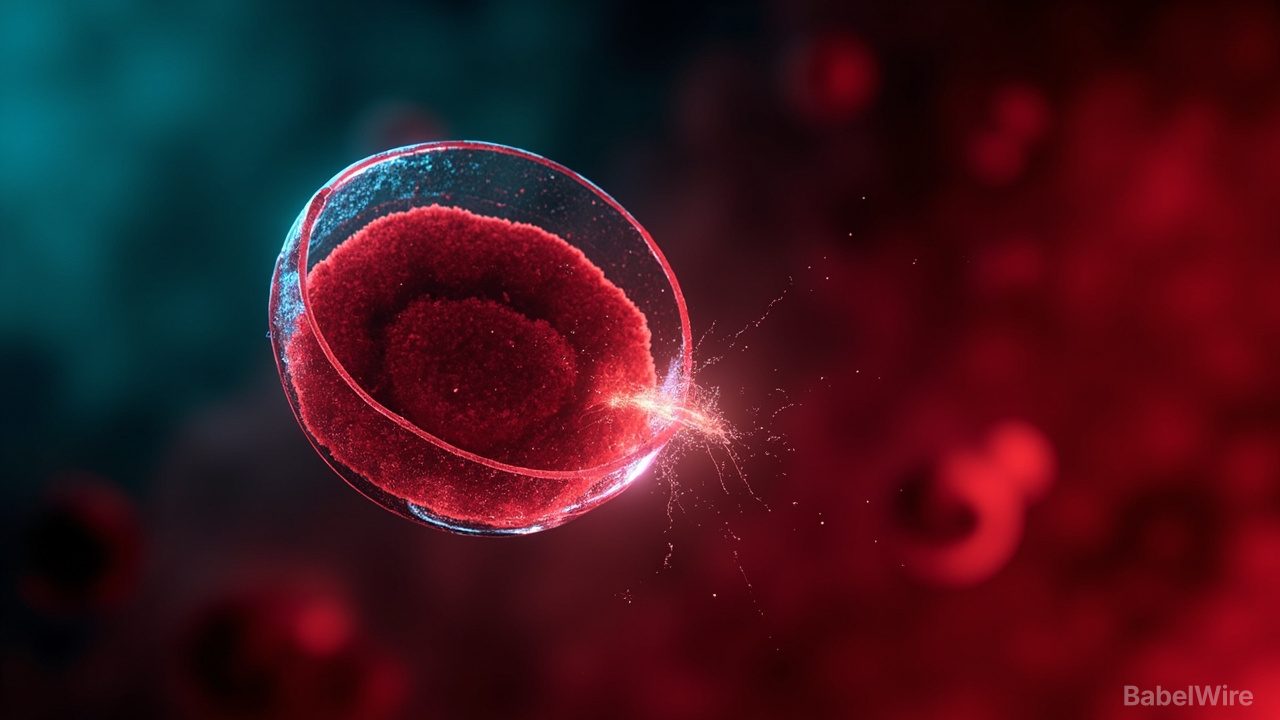
Quanta Magazine's science coverage today goes to the surface of a red blood cell, where a malaria parasite is caught mid-invasion.
Every blood-stage malaria infection starts with this maneuver. A Plasmodium merozoite — the form released when infected red blood cells burst — drifts up against a healthy cell, attaches, swings around so its apical end faces the membrane, and forces itself inside. A tight junction forms at the point of contact, the parasite slips through, and what's left behind is a host cell that looks, at first, untouched. The whole sequence is over in seconds.
That speed is precisely the problem. Merozoites are fragile and short-lived outside a cell, red blood cells deform constantly, and the action takes place in dilute suspension rather than on a prepared slide. As a result, the molecular side of invasion has been mapped in far more detail than the event itself: adhesion and invasion proteins on the merozoite surface have been catalogued for decades and remain among the most intensively studied candidates for vaccines and drugs against blood-stage disease, while direct observation of the breach has lagged well behind.
The new work Quanta reports closes part of that gap, catching the parasite in the act rather than inferring what it does from its components.
Why it matters: the blood stage is what makes malaria symptomatic and lethal, and any intervention that blocks entry has to contend with the exact sequence the new work observes — attachment, reorientation, penetration. Seeing that sequence clearly turns a list of proteins into a mechanical event, and mechanical events are far easier to interrupt.
Read the full piece at Quanta Magazine.