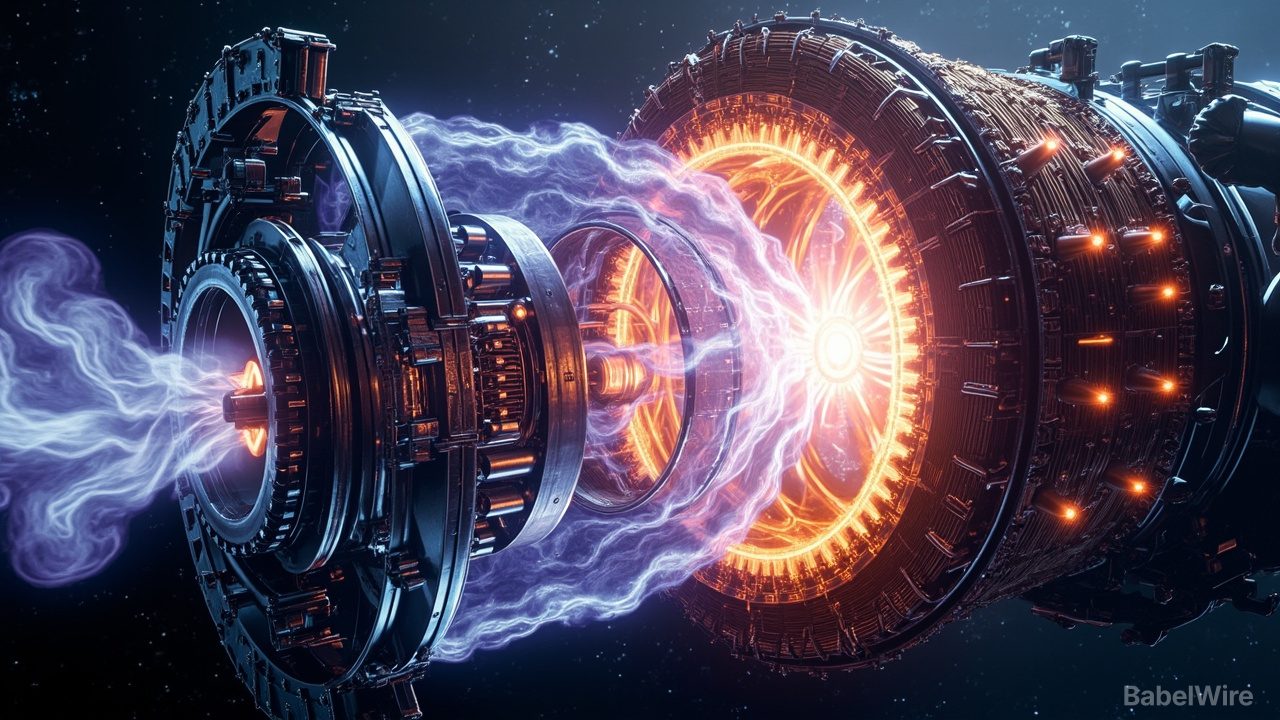
Golem reports on research into a fusion reactor concept that blends the tokamak and the stellarator.
The two mainstream magnetic-confinement approaches each carry a trade-off. The tokamak is the more mature and more compact machine with better power density, but it needs a current driven through the plasma and mostly runs in pulses. The stellarator operates continuously and needs no plasma current at all, but its twisted coil geometry is far harder to build and its confinement long had a worse reputation.
The hybrid idea is not new — early stellarators were in fact hybrid-like, and Wendelstein 7-X was deliberately optimized to behave more tokamak-like. What is current is treating the combination as a design space in its own right, using modern coil optimization and, in some proposals, a tokamak-style current only in a short or auxiliary role while the external stellarator fields carry the steady-state operation.
That matters because every serious candidate machine is a multi-year, multi-billion build. Hybrid studies are a cheap way to test whether the trade-off curve can move: if stellarator-style continuous operation could be kept while reaching tokamak-class confinement, the case for a reactor that sits at power continuously rather than cycling gets stronger — which is what a power plant needs anyway.