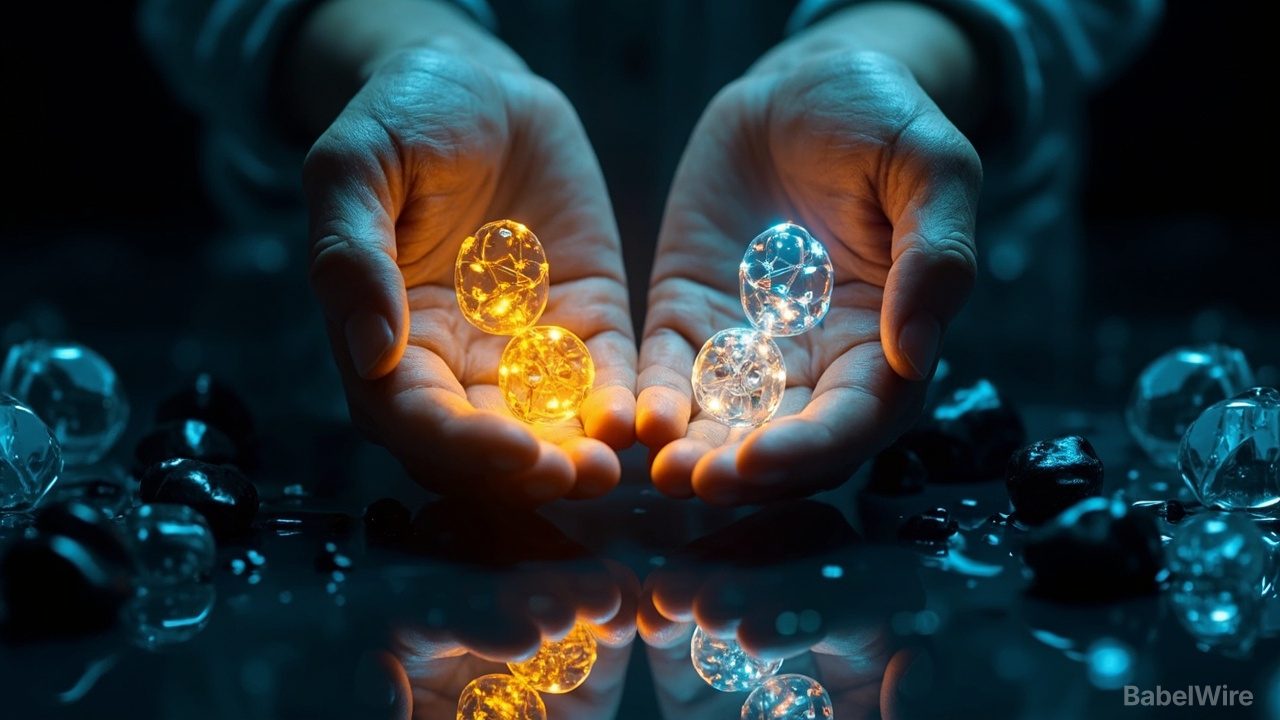
Some chemical reactions produce two molecules that are non-identical mirror images of each other. Life uses only one of them: the amino acids in your cells and the sugars in DNA are all single-handed, a property chemists call homochirality. Making a reaction settle on one hand is enormously valuable — in drug manufacturing one enantiomer can treat a disease while its mirror image causes harm, as the thalidomide tragedy showed — but for decades it was unclear how such selectivity could arise.
Henri B. Kagan, professor emeritus at what was then Université Paris-Sud, and Kenso Soai, professor emeritus at Tokyo University of Science, provided the answer in two steps. In 1986 Kagan showed that a catalyst mixture could produce a product with a far greater excess of one mirror image than expected — a non-linear effect — upending the assumption that a catalyst's chirality transfers to the product proportionally. He had, in effect, found a way to amplify asymmetry.
Soai then closed the loop with autocatalysis: a reaction in which the product catalyses its own formation. Starting from a tiny random excess of a molecule called 5-pyrimidyl alkanol, his reaction amplifies that excess until one enantiomer makes up as much as 99.99 percent of the output. The 'Soai reaction' fulfils a model the physicist Charles Frank sketched in 1953 and is regarded as one of chemistry's most elegant experiments.
The academy said the discoveries are 'hugely important for chemists who design reactions that are utilised in applications such as pharmaceutical manufacturing', and have helped explain how life's one-handed chemistry could have begun. The prize, announced on 7 October, is the third awarded this week after the medicine and physics awards.