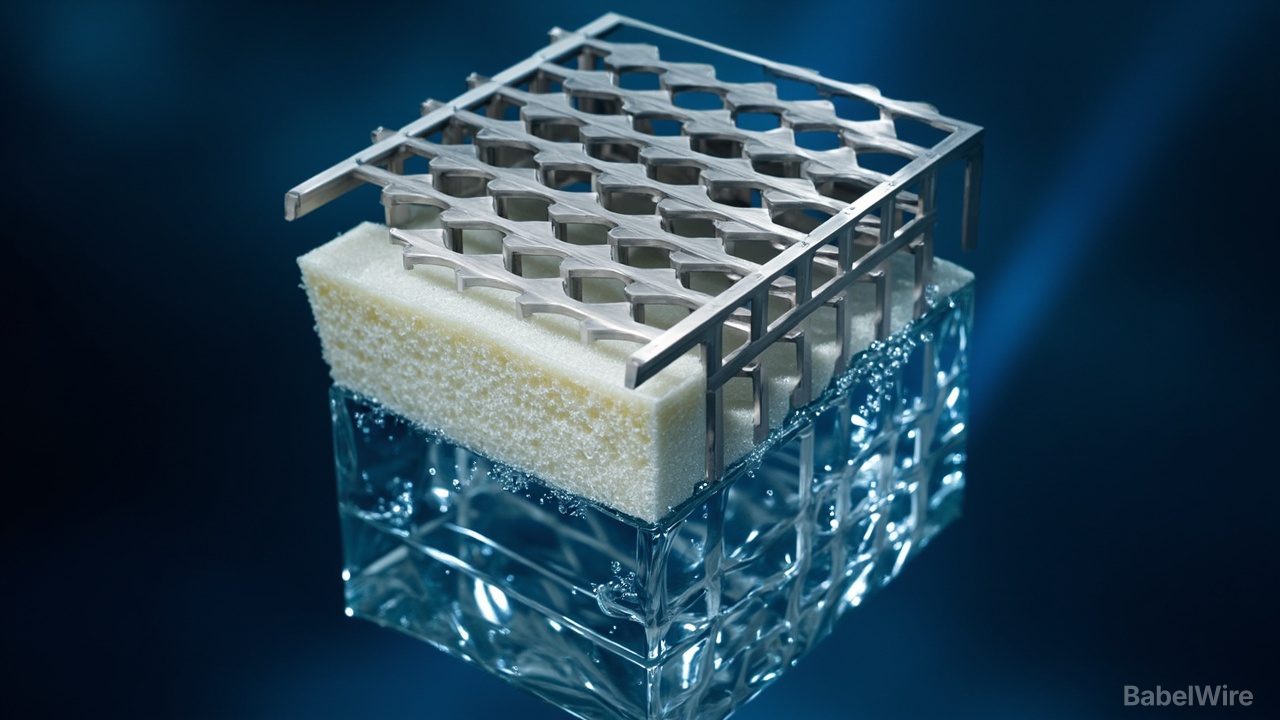
Materials engineers in Australia and France have built a titanium alloy lattice that floats in water despite being pierced by open pores — a combination they say opens a new design space for marine structures, vehicles and rescue equipment.
Open-cell metallic structures are strong and light, which is why aerospace and biomedical engineering use them. In water they normally fail for a simple reason: the interconnected pores fill, so a structure whose bulk density is far below that of water still sinks. In a paper in Advanced Materials, Ma Qian's group at RMIT University in Melbourne and colleagues at the Conservatoire National des Arts et Métiers in France proposed a different yardstick — "skeletal density", which counts only the parts of a structure that exclude water. If that value is below the surrounding liquid's density, the object floats even when water flows through it.
They used the measure to design a hybrid around a hollow-strut lattice, a metamaterial whose struts contain millimetre- or sub-millimetre-scale channels and which is stronger than solid-strut lattices of the same density. Those channels can be filled — impossible in conventional solid-strut designs — so the team injected expandable polyurethane foam with a density of 0.08–0.11 g/cm3 into a Ti-6Al-4V lattice. The closed-cell foam, with pores from about 10 µm to 200 µm, blocks water from the internal channels while the external architecture stays permeable, so buoyancy comes without a notable density penalty. Microscopy showed continuous, defect-free bonding between foam and strut walls.
Unfilled lattices sank in fresh water regardless of strut diameter. Filled ones floated: the team kept them submerged in fresh water for more than two months, then for two weeks in natural seawater — measured at 1.03 g/cm3 against 0.997 g/cm3 for fresh water — where they stayed afloat and lost only about 0.15% of their mass, which the researchers read as corrosion resistance. The foam-filled lattices also showed higher specific strength than high-density polyethylene and 316L stainless steel, two common marine materials.
"The innovation opens a new design space for marine structures, vehicles and rescue equipment where we need strength, low weight and buoyancy all at the same time," Qian said. He argues the same trick works with other fillers: a biodegradable magnesium scaffold combined with a growth-factor hydrogel for bone regeneration, or a titanium hollow-strut lattice joined to carbon-fibre-reinforced polymer for lightweight, stiff aerospace hybrids.
The team is now seeking commercial partners and wants to test larger marine applications, including autonomous underwater vehicles and floating platforms, plus long-term performance under realistic marine conditions.