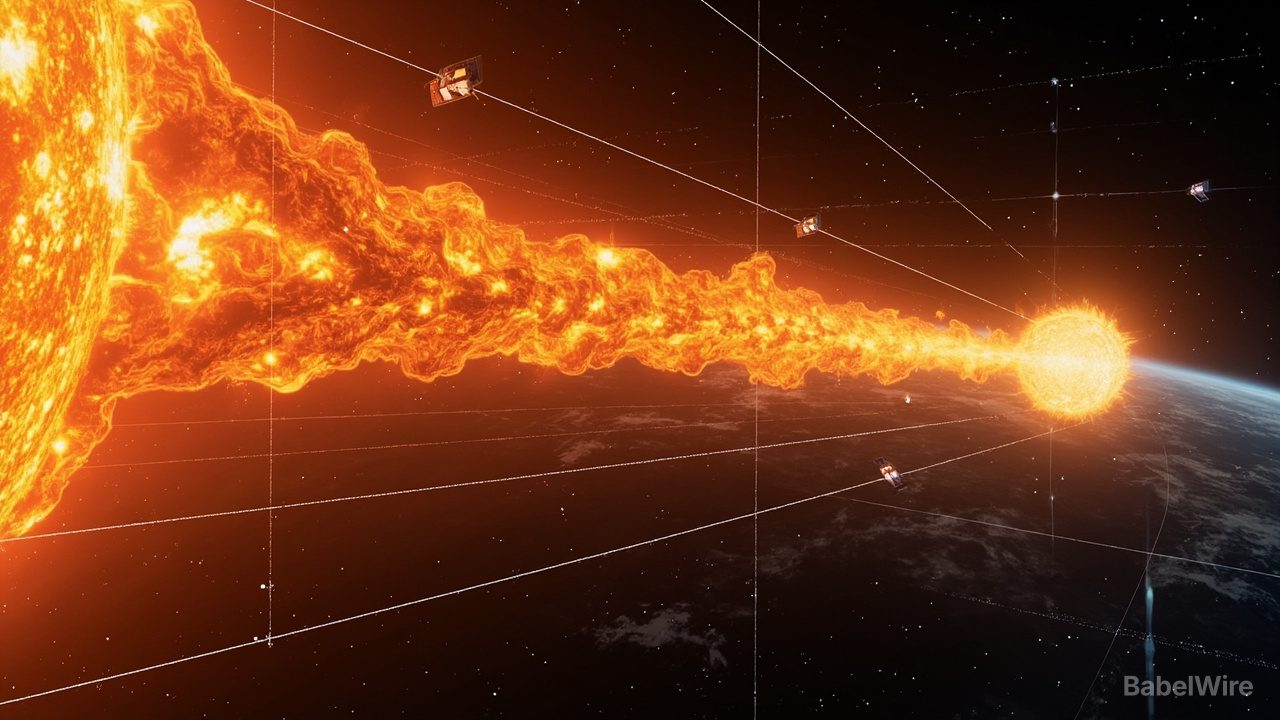
NASA's PUNCH mission has passed its first forecasting test with stunning precision: using continuous images of a coronal mass ejection (CME), scientists predicted its arrival at Earth to within 30 minutes — about 10 times better than current methods, which only offer a 5-hour window.
PUNCH (Polarimeter to Unify the Corona and Heliosphere) consists of four small spacecraft in low Earth orbit that stitch together continuous 3D views of the inner solar system, capturing a new image every four minutes. Before the mission launched in 2025, CMEs could only be tracked for about a fifth of their journey from the Sun, leaving forecasters to guess for the rest. Now scientists can follow the eruptions nearly all the way to Earth.
In the proof-of-concept test, researchers fed imagery of the May 31, 2025 CME into a model that tracked its leading edge. Twelve hours after the eruption left the Sun, the model settled on a final prediction: arrival in eight hours. The actual arrival came within half an hour of that estimate — and the model also flagged when its own estimate had stabilized, so forecasters could trust it. The results, presented Tuesday at the Committee on Space Research (COSPAR) meeting and under review at the journal Space Weather, could transform forecasts of storms that threaten power grids, satellites and astronauts. "We accomplished an order of magnitude better result than the state-of-the-art method with a really basic process," said Craig DeForest, PUNCH principal investigator.