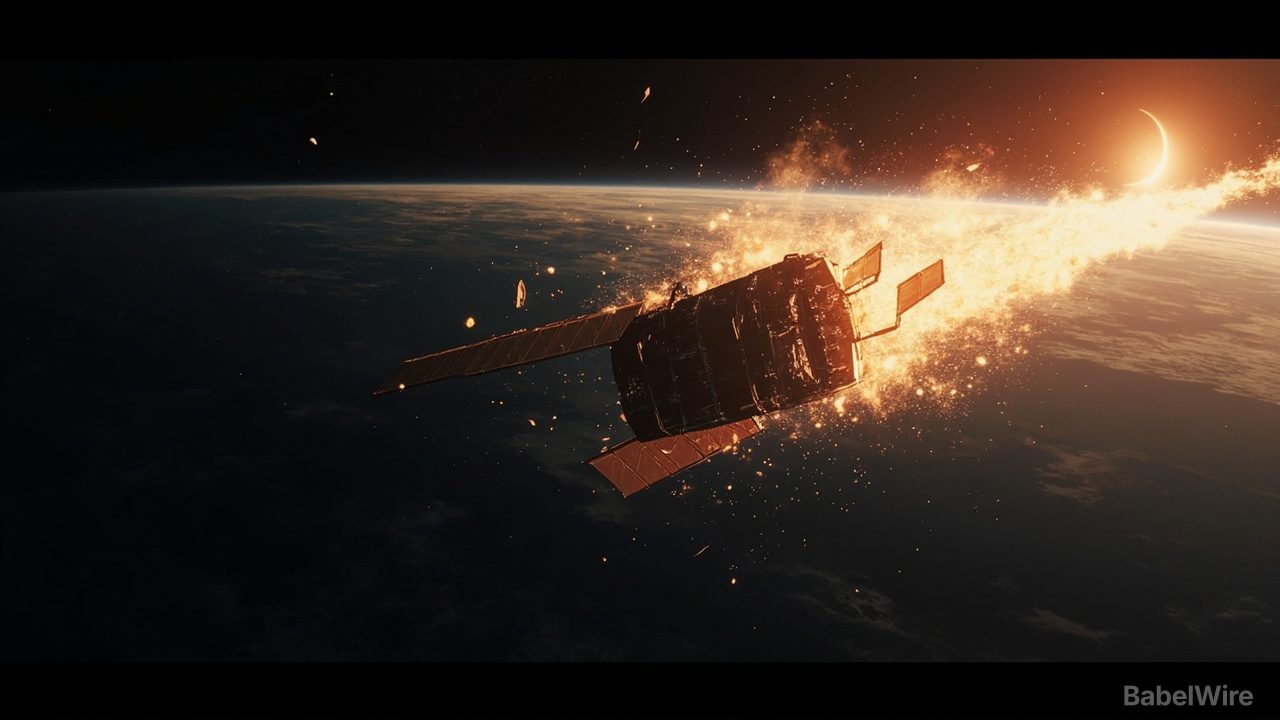
NASA's Neil Gehrels Swift Observatory is now hours away from the end of a mission that was designed to last two years. As of Monday, the U.S. Space Force predicted re-entry at roughly 3:30 a.m. EST on Wednesday 4 November, with an uncertainty of eleven hours — a window that stretches from Tuesday evening to Wednesday afternoon.
Most of the spacecraft will burn. Not all of it will. NASA expects some components to survive to the surface, and because Swift's orbit was inclined only about 20.6 degrees, any surviving debris is confined to the band between 20.6 degrees south and 20.6 degrees north latitude. That is the tropics, not the latitudes where most of the world's space-surveillance radar and news desks happen to sit. NASA puts the risk of harm to anyone on the ground at approximately 1 in 2,100.
The observatory is 5.6 metres tall and 5.4 metres wide across its deployed solar arrays, and weighs around 3,200 pounds (roughly 1.45 tonnes). It launched in 2004 as a first-of-its-kind multiwavelength machine aimed at gamma-ray bursts, the most violent explosions in the universe. Swift's trick was speed: it could swing its instruments onto a new burst within seconds of an alert and relay coordinates to ground-based telescopes so they could catch the afterglow while it was still bright. The two-year prime mission stretched into more than two decades of general-purpose work — active galaxies powered by supermassive black holes, stellar X-ray flares, supernovae, and comets and asteroids closer to home.
The end was not a decision so much as an accumulation. Solar activity thickened the upper atmosphere, which dragged the satellite steadily lower. NASA sponsored a commercial rescue: Katalyst Space Technologies' LINK spacecraft, a three-armed robotic salvager built to grab Swift and raise its orbit, on a mission reported at around $30 million. LINK ran into attitude-control trouble, the attempt was called off in August, and LINK itself re-entered the atmosphere in September. NASA formally ended Swift's science mission on 23 October.
What is left is a prediction rather than a schedule. A controlled deorbit would pick a place; an uncontrolled one picks a latitude band and a rough time, and the rest is atmospheric density and the spacecraft's tumbling attitude. NASA and the Space Force say they will keep updating the prediction as the pass approaches, and the agency's Swift blog is carrying the revisions.
The quiet irony is that Swift spent 22 years being the thing that told other observatories where to look. On Wednesday it will be the object that needs tracking, and the answer will arrive with an eleven-hour error bar.
Sources
- science.nasa.govNASA's Swift Observatory to Re-Enter Atmosphere — NASA Science
- theverge.comA truck-sized NASA space telescope is about to crash to Earth — The Verge
- earthsky.orgSwift spacecraft fiery reentry will be in the next 2 days — EarthSky
- apnews.comPrivate spacecraft falls back to Earth after failed rescue — AP