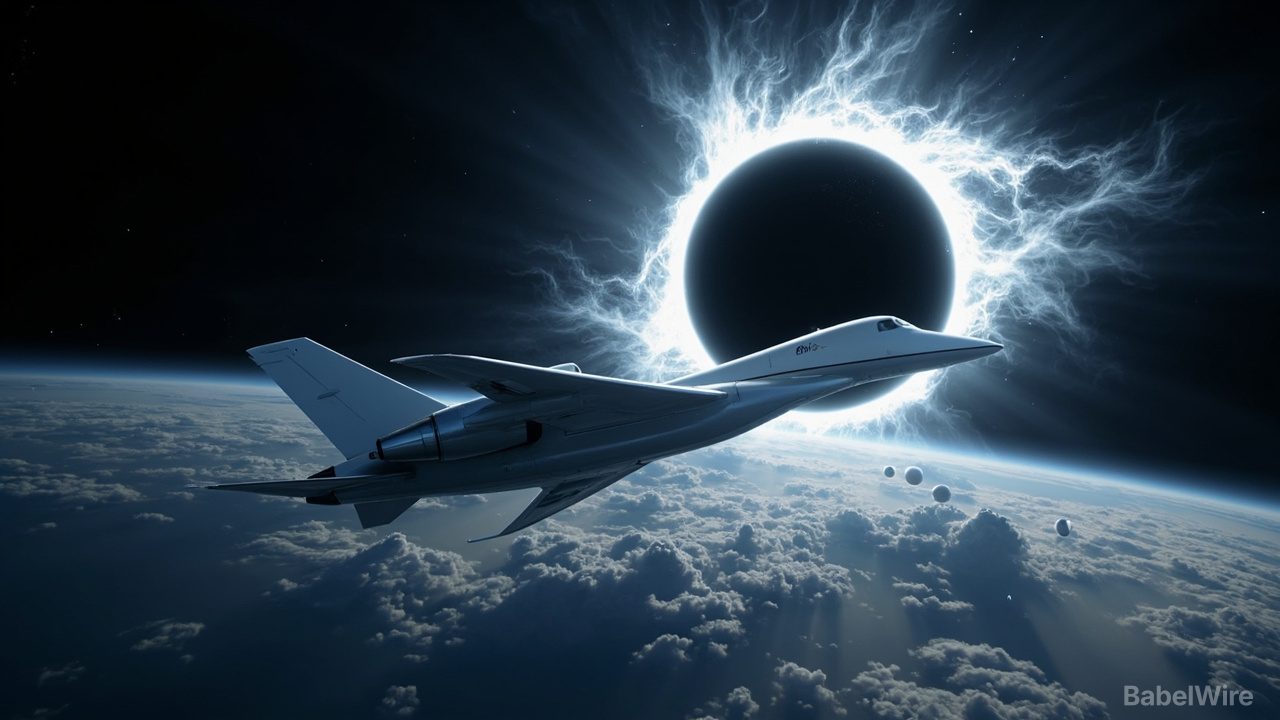
On Wednesday, the Moon's shadow will sweep across the Arctic, Greenland, Iceland and Spain in the year's most spectacular astronomical event — and NASA-funded scientists intend to be inside that shadow, chasing it with a jet and an armada of balloons.
The total solar eclipse on Aug. 12 will darken skies along a path stretching from northern Russia across Greenland, Iceland and Spain. While ground-based observers will see the Sun's corona for at most two minutes and 18 seconds, NASA's WB-57 high-altitude research aircraft will fly along the eclipse path at 460 mph and 50,000 feet, stretching that view to nearly three minutes — above the clouds, where infrared wavelengths that never reach the ground become observable.
Inside the jet's nose cone, the SCIFLI team's SAMI instrument — four cameras shooting at least 20 frames per second in visible and infrared light — will record the corona's structure, outflows and rapid changes. The images should help scientists understand how the corona is heated to nearly a million degrees, how prominences form, and how coronal material feeds the solar wind. "Every eclipse is different. So we could see things we didn't see before," said principal investigator Amir Caspi of the Southwest Research Institute.
Meanwhile, the Nationwide Eclipse Ballooning Project is sending student teams to Iceland and Spain. In Iceland, two teams will launch 80 balloons from 18 hours before to eight hours after totality to study Earth's boundary layer — the atmosphere's lowest layer, which collapsed during eclipses in 2023 and 2024 under clear skies. Whether the same happens during Iceland's long summer days is an open question. In Spain, three teams will launch six balloons carrying 360-degree cameras to image the shadow from above and ozone sensors to measure how the brief darkness suppresses ozone formation.
ESA is also running public observation campaigns along the path, and NASA will broadcast the eclipse live from Iceland and Spain. For scientists, the eclipse remains a rare, low-cost natural experiment that orbiting solar probes cannot replicate — a fleeting moment when the Sun's most mysterious region becomes visible from Earth.