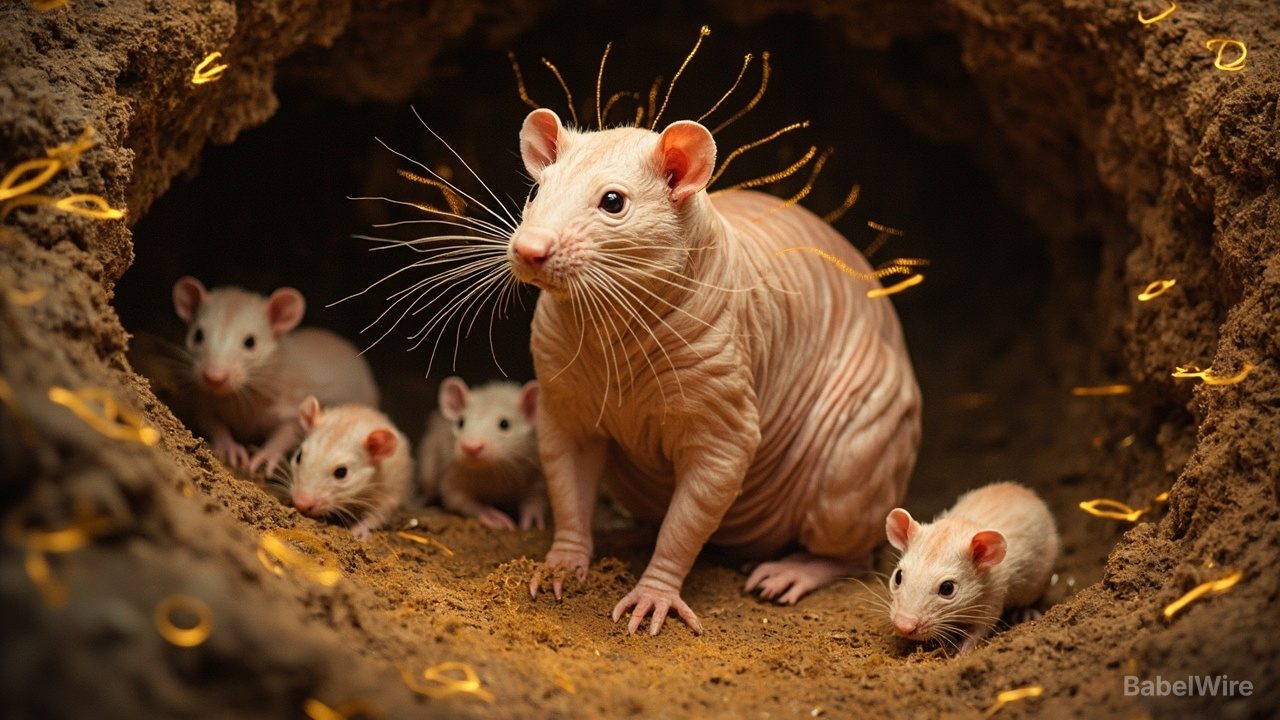
Naked mole-rats live in highly cooperative societies where a single female reproduces while everyone else forages and cares for the young. But how does the queen keep her subjects in line? Researchers led by Gary Lewin at the Max Delbrück Center in Berlin found the answer in a single molecule: isopropyl myristate (IPM). The compound — odorless to humans — is produced only by breeding queens and activates the olfactory cortex, the brain region responsible for smell, in the other animals.
The effect is dramatic, the team reports in a paper published July 15 in Nature: individuals exposed to the odor will not fight or mate — until the queen and her scent are gone. In one experiment, the researchers removed the queen and treated the colony daily with IPM. "In the entire three months, there was no fighting. Everybody was cool with each other … and there was no sex," Lewin says. As soon as treatment stopped, the first death came within a week; a few weeks later, mating events followed and a new queen emerged. In isolated pairs, five of six untreated females became pregnant, while no pregnancies or mating occurred among pairs exposed to IPM.
Blood work showed the compound regulates fertility hormones, lowering progesterone and raising prolactin to suppress pregnancy. There is also a monitoring function to the scent: the queen produces IPM only when she is pregnant or preparing for pregnancy. If she stops, the other mole-rats know the queen is not doing her job — so they kill her, Lewin says.
The discovery offers a rare window into behavior that is extremely unusual among mammals. "We think of that as something uniquely human, but it's actually something that mole-rats have been doing for millions of years before we even appeared on the scene," Lewin says. To collect the scent samples, the team used a technique invented for gathering odor samples from outdoor toilets — a reminder that pioneering work on the animal kingdom's strangest creatures can take unconventional turns.
Sources
- sciencenews.orgScience News: Naked mole-rat queens rule their colonies with a potent odor
- nature.comNature: A queen odour mediates reproductive suppression in a eusocial mammal
- smithsonianmag.comSmithsonian Magazine: Naked Mole-Rat Queens Emit a Special Scent to Stop Their Rivals From Reproducing
- mdc-berlin.deMax Delbrück Center: The smell of success