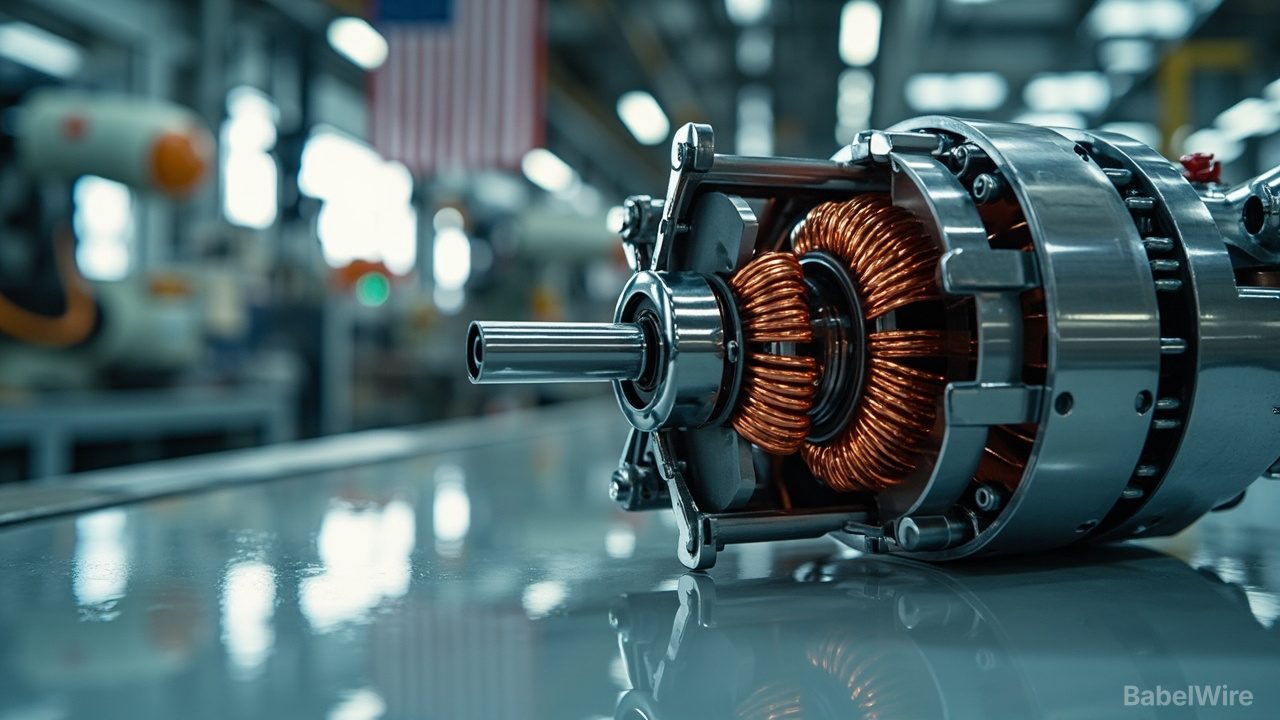
Modal Motors, a startup founded in2024 and based in Austin, Texas, is taking on one of the hardest problems in the electric vehicle supply chain: building high-performance electric motors without relying on Chinese rare-earth magnets.
The China Problem
Roughly80% of the world's rare-earth magnet production — the critical component in most high-efficiency electric motors — is controlled by China. This concentration gives Beijing enormous leverage over the global EV transition. When trade tensions flare, as they have repeatedly in recent years, automakers face the prospect of supply disruptions that could halt production lines.\n The problem extends beyond rare earths. Much of the motor manufacturing supply chain — copper wire processing, precision machining, motor controller electronics — also runs through Chinese factories. For Western automakers, dependency on Chinese motor components has become a strategic vulnerability.
Modal's Approach
Modal Motors has developed a motor that uses ferrite-based permanent magnets instead of neodymium rare-earth magnets. Ferrite magnets are cheaper, more abundant, and entirely sourced outside China. The trade-off has historically been lower magnetic strength and efficiency — but Modal claims its proprietary magnet geometry and motor topology close that gap.
The company's first motor, the MM-1, is a permanent magnet synchronous motor targeting the300 kW class — suitable for mid-size to full-size EVs. Modal claims it achieves92% efficiency, within striking distance of rare-earth motors at95%, while using materials that cost a fraction of the price.
Manufacturing Independence
Modal is also building out a US-based manufacturing line for the complete motor assembly — not just the magnets, but the rotor, stator, housing, and power electronics. The company says this vertical integration is essential to actually decoupling from Chinese supply chains, since many "non-Chinese" motor designs still rely on Chinese-sourced subcomponents.
The company has secured$180 million in Series B funding and is building a150,000-square-foot factory in San Antonio, Texas, with production expected to begin in early2027.
Industry Skepticism
Not everyone is convinced. Some industry analysts point out that ferrite motors have been tried before and failed to achieve commercial scale. The efficiency gap, even if narrowed, still matters at the margins — every percentage point of motor efficiency translates directly into vehicle range.
Others question whether building an entirely US-based supply chain is economically viable at scale, given higher labor and material costs compared to Chinese alternatives.
Modal's response: the math changes when you factor in tariff risk, supply disruption probability, and the long-term strategic value of supply chain independence. "The cheapest motor is the one that actually shows up," said CEO Marcus Chen.
The Broader Picture
Modal Motors is part of a growing wave of US and European companies attempting to reshore critical EV components. The Inflation Reduction Act's domestic content requirements have accelerated this trend, creating financial incentives for US-manufactured motor components.
If Modal succeeds, it could reshape the competitive landscape of the EV motor market — and prove that supply chain decoupling from China, while expensive upfront, may be the only sustainable path for Western automakers.