The oldest known solids of the solar system carry the imprint of a magnetic field far stronger than the one around Earth today — evidence, scientists say, that magnetism has to be taken seriously in simulations of how planets form.
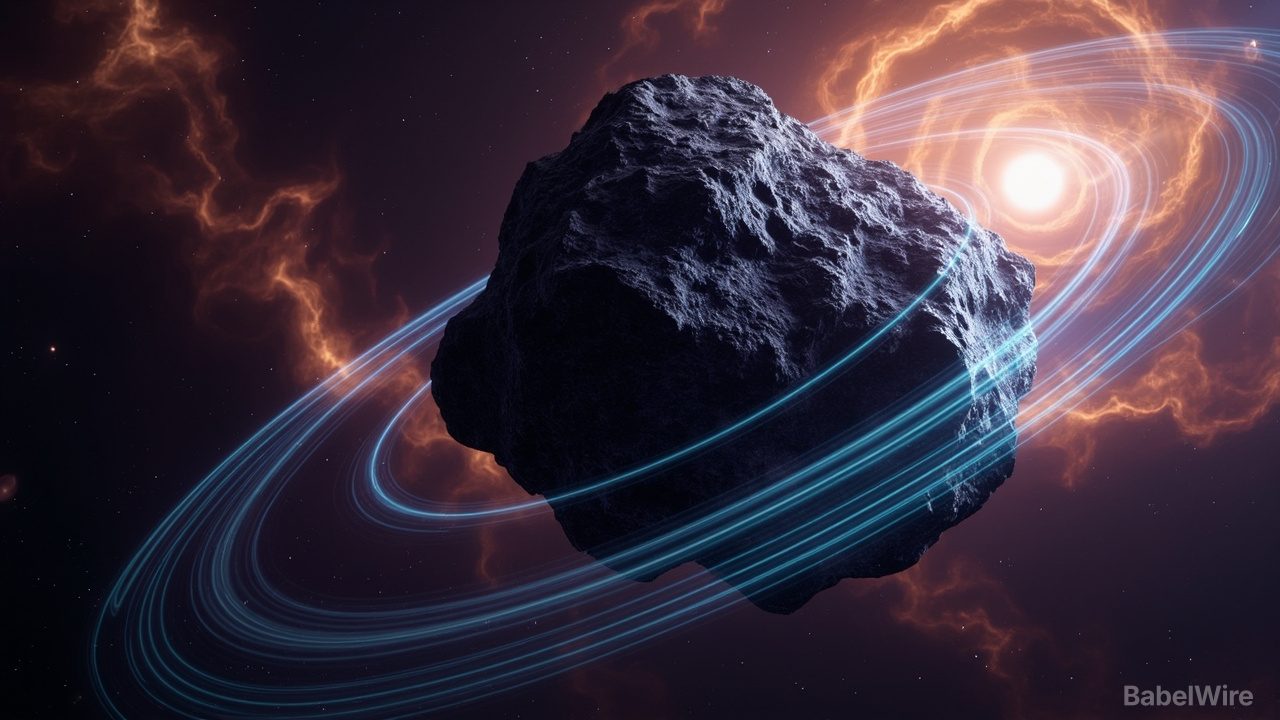
Researchers led by planetary scientist Cauê Borlina of Purdue University studied calcium-aluminium-rich inclusions in the Dominion Range 08006, a 667-gram carbonaceous chondrite found in Antarctica in 2008. These inclusions are the oldest solids in the solar system: minerals with extremely high melting points that condensed very early, in the first 500,000 years, before Earth existed. Until around 2010, such inclusions were thought to contain no magnetic minerals, but the team found nanometre-scale grains of ferromagnetic iron-nickel in some of them.
Rather than heating the precious samples — which oxidizes meteorites extremely quickly and ruins calibration — the researchers used anhysteric remanent magnetization to reconstruct the field the grains experienced when they cooled through their Curie temperature. The answer: fields of 150 to 600 microtesla, compared with roughly 30–60 microtesla on Earth today.
Meenakshi Wadhwa of the University of California, San Diego, a former director of Arizona State University's Center for Meteorite Studies, called the work "genuinely significant": it provides the first definitive paleomagnetic signal from a carbonaceous chondrite, and the estimated field is several times higher than previous estimates. She cautioned that the sample is small — five inclusions from a single meteorite — and that measurements from other chondrite groups will be needed to confirm the signal is a true nebular record rather than something local to this one rock.
Borlina's message to modelers is blunt: simulations of protoplanetary disks often "just crank up the gravity" to match accretion rates, but "you can't just ignore magnetic fields — they need to be present in your simulations." The study, by Borlina and colleagues in the US, China and the UK, is published in the Proceedings of the National Academy of Sciences.