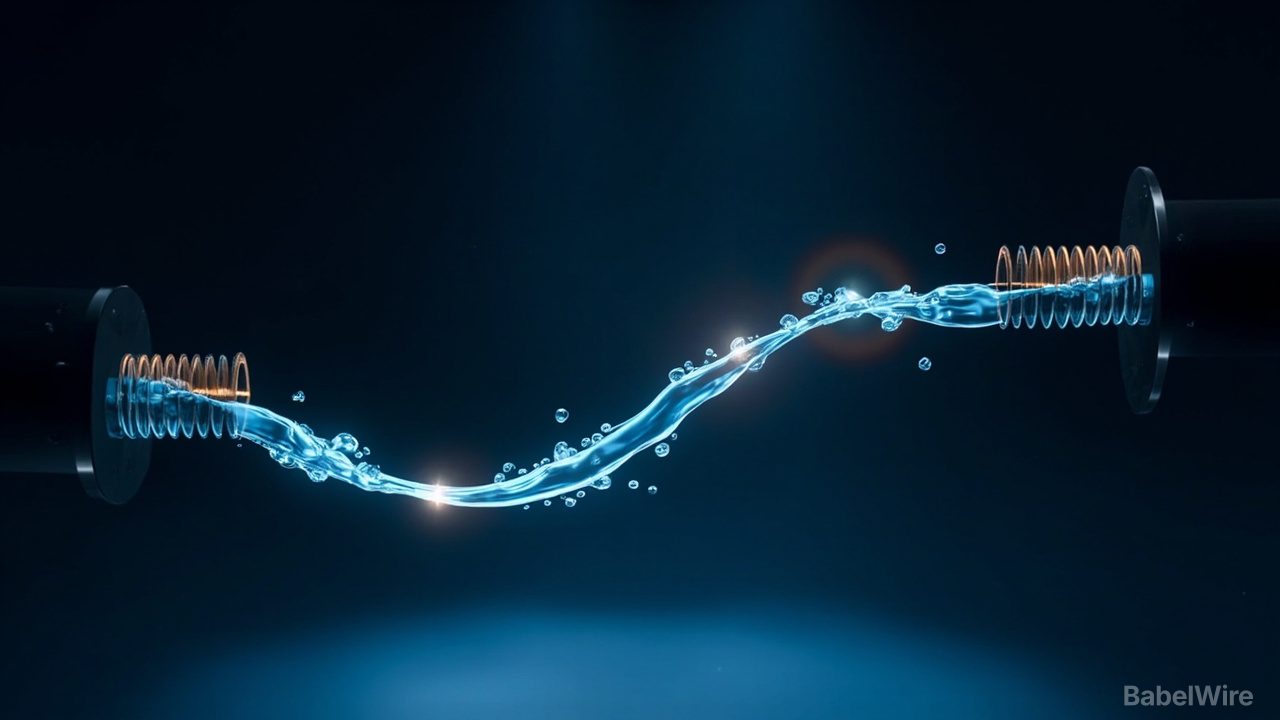
Heise reports that researchers have guided a flow of liquid through the air without a container, a channel or any physical wall — an "invisible pipe" made of sound.
The mechanism is acoustic radiation pressure. Sound carries momentum, and a sufficiently intense ultrasonic field exerts a steady force on matter placed inside it. Two opposing waves produce a standing field with fixed pressure nodes — the pockets into which droplets and particles are pushed and pinned. That is how acoustic levitation holds beads and droplets in mid-air, and phased arrays go further still: they shift the interference pattern electronically, so the trap moves and the levitated object travels with it.
Sustaining a flowing liquid is a harder problem than suspending a single droplet. A free jet of liquid is unstable — surface tension pinches it into droplets, the Rayleigh–Plateau instability — and gravity pulls the whole thing down the moment acoustic support weakens. Holding a stream coherent across an open gap therefore means continuously rebuilding the trap along the path, fast enough that the fluid never has time to fall apart.
The payoff is a container that disappears. In chemistry and pharmaceutical production the vessel is rarely neutral: surfaces nucleate crystals, adsorb the compound of interest, shed leachables, and must be cleaned between batches. A liquid that never touches a wall cannot contaminate one, cannot be contaminated by one, and can be moved between two sealed environments without an interface. Contactless handling also suits reagents that are hazardous, sticky, or simply too small to pipette.
What the report leaves open is scale: how far the liquid travels, how much of it per second, how much acoustic power is required, and whether the stream stays a stream or arrives as a fast chain of droplets. Those numbers decide whether this is a laboratory curiosity or a manufacturing technique. Acoustic forces strong enough to hold liquid against gravity also heat it and can atomise its surface, so the energy budget is not a detail.
The container is one of the oldest variables in experimental science, and one of the least examined. Removing it — even across a few centimetres of air — changes what an experiment is actually measuring.