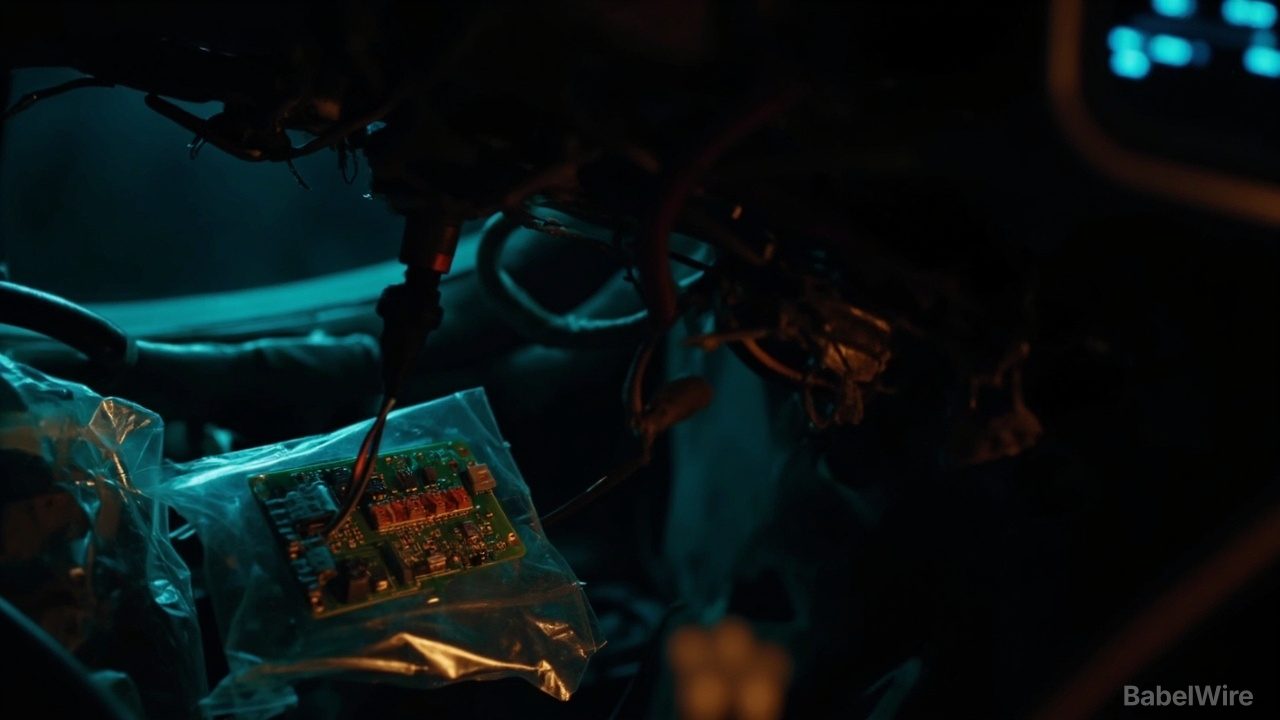
Seoul's Metropolitan Police Agency said on Tuesday that it had booked 80 people and seized 21 devices — the largest enforcement action yet against the hardware that switches on Tesla's "Full Self-Driving" in cars that are not allowed to run it, and the first in which buyers of a paid feature are the defendants.
The devices are unglamorous, which is the point. They plug into the car's CAN bus, the internal network that links its electronic control units. Tesla builds the same computer into every car regardless of whether the region has approved the feature; what stops it is a software lock. Bypass the lock and the car does what the hardware always could.
Suspects bought ready-made modules from Europe and China, or built their own. One plugged a European unit into his own Tesla. Another, an IT worker, assembled his with information he found on GitHub. The group also traded tips online on how to activate FSD without leaving a record that it had been switched on — apparently with Tesla's own detection in mind.
The charge is not piracy. It is a violation of Korea's Motor Vehicle Management Act, which bans unauthorised software changes that can affect a vehicle's safety. The maximum is two years in prison or a fine of 20 million won, about $15,000. The Ministry of Land, Infrastructure and Transport asked police to investigate in April after finding signs of unauthorised activation. A police official told Korea JoongAng Daily that "safety risks were confirmed," including the possibility that FSD misreads driving conditions.
The root of the case is a certification gap. Tesla has offered FSD (Supervised) in South Korea since late 2025, but only on US-built vehicles: Model S, Model X and Cybertruck. Those models are exempt from Korean safety certification under the Korea–US free trade agreement. The Model 3 and Model Y, which Tesla ships to Korea from Giga Shanghai, have not cleared the country's standards for the feature.
And those two models are most of the fleet. How many Korean Teslas may legally use FSD is disputed even by the authorities: figures from Carisyou Data Lab cited by Korea JoongAng Daily put it at 47,458 of 229,311 cars, or 20.7 percent. A government tally in May, released by lawmaker Park Yong-gap, found 4,292 of 180,684, or 2.4 percent. Both cannot be right, and both say the same thing: the overwhelming majority of owners cannot legally use what some of them paid more than $6,000 for.
Tesla has been fighting the modules itself since April, detecting them remotely and stripping FSD from affected cars. It has warned owners they would be fully liable for any crash and could lose warranty coverage, and permanently banned some Chinese owners from FSD. It is not the first time the protections have been tested: in 2023, researchers used a hardware weakness in the AMD processor behind the media control unit to unlock certain paid features.
What makes the Korean case different from earlier skirmishes is the direction of liability. The lock is not a paywall but a certification boundary, and the state is treating its circumvention as a safety offence. At the same time, Tesla sold a feature on cars it had no regulatory path to enable legally — which is how you get a market for exactly the devices now sitting in a Seoul evidence room.
What remains open: whether Tesla refunds owners who bought a feature their cars may never be allowed to run, and whether other regulators copy the approach. Europe, where Tesla's fleet is far larger than Korea's, is still working through FSD approval.
Sources
- heise.deTesla-Besitzer in Südkorea umgingen Sperren für Full Self Driving (heise online)
- electrek.coKorean police book 80 Tesla drivers over illegal FSD unlock devices (Electrek)
- tomshardware.comSouth Korea clamps down on Tesla drivers for unlocking restricted FSD (Tom's Hardware)
- eletric-vehicles.comTesla FSD illegally unlocked by 80 drivers in South Korea, police say (eletric-vehicles.com)