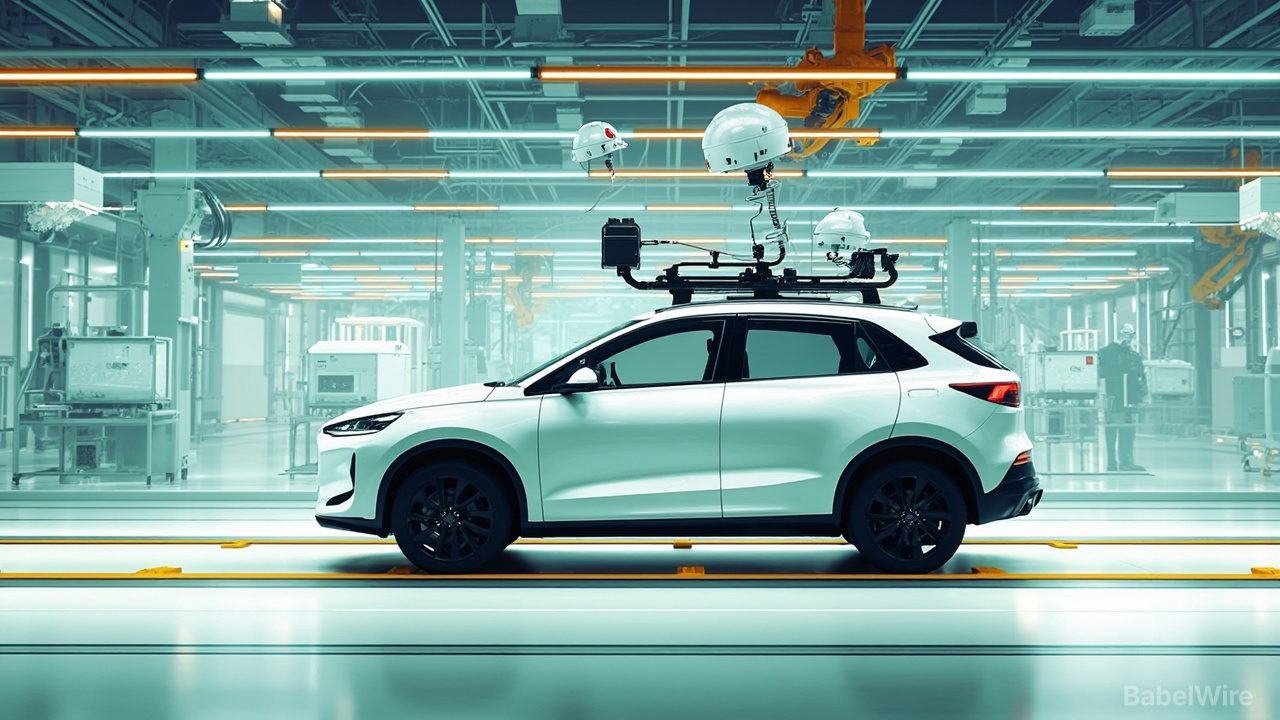
Toyota and Waymo said on Friday that Waymo's next robotaxi will no longer be a converted production car. It will be built at Toyota's Takaoka plant in Toyota City, Aichi Prefecture, on the same line as the regular version — and, in both companies' phrasing, "under one roof": assembling the base vehicle and installing Waymo's sensing hardware in one place.
Formally this executes a preliminary agreement from April 2025 that named no vehicle and set no timeline. Practically it is a production plan: a vehicle, a factory, a first market, a start year. Testing begins in Japan in 2027, initially with "a small number of vehicles", Toyota board member Hiroki Nakajima told reporters. Commercial service is to follow, with the United Kingdom named as the next market.
Both countries drive on the left, and the bZ4X is built in right-hand-drive form at Takaoka. "We'll start with the right-hand drive markets in Japan and the UK," said Waymo co-CEO Dmitri Dolgov, adding that further countries are conceivable but carry no timeline. The ordering is not incidental: Waymo's fleet has been built largely on Jaguar I-Paces, which were engineered for left-hand-drive markets.
The passenger-side differences are small and revealing. The robotaxi version gets generous rear legroom, automatic doors, a power liftgate and ambient lighting — the hardware of letting people in and out of a car that has nobody in the driver's seat to help them.
The timing is tight. Waymo said on 14 September that it will begin fully driverless public rides in Tokyo in 2027 with the taxi operator Nihon Kotsu and the ride-hailing app GO, subject to regulatory approval, growing toward about 100 vehicles. The bZ4X fleet will not replace the I-Paces there; it arrives alongside them. On 28 October, Sundar Pichai said Waymo has driven more than 300 million fully autonomous miles across 15 US cities, with expansion planned for Canada, Germany, Singapore and Spain; in the second quarter the fleet averaged 3.9 million driverless miles a week.
The real reason for the deal sits in the supply chain. Waymo's newer Ojai robotaxi is built on a Zeekr vehicle from China's Geely and shipped to the United States, where Waymo fits the sensors in Mesa, Arizona. A stalled Senate bill could bar that China-built vehicle from import. A Toyota built in Japan is the geopolitically quieter platform — and a right-hand-drive one besides.
Manufacturing depth matters at least as much. Retrofitting sensors, brackets, wiring and cooling into a finished car is the slowest and most expensive part of scaling a robotaxi fleet. Putting assembly and sensor integration in the same hall cuts cycle time and rework — which is what a fleet needs to go from hundreds of vehicles to tens of thousands.
For Toyota, the contract is part of a strategy visibly different from its domestic peers'. Toyota does not write ride-hailing software. Toyota sells vehicles. The bZ4X is already the base for Pony.ai in China, which reported 1,000 secured bZ4X units this year and is targeting more than 3,000 robotaxis in over 20 cities by the end of 2026 — including a London service with Uber that would compete directly with Waymo. In the US, May Mobility runs the Sienna; in Japan the same group operates in nine cities. That makes Toyota a partner four times over and a competitor zero times.
The numbers that would settle the question were not disclosed: financial terms, build volumes, and when the first paying passenger rides. 2027 is a test year, and the Tokyo service depends on a regulatory decision. What is now on the record is narrower and more consequential — Waymo has announced the move from retrofitting cars to ordering them, and the order runs through a Japanese factory.