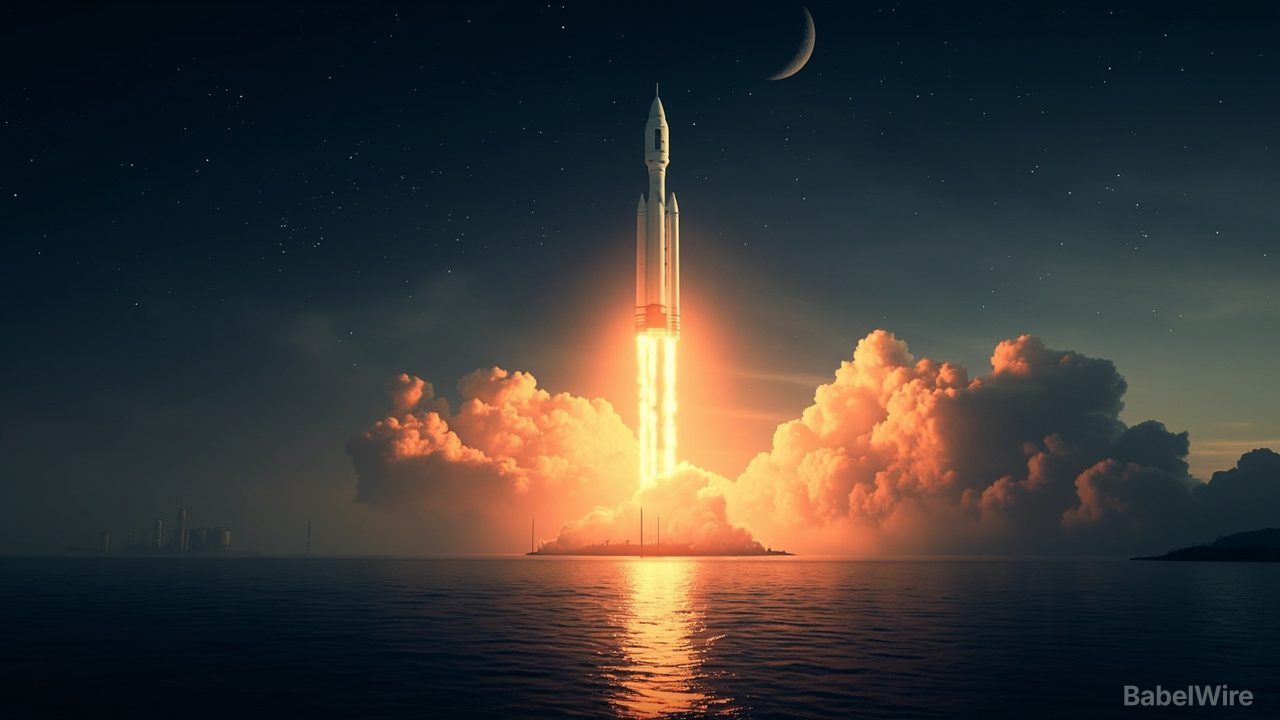
Japan's H3 rocket returned to flight in its most important configuration on August 10, 2026, successfully launching the Michibiki 7 navigation satellite — the first flight of the H3-22S version since the failure that grounded it in December.
The rocket lifted off from the Tanegashima Space Center at 3:23 p.m. EDT (19:23 UTC) after several days of delays caused by a passing typhoon. It was the first nighttime launch of the H3. About 29 minutes after liftoff, the upper stage deployed the 4.9-metric-ton satellite into its planned transfer orbit.
Michibiki 7 is the fourth and final new satellite of Japan's expanded Quasi-Zenith Satellite System (QZSS), a regional navigation constellation designed to augment GPS over the Asia-Pacific region. With the full fleet of seven satellites — a mix of geostationary and inclined geosynchronous orbits — at least four are always visible over Japan, allowing the country to use the system on its own for positioning without relying on signals from other navigation systems.
The launch completes an expansion that was originally due to finish earlier. In December 2025, an H3-22S launch failed after shocks during payload fairing separation damaged both the satellite — Michibiki 5 — and the payload adapter, causing a pressure loss in the upper stage's liquid hydrogen fuel system. Michibiki 5 was lost. The H3 returned to flight in June 2026 in a different configuration, the three-engine H3-30S, which carried several small satellites.
Officials are betting on the H3 as the workhorse of Japan's space ambitions. At the Spacetide conference in July, government officials set a national goal of 30 launches a year from Japan by the early 2030s — a steep jump from the three launches conducted from Japan so far this year. Mitsubishi Heavy Industries, which builds the H3, and JAXA are discussing raising the rocket's production rate from six to eight launches per year.
Next up for the H3: a projected November launch of JAXA's Martian Moons Exploration (MMX) mission, which will travel to the moons of Mars and attempt to collect samples from Phobos for return to Earth. A second HTV-X cargo mission to the International Space Station is also tentatively scheduled to fly on the H3 this year.