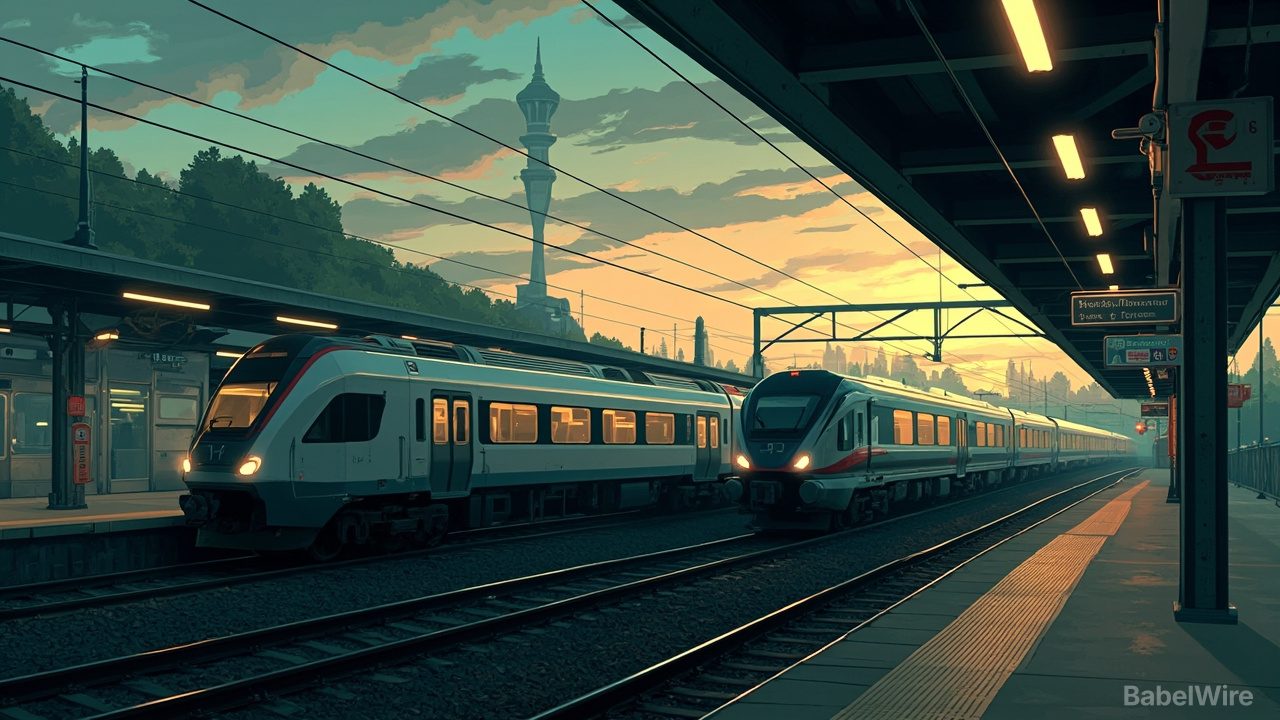
At Innotrans 2026 in Berlin, the world's leading rail technology fair, batteries clearly dominated the alternative-drive vehicles on the tracks. On short routes that touch an electrified section, battery range is now sufficient to cover the gaps, which erodes hydrogen's main selling point. CAF showed a train with up to 230 km of range destined for Germany's Rhein-Ruhr transport authority, and Siemens' Mireo Plus H hydrogen train still reaches around 800 km — a distance rarely needed on German routes without overhead lines.
Short-range designs remain common. Skoda's RegioPanter for Czech operator Ceske drahy covers just 80 km on battery, managing 120 km/h under battery power and 160 km/h with the pantograph raised. With only about a third of the Czech network electrified, the operator says older battery trains have already pulled in roughly 20 percent more passengers within 18 months.
Battery locomotives are arriving too. Stadler's Euro DuFour can be fitted with batteries and is slated to be operational in 2027, ahead of Siemens' battery Vectron planned for 2029/2030. Pesa's Gama 3.0 offers an optional diesel (480 kW) or battery module, aimed at shunting and last-mile work, while Vossloh's Modula can mix a pantograph, battery and diesel engine.
Hydrogen's remaining momentum is concentrated in East Asia. Hyundai Rotem is pushing the Busan Train Express (BuTX), a 54 km high-speed metro that will carry its hydrogen supply on board and run at 150 km/h, avoiding the cost of installing and maintaining overhead lines. Busan is due to decide in February 2027 whether the train uses distributed traction or power cars like the ICE 1; construction is expected to start in 2027/2028 and finish by mid-2030. Smaller projects elsewhere include a fuel-cell container wagon meant to act as a tender behind an electric locomotive, and an ongoing Korean hydrogen train demonstration running to the end of 2027.