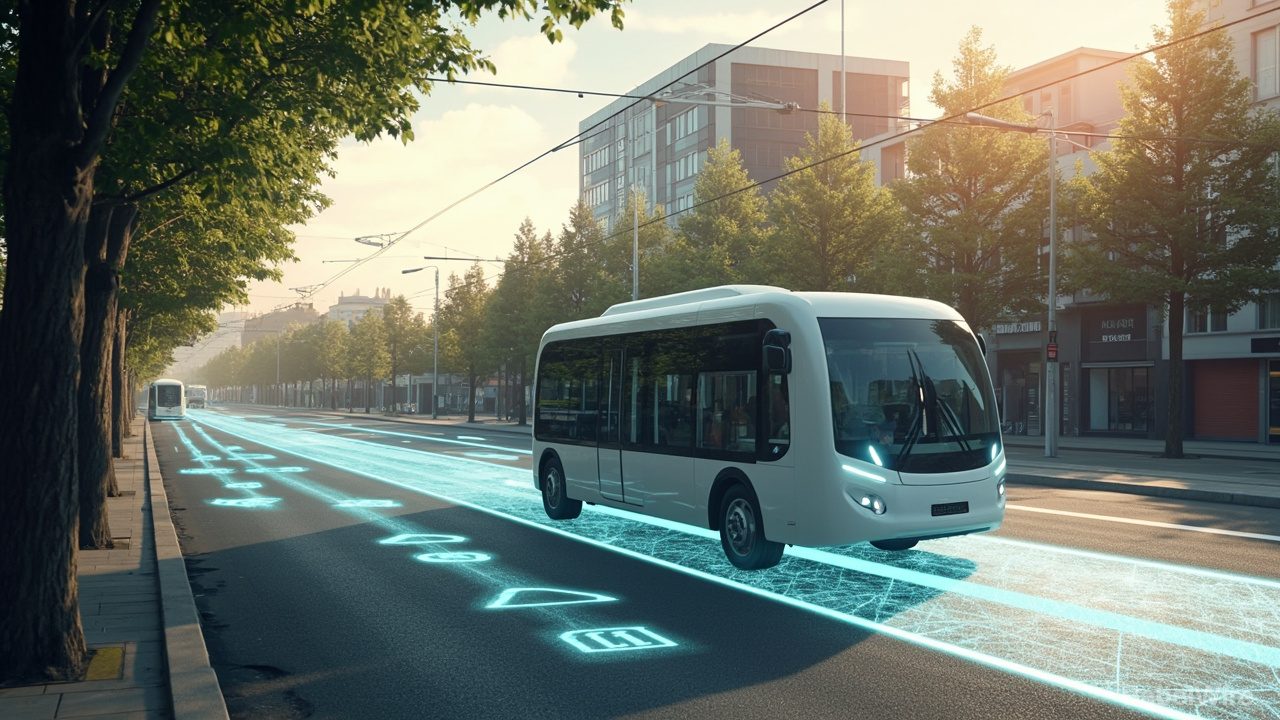
Public transport in Germany's Rhine-Main region is about to get a new kind of vehicle. Deutsche Bahn and the Rhein-Main-Verkehrsverbund (RMV) confirmed this week that their autonomous on-demand service is moving to Holon shuttles, with passenger operations planned for parts of Darmstadt and the Offenbach district from 2027. The first phase is unglamorous mapping: test drives to teach the vehicles the area, after which riders will be allowed aboard.
The vehicle is purpose-built for public transport rather than adapted from a car. It is barrier-free, with five seats and a wheelchair space — three seats when the wheelchair bay is in use, and up to 15 people in total, per the manufacturer. Holon, based in Paderborn, says the shuttle performs the driving task fully autonomously but is supervised by an on-board safety operator. The vehicles received approval for test operations in Germany at the end of 2025.
Kira+ replaces Kira, which has been running in southern Hesse since May 2025 with five-seat cars in Darmstadt, Langen and Egelsbach. By the end of May roughly 4,200 test users had been admitted, booking vehicles through an app that serves about 130 stops. RMV chief Knut Ringat framed the goal plainly: to fold autonomous services into regular public transport so that, with political support, an attractive and affordable service can be offered "everywhere and at any time".
Hessen has tried this before, and the record is a useful reality check. Deutsche Bahn ran EasyMile EZ10 shuttles in Bad Birnbach, Bavaria, for seven years; the project was well received locally but lost its funding at the end of 2024, and EasyMile withdrew from autonomous passenger transport entirely, seeing a business only in driverless freight. The difference now is scale and intent: a larger region, a vehicle designed for the job, and a stated ambition to make autonomy a normal part of the timetable rather than a showcase.