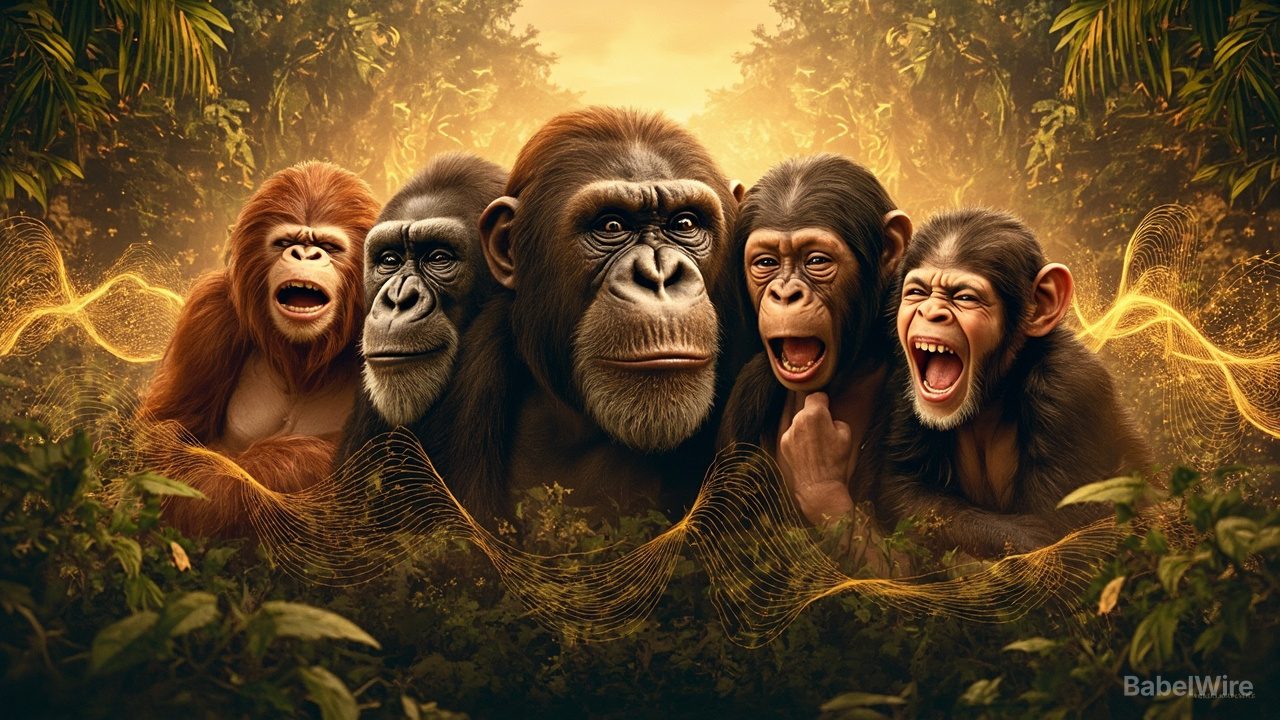
**Scientists have long assumed speech appeared suddenly in human evolution, but a new study has found a crucial clue hiding somewhere far more unexpected than fossils or ancient tools — in the laughter of great apes.**
A team led by the University of Warwick discovered that all five great ape species — orangutans, gorillas, bonobos, chimpanzees, and humans — share the same basic rhythmic pattern in their laughter. The finding, published in Communications Biology, suggests that the rhythmic foundations of human speech were already present in a common ancestor that lived roughly 15 million years ago.
"Speech leaves no fossils, and complex language exists only in our own species. But we've found a 15-million-year-old clue in an unexpected place: our laughter," said Dr. Chiara De Gregorio, honorary research associate at the University of Warwick. "Unlike speech, laughter is shared by all living great apes. By comparing how different species laugh, we can see that a basic rhythmic structure has remained unchanged since our last common ancestor."
The team gathered laughter recordings from four orangutans, two gorillas, three bonobos, four chimpanzees, and four human children aged six months to seven years. Every recording captured spontaneous laughter prompted by playful interactions like tickling and games. In total, they measured 140 individual laughter sequences, focusing not on pitch or volume, but on the timing of gaps between each burst of sound.
**What they found was remarkable.** Across every species, from orangutans to human toddlers, laughter followed the same evenly spaced rhythmic pattern. The steady, regular beat showed up everywhere, regardless of species.
However, the researchers also identified what makes human laughter unique. While the basic rhythm stayed constant, human laughter became faster and far more variable than that of other apes. Only humans modulated their laughter tempo depending on the social context — laughing differently when tickled than when simply playing.
**That flexibility is the key.** The findings challenge a long-held assumption that early humans suddenly developed vocal abilities that set them dramatically apart from their ancestors. Instead, the data suggest a stepwise accumulation of changes over millions of years.
"As we move from orangutans to gorillas, then to chimpanzees and bonobos, and finally to humans, laughter becomes progressively faster and more variable," De Gregorio explained. "Rather than a sudden leap occurring only in humans, the data suggest a stepwise accumulation of changes over millions of years."
Strikingly, that progression tracks the growth of social life itself. Orangutans are solitary, gorillas live in family groups, chimpanzees and bonobos navigate highly complex social networks, and humans live in extraordinarily intricate societies. As social interactions became more complex, the pressure to communicate more nuanced information likely drove improvements in vocal control.
"The same evolutionary forces that made laughter more flexible and informative may also have helped pave the way for the emergence of language," De Gregorio said.