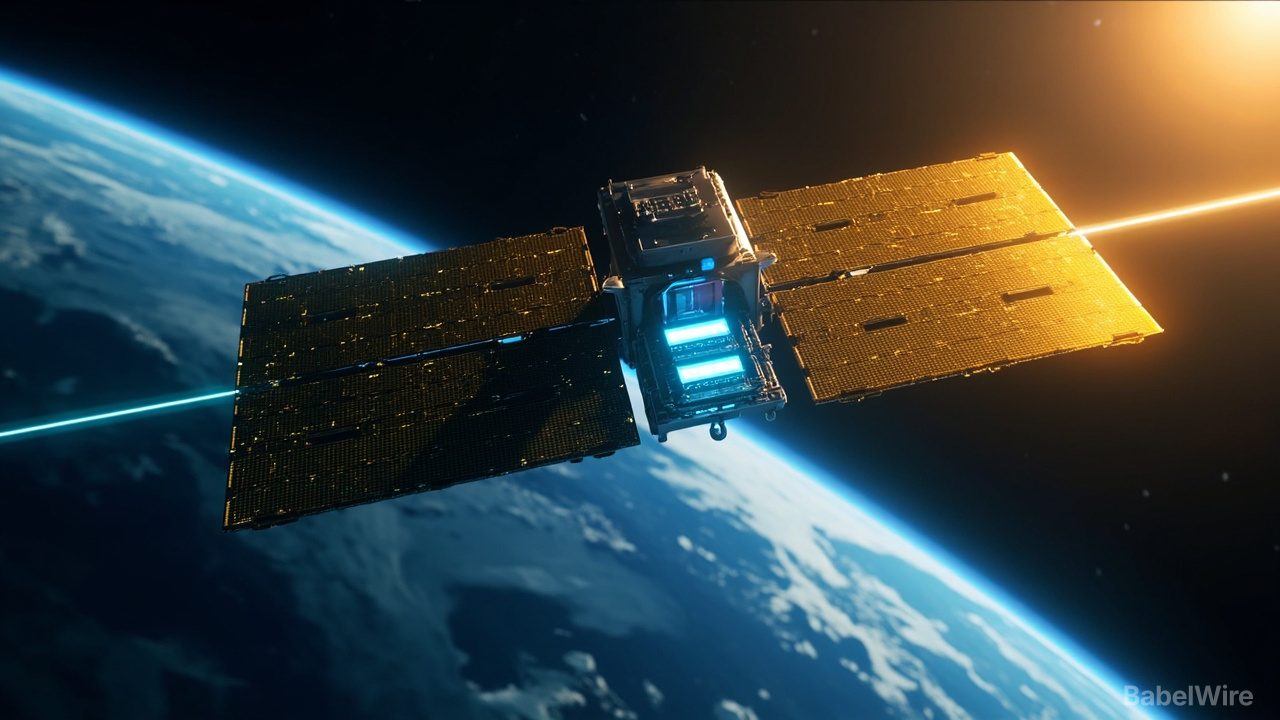
Google is about to find out whether its AI hardware can survive space.
On 1 October, the company will launch a prototype satellite carrying four Trillium Tensor Processing Units (TPUs) — the same class of chip that powers its Gemini models on the ground — as part of Project Suncatcher, a long-running research effort first announced in 2025. The spacecraft, built in partnership with Earth-imaging company Planet, rides to low Earth orbit on SpaceX's Transporter-18 rideshare mission.
The mission is not an operational data centre. It is a survival test. Google's engineers want in-orbit data on three things: whether the chips endure the physical stress of launch, whether they tolerate the radiation environment beyond the atmosphere, and whether they can be cooled in a vacuum where there is no air to carry heat away.
Ground testing already offers some encouragement. Google says the hardware withstood vibration testing that mimicked the frequencies of a rocket launch, with the satellite shaken on all three axes. Individual components can experience loads of 50 to 100 times the force of gravity. The TPUs were also bombarded with protons at UC Davis's Crocker Nuclear Laboratory while running AI workloads: Google says the Trillium chips survived a total ionizing dose greater than what they would receive on a five-year mission.
Cooling is the harder problem. TPUs generate a lot of heat in a small area, and in the vacuum of space heat can only be shed through radiators. Google is testing a combination of heat pipes and radiators in a thermal vacuum chamber that simulates space conditions.
Why bother? Because in low Earth orbit, satellites can see near-constant sunlight, and Google estimates solar panels there could generate up to eight times more power than comparable panels on the ground — an attractive prospect for an industry whose biggest constraint is energy. Future designs would carry dozens of TPUs per satellite, flying in clusters and communicating with each other by high-bandwidth lasers, which must hold a link with the precision of hitting a coin-sized target from miles away while both ends are moving. Google plans a two-satellite test of that laser link in 2027.
The company is careful to frame this as the beginning of a long research arc, comparable to early work on self-driving cars or quantum computing. The first flight is designed to gather data, identify failure points and inform the next launch — not to prove that orbital data centres make economic sense. That question stays open.
Sources
- blog.googleGoogle — Behind Project Suncatcher, our moonshot to put AI in space
- ca.finance.yahoo.comReuters (via Yahoo Finance) — Google plans first test of AI chips in space under Project Suncatcher
- technology.orgtechnology.org — Google Sends TPU AI Chips to Orbit for Testing
- the-decoder.comThe Decoder — Google's Suncatcher project aims to put AI data centers in orbit
- hwbusters.comHWBusters — Project Suncatcher Puts Four Google TPUs in Orbit on October 1