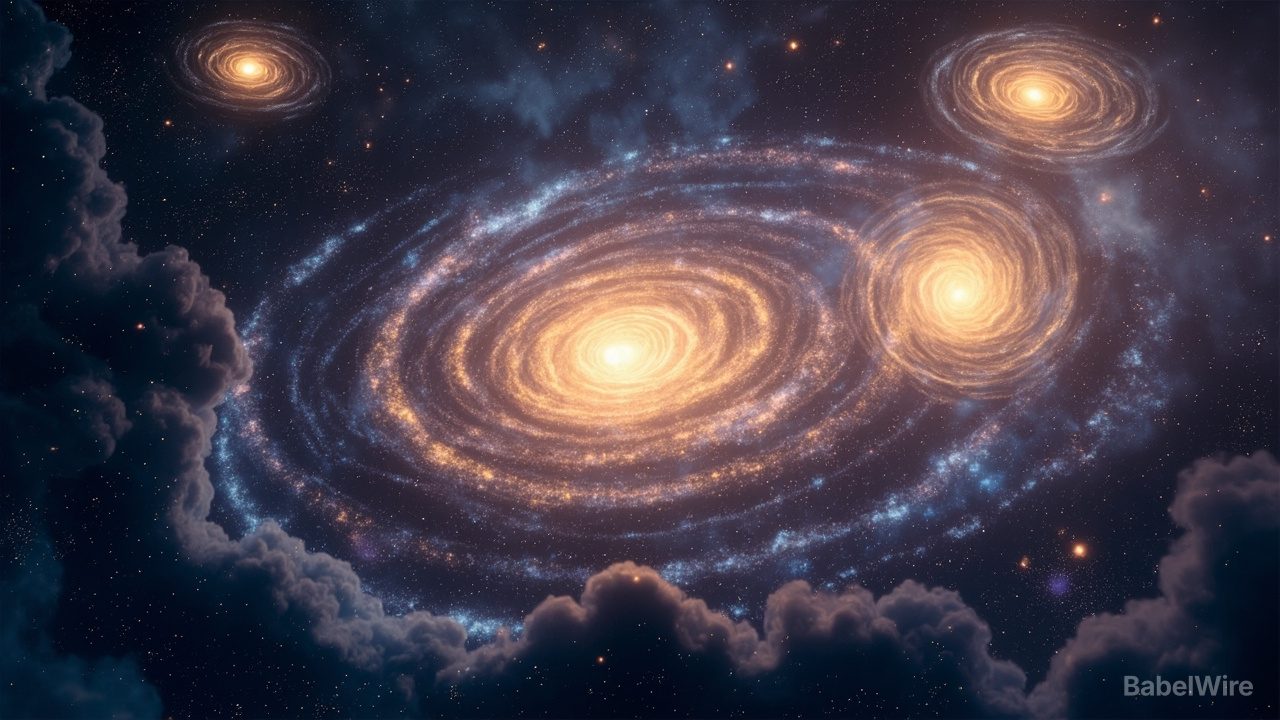
Why do galaxies spin? The question has puzzled astronomers for about a century, ever since astronomers realized that the hazy swirling blobs in the night sky are spiral galaxies separate from the Milky Way. Now a team reports in Nature Astronomy what outside experts call the strongest evidence yet that a portion of galaxy spin was imprinted before galaxies even existed — by churning gravitational interactions when the universe was an infant.
In the very early universe, dark matter clumped into large structures called halos, whose gravity drew in gas and kick-started galaxy formation. A theory dating to 1969 proposed that halos still in the process of forming tugged gravitationally at each other: an elongated halo feels a stronger pull on the end nearest a massive neighbor, and this uneven, tidal force exerts a torque that sets it spinning. Once a halo spins, the galaxy it gives birth to spins too — and some of that rotation should survive to the present day. Skeptics argued that mergers and collisions would erase any trace of it.
Led by Ming-Jie Sheng of Xiamen University, the team used a 3D map of the local universe from the Sloan Digital Sky Survey (SDSS) and a simulation to work out the distribution of protohalos in the early universe that would have produced today's galaxy pattern. They then estimated the rotation rates of more than 1,600 galaxies from shifts in the wavelengths of their light. The pattern of rotations across the local universe matched the primordial prediction to a degree extremely unlikely to be a statistical fluke. "We have convincingly detected a surviving imprint of primordial spin," says astronomer Pablo López of the National University of Córdoba, who was not involved in the work.
The result suggests about 13% of today's galaxy spin is a survivor from the early universe; the rest has been washed out by mergers and later evolution. If confirmed, the finding could open a new window on cosmology: team member Ue-Li Pen of the University of Toronto notes that neutrinos — lightweight, almost undetectable particles that swarm through space — also exert tidal torques on matter, with the strength depending on the neutrino's mass. That could give astronomers a new way to measure neutrino masses, among other elusive cosmological parameters.
For now, the discovery offers a satisfying answer to an old question: galaxies carry a memory of the universe's earliest moments, a faint primordial rotation imprinted before their first stars ever shone.