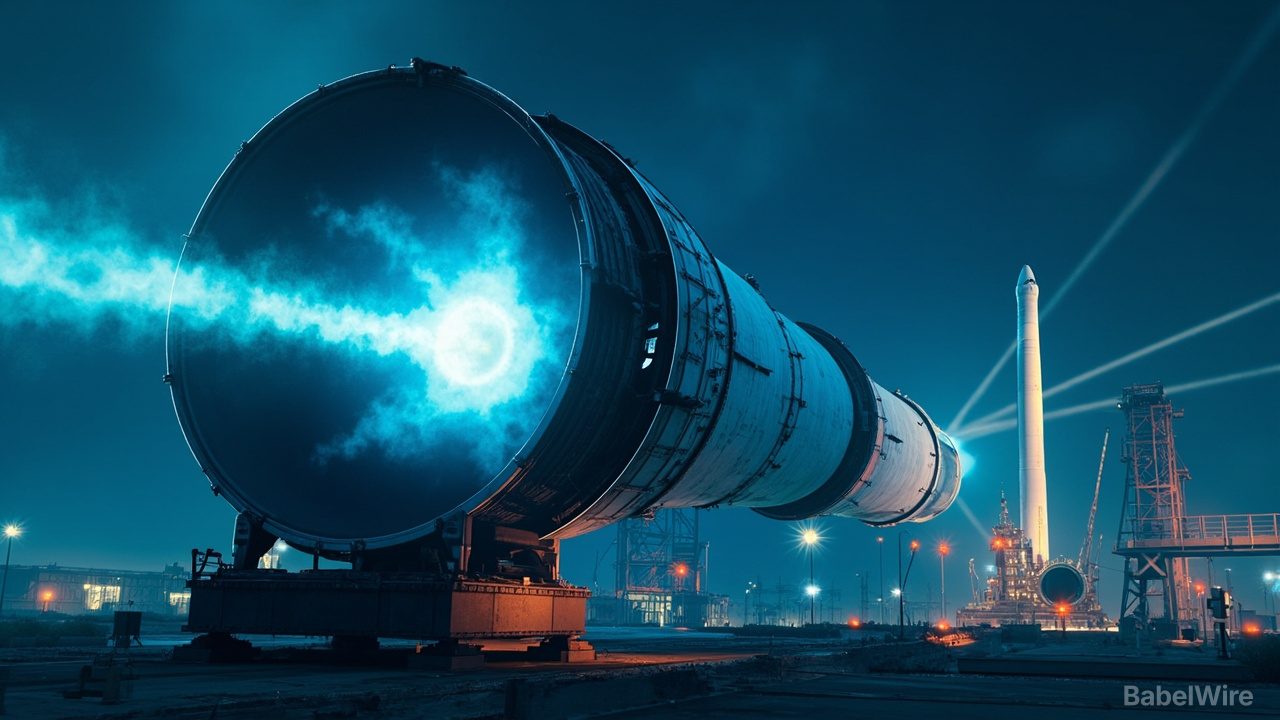
Blue Origin announced two deep changes to its New Glenn rocket on Thursday at the UP.Summit in Florida. A day earlier, chief executive Dave Limp had told employees the rocket will not fly again until January 2027.
Both things are true, and together they tell the more useful story. What Blue Origin is fixing right now is a manufacturing problem, not a launch problem — and those are not the same problem.
The first upgrade is an engine called Northstar, which will eventually replace the BE-4 that powers the first stage today. According to Limp it has half the parts, 30 percent less mass, and about 65 percent of it can be 3D-printed. Blue Origin believes it can build one for 25 percent of the cost of a BE-4 and eventually assemble an engine in less than a day. A test-firing campaign is already underway.
The performance goes up, not down: Northstar starts at 715,000 pounds of thrust against the BE-4's 640,000. Like its predecessor it burns methane and liquid oxygen in an oxygen-rich staged combustion cycle with a single-shaft turbopump. The old engine stays in production for United Launch Alliance, whose Vulcan flies two of them.
The second upgrade is a third stage, GS3, powered by the BE-7 engine already used on the company's lunar landers. It fits inside the interstage, preserving the full fairing volume for payload, and is meant to enable direct injection to geostationary orbit and Earth-escape trajectories. On the smaller 7×2 configuration that means 8 metric tons straight to GEO and 10 tons to translunar injection; on the larger 9×4, 14 and 20 tons. Debut is targeted for 2028 with a government customer. "We have one customer signed up for cislunar space in 2028," Limp said. "We are open for business."
The awkward part is hydrogen. It is the smallest atom and leaks through everything; in a large composite tank, thermal cycling and mechanical strain aggravate cracking. Whether a 5.5-meter composite tank could hold hydrogen at pressure was genuinely open. At Launch Site One in West Texas the tank held 100 percent of expected maximum operating force for 2.5 hours and 150 percent for ten minutes. That cleared the concept.
Then there is the number that frames everything else: Blue Origin wants New Glenn to eventually launch more than 1,000 times a year. Limp said demand for launch has "never been higher."
Do the arithmetic. A 9×4 New Glenn expends nine first-stage engines per flight. A thousand flights a year would consume roughly 9,000 engines annually — at one engine per day, that is 24 years of production. Which is why a quarter-price engine is not an optimization. It is a precondition.
But engine cost was never the binding constraint. The pad was. In May a New Glenn erupted during a hot-fire test days before it was to deploy 48 satellites for Amazon's Leo internet service. Launch Complex 36A has been under reconstruction since, and bad summer weather added to the delay. Limp told staff the adjustment "doesn't diminish what we've accomplished," and that returning to flight remains the top priority. As recently as last month Jeff Bezos told Fox News he still expected a December launch; a source said the new date is about ten days beyond that.
That is the honest state of play. A company building engines at a quarter of the price and a lunar-capable third stage has not flown since its third mission in April. New investment in its Florida facilities is meant to support multiple flights per week by the end of the decade. That is the real scoreboard — not what an engine costs, but how often the pad gets used.