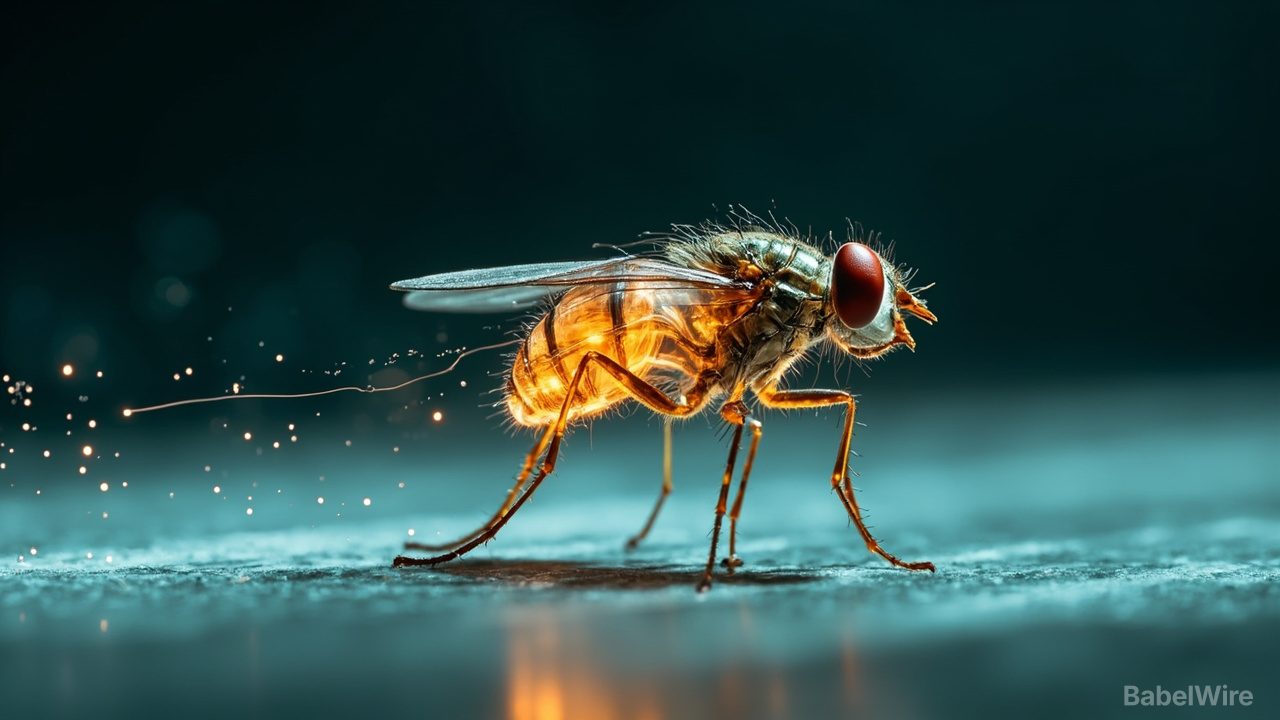
A fruit fly carries a chemical record of what it ate as a larva into its adult body, and that record helps decide how long it will live. That is the conclusion of a study led by Fumiaki Obata, a biologist at the RIKEN Center for Biosystems Dynamics Research in Kobe, Japan, published in Nature.
Scientists have known since the 1930s — first in water fleas and rats, later in flies and mice — that a restricted diet early in life can extend lifespan. What stayed unknown was the mechanism. The RIKEN team cut only the yeast in lab fly food, from 8 percent to 1 or 2 percent, roughly halfway through the larval period, then put the animals back on standard food as adults. The protein-restricted flies outlived their well-fed siblings, males and females alike, but paid for it: they were paler and up to 28 percent lighter, and the females laid fewer eggs. Adding amino acids back to the larval food erased the benefit, telling the researchers that the adult body was somehow remembering larval protein intake.
To find the store, the team raised larvae on a synthetic diet in which the amino acids lysine and arginine were built with heavier carbon and nitrogen isotopes, then switched adults to food tagged with lighter isotopes. Mass spectrometry of head proteins showed that three days into adulthood nearly 64 percent of them were still made from larval amino acids; by day six that had fallen only to about 46 percent. Ribosomal proteins stood out — and flies fed little protein as larvae had fewer of them and built new proteins more slowly during their first adult week.
The candidate that survived the hunt was larval serum protein 2, or Lsp2, a storage protein larvae stockpile as a pantry for metamorphosis, when they cannot eat. Silencing Lsp2 in larvae reproduced the whole chain: fewer ribosomal proteins, slower protein production, longer life. Lsp2 is unusually rich in phenylalanine and tyrosine; removing tyrosine from larval food, or cutting phenylalanine to a quarter of its usual level, was enough to lower Lsp2 and extend lifespan, while restricting isoleucine did nothing.
Obata stresses that the links are not equally solid. 'If you have less translation and less protein production, that leads to the lifespan extension,' he says, attributing the benefit to improved proteostasis, the cell's ability to keep its proteins in working order. How Lsp2 preferentially reaches the ribosome is still a mystery, and the team could not restore ribosome levels to prove causality directly, because that would mean manipulating roughly 100 different ribosomal proteins at once.
Humans have no direct counterpart to Lsp2. Obata's best guess for a functional analogue is albumin and globulins, which together make up about 90 percent of the protein in blood; human albumin, however, is not especially rich in tyrosine or phenylalanine, so a human version of the mechanism would probably rely on different amino acids. Testing that would start in mice, then perhaps primates, and finally in human studies looking for a correlation between albumin levels and lifespan.