Most direct-air-capture systems work like a reversible filter: air passes through granules or a liquid that absorbs CO2, then heat is applied to release the gas in a concentrated stream. A team at the University of Delaware, led by James Buchen, has now demonstrated a battery-based alternative that they say is more viable than earlier electrochemical attempts — and, crucially, less energy-hungry.
The chemistry, published in Nature Energy, is a kind of seesaw. Hydroxide produced at the cathode reacts with CO2, converting it to carbonate or bicarbonate that crosses a separator membrane to the anode. There the lower pH reverses the reaction, turning carbonate back into CO2 gas. The cathode makes hydroxide; the anode consumes it.
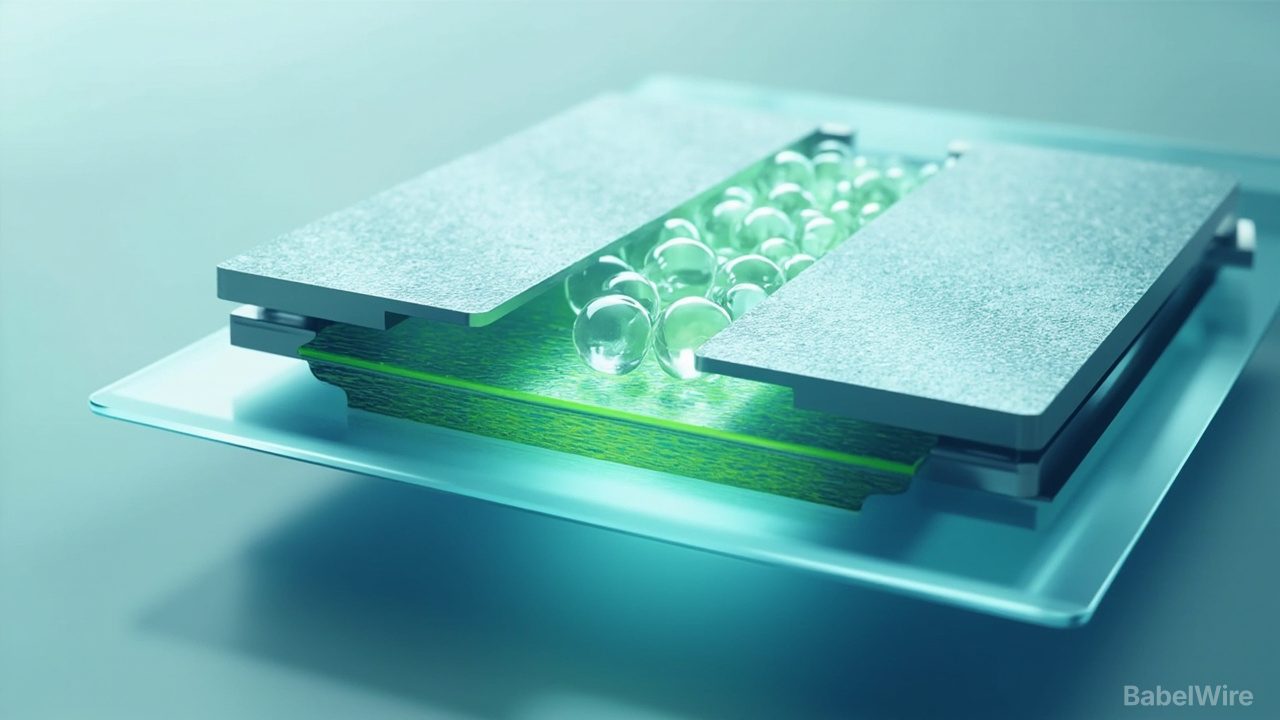
Both electrodes are nickel hydroxide — the same material as the cathode in old nickel-metal hydride AA batteries. But this is not a battery you charge to power a phone; it is a chemical shuttle. Apply voltage one way and hydroxide is driven toward the anode; reverse it and the old anode becomes the new cathode, running the same chemistry backwards — and all the while the cell is pulling CO2 across itself.
The lab-scale device stacked nine cells, each about half a letter-sized sheet of paper, with a blower pushing air through serpentine channels borrowed from fuel-cell hardware. It consumed roughly 0.8 megawatt-hours per ton of CO2 captured. Existing ambient-air facilities run at about 1.5 to 3 MWh per ton.
The paper also sketches the economics. Several authors are part of RepAir Carbon, a startup built on the technology. They estimate a first small pilot plant at about $566 per ton, then use the lithium-ion industry's learning rate and standard cost scaling to project two generations forward: a plant a thousand times the pilot's capacity could reach $92 per ton. Climeworks is targeting $250–$350 per ton by 2030 and has shown how hard optimistic scaling projections can be to hit. The $100-per-ton mark has long been the sector's goal.