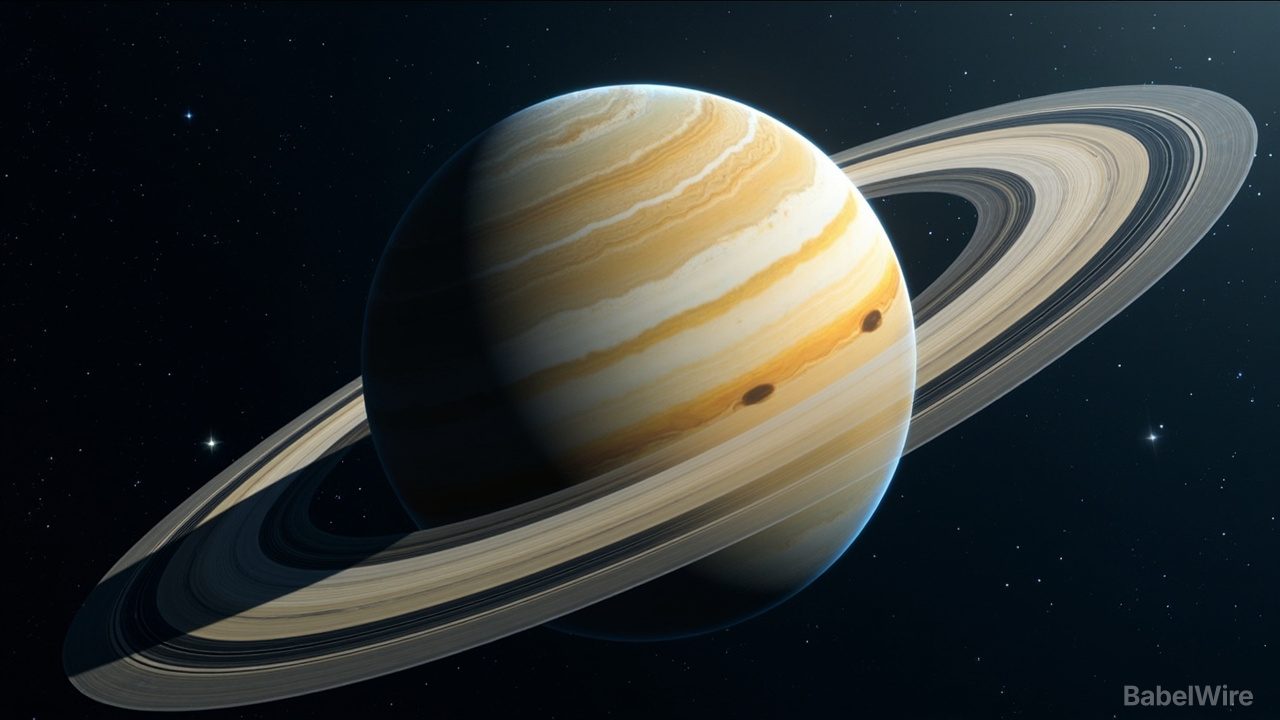
Since the Voyager flybys, a hexagonal storm at Saturn's north pole has fascinated researchers. In its Tuesday column "Zahlen, bitte!", heise online has assembled what four decades of observation have revealed about the feature — and what remains unexplained.
The numbers are the point. The polar vortex forms a fairly regular hexagon with sides about 14,500 kilometres long; its diameter is roughly 29,000 kilometres, more than twice that of Earth. Jet-stream winds reach about 320 km/h, and a full rotation takes about 10 hours, 39 minutes and 23 seconds. At the centre sits a kind of eye of the storm roughly fifty times larger than those of terrestrial hurricanes. The pattern was identified in 1988, when the astronomer David Godfrey analysed images Voyager 2 had taken at Saturn in 1981.
The Voyagers were only passing through — without the instruments or the dwell time for a closer look. That fell to Cassini-Huygens, launched in 1997 and inserted into Saturn orbit in 2004. At first the north pole lay in the shadow of Saturnian winter: a Saturn year lasts 29 Earth years, so winter there runs about seven years, and only the infrared instrument VIMS could observe the hexagon in 2006. Optical study became possible only from August 2009, with the onset of northern spring. The images showed that the hexagon still existed essentially unchanged two decades on.
Structurally the polar storm resembles a terrestrial hurricane — Kevin Baines of the Jet Propulsion Laboratory described it as having "at least the structure of a hurricane" — but it forms under entirely different conditions. Earthly tropical storms need warmth and water from the surface, which a gas planet cannot supply, and Earth receives roughly a hundred times more sunlight than Saturn. A shallow atmosphere and the absence of obstacles such as mountain ranges may be what allow such perfect symmetry in the first place. Oxford researchers reproduced a comparable vortex in the laboratory in 2010; in 2020 Rakesh Yadav and Jeremy Bloxham showed in simulations how flows deep inside the planet generate smaller vortices around an eastward jet stream and pinch it into a hexagon.
The hexagon is no longer alone. In 2018 Leigh Fletcher of the University of Leicester found a second, smaller hexagonal vortex in Cassini data, which had formed hundreds of kilometres above the main one from 2014 — with no agreement on whether it is independent or connected. In 2025 US and European researchers found pearl- and star-shaped structures in James Webb Space Telescope infrared images, in the ionosphere and some 500 kilometres lower in the stratosphere, for which there is still no explanatory mechanism. And Hubble photographed a new ten-sided wave at the south pole that only began forming in 2023 — the first such feature in that hemisphere.
Why such patterns appear only at Saturn remains open. Jupiter is also mostly hydrogen and helium but has eight smaller cyclones orbiting a centre instead of one large polar vortex. An MIT study suggests a softer gaseous substrate favours multiple vortices while a denser one favours a single large storm. For Baines, the hexagon remains "one of the greatest mysteries of Saturn's dynamics" — and with the young decagon at the south pole and the unexplained Webb patterns, the list of questions is growing rather than shrinking. One further thread concerns Enceladus: in the ocean beneath that moon's ice crust, recent work suggests, possible life would be easier to detect than previously assumed.