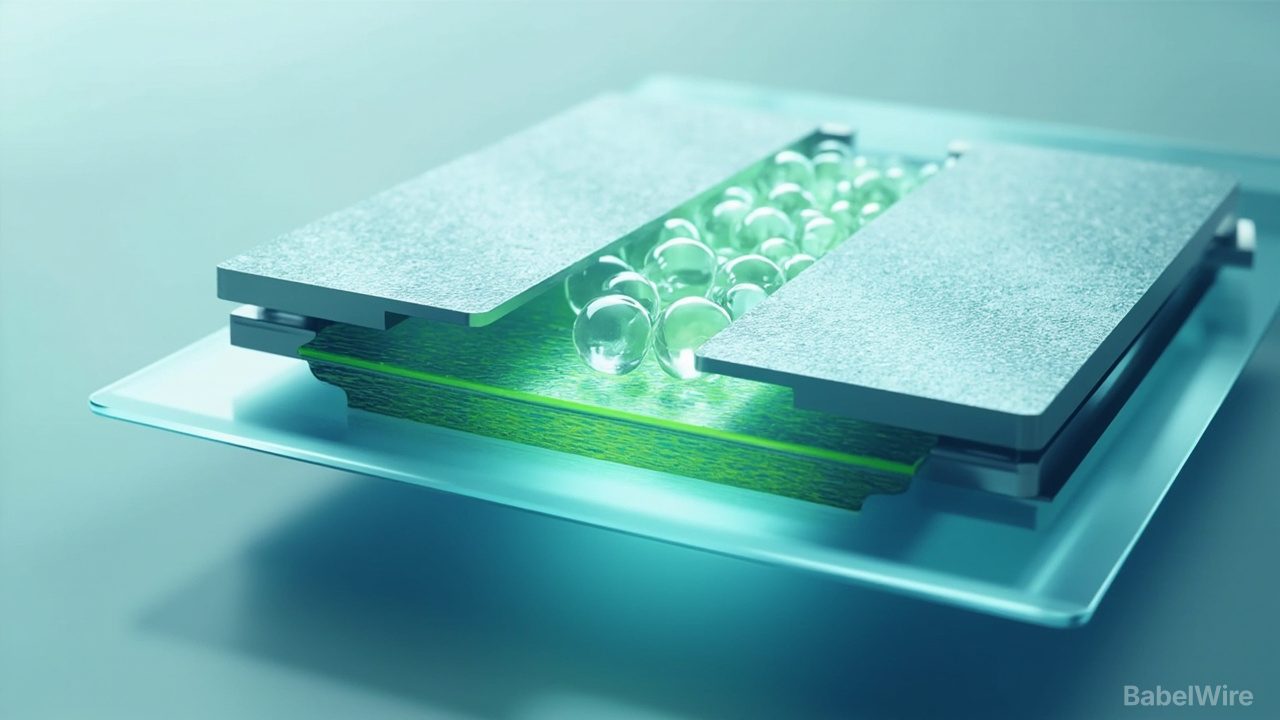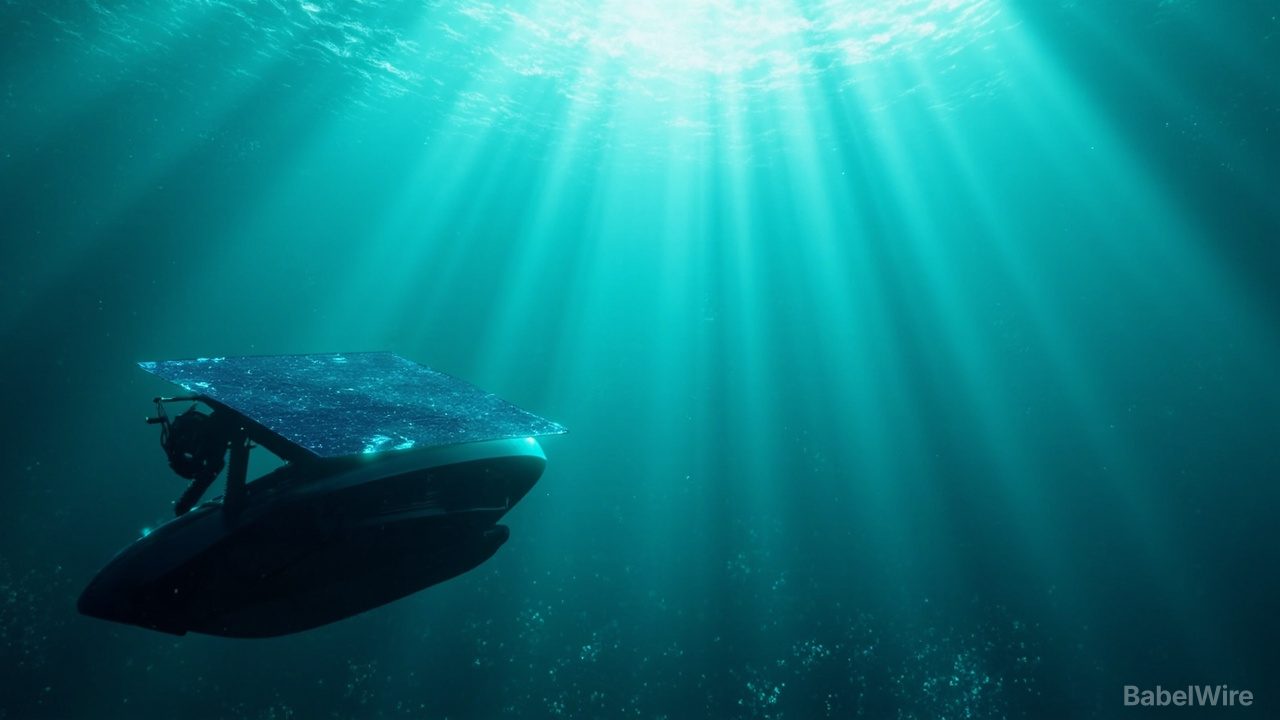
In a paper in Joule, a team led by Wen-Hua Zhang at Yunnan University in China describes a wide-bandgap perovskite solar cell engineered specifically for the dim, blue-green light that survives a few metres below the ocean surface — and reports a record 34.71% power conversion efficiency underwater.
The physics problem is severe. Water is a brutal optical filter: light longer than about 630 nanometres is absorbed within the first few metres, so the low-energy red and infrared photons that terrestrial silicon and standard 1.55 eV perovskite cells are optimised for never arrive. What is left a few metres down is a faint 400–600 nm blue-orange glow.
Zhang's team matched the cell to that window with a mixed-anion lead halide perovskite tuned to an optical bandgap of about 1.96 eV. Wide-bandgap perovskites are notoriously fragile: bright light and heat drive halide-ion migration, phase separation and defect formation. Underwater the chemistry is kinder — temperatures below 25 °C and reduced light intensity suppress thermal degradation — but internal defects remain.
To fix those, the researchers added polyhexamethylene guanidine hydrochloride (PHMG), a polymer whose guanidinium cations act as multisite anchors, locking into vacancies in the crystal lattice and hydrogen-bonding to lead and halide ions. The result raises the activation energy barrier for ion migration from 0.07 eV to 0.21 eV, freezing phase segregation, and shifts the film's surface conductivity from p-type to n-type, creating band bending that speeds electron extraction and cuts non-radiative recombination.
The numbers: 16.79% certified efficiency under standard terrestrial sunlight; 34.71% for a 0.0895 cm² cell under a custom underwater solar simulator mimicking 10 m depth. The team also built modules with nearly 29 cm² of active area, encapsulated in polyisobutylene, cover glass and epoxy. Deployed on a miniature robot in the South China Sea near Weizhou Island, the modules kept producing power at 10 m, generating 324 mWh to charge lithium-ion batteries that lit an LED panel.
Accelerated ageing and Arrhenius modelling predict a T80 lifetime — 80% of initial efficiency retained — of roughly 48,094 hours, or 5.49 years of continuous operation at 25 °C. Mass spectrometry found negligible lead leakage. Zhang flags biofouling as the next open problem, calling it a challenge for multidisciplinary work. The intended applications are autonomous marine infrastructure: deep-sea sensors, research cameras and underwater IoT nodes.