Scientists at the Max Planck Institute for the Science of Light have achieved a dramatic increase in light-sound coupling inside optical fibers by freezing a liquid core to -196°C with liquid nitrogen. The interaction becomes more than 1,000 times stronger than in standard glass fibers, enabling a new class of photonic devices.
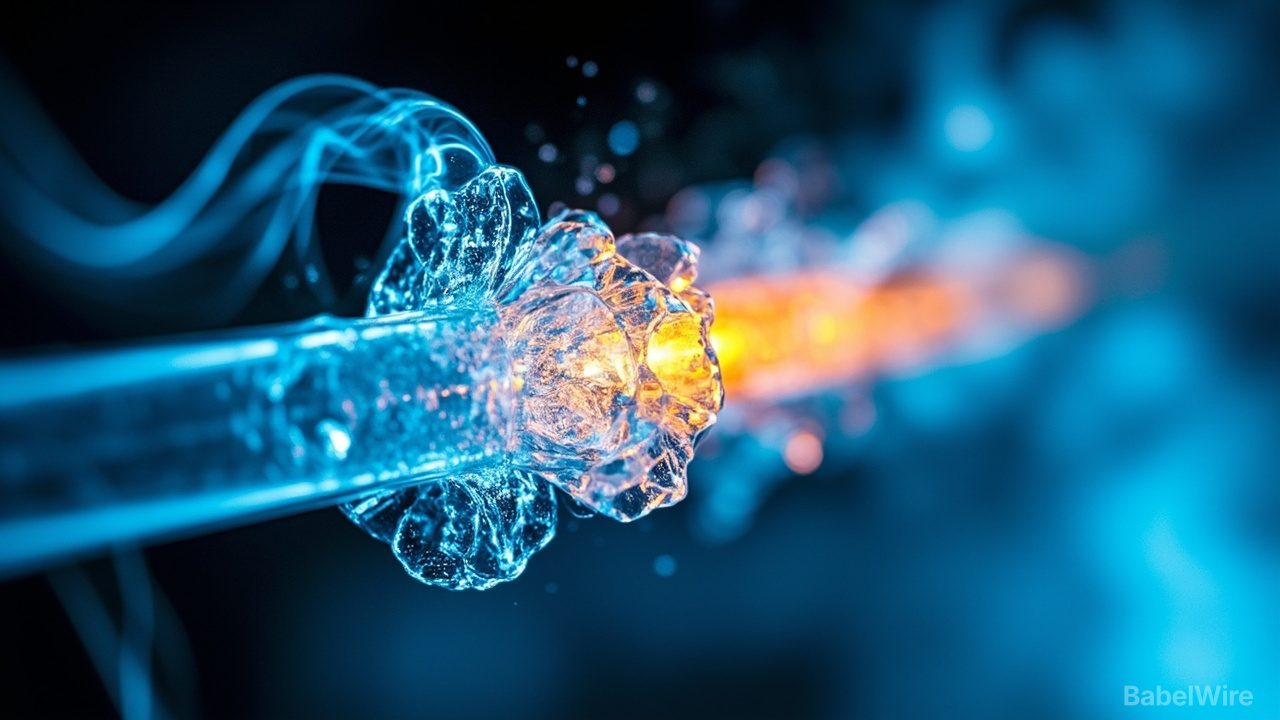
The frozen liquid-core optical fiber (LiCOF) retains its ability to guide light even after the core solidifies — a surprising result, since phase transitions typically disrupt waveguiding. The exceptionally dense, tightly confined frozen environment amplifies Brillouin-Mandelstam scattering, the interaction between photons and hypersonic acoustic waves.
The team, led by Prof. Birgit Stiller at MPL Erlangen with collaborators at Leibniz University Hannover and IPHT Jena, used the effect to demonstrate optoacoustic memory: information carried by a fast light wave is transferred to a slower sound wave, temporarily stored, then converted back to light. This could serve as a fundamental building block for photonic neuromorphic computing.
The research, published in Optica (Vol. 13, Issue 7), could also have implications for quantum information processing, microwave photonics, and high-precision sensing. "By freezing the liquid core, we have created an entirely new physical platform that provides extreme nonlinearities while being easy to handle," said Stiller.