**A sugar molecule has been detected in interstellar space for the first time, a discovery that could help solve one of biology's oldest puzzles: how did the building blocks of life arrive on early Earth?**
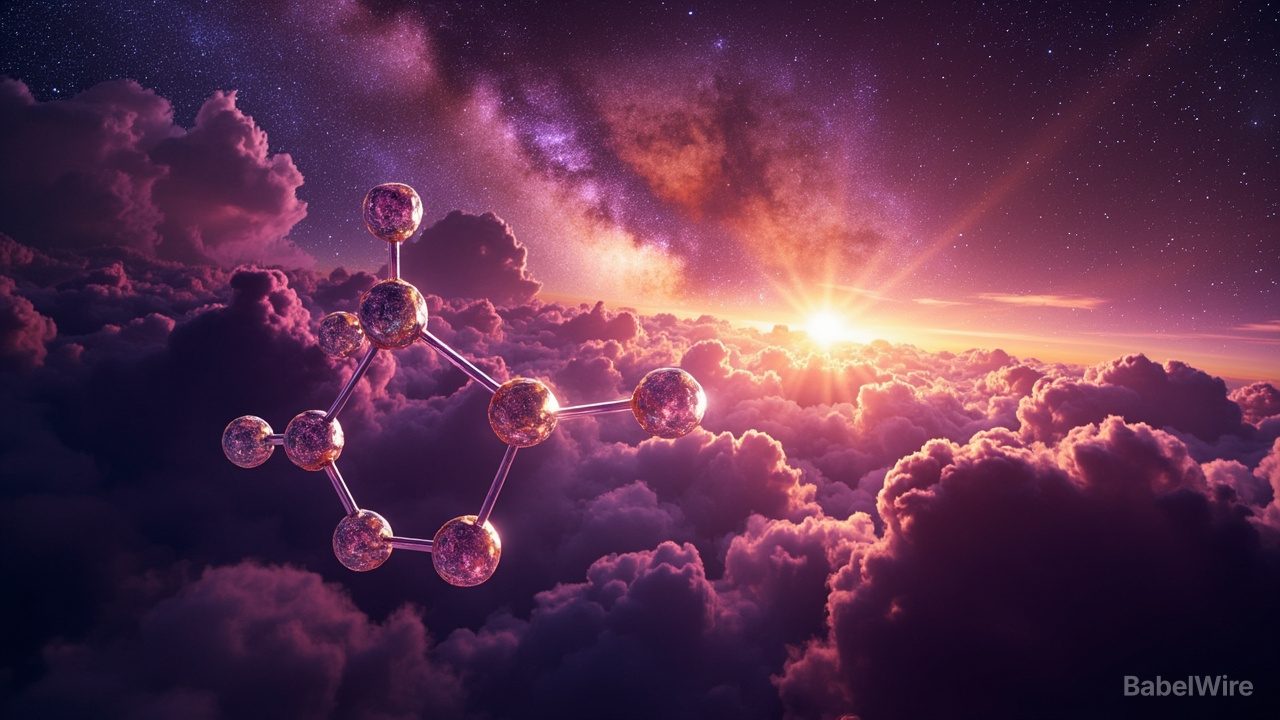
An international team led by researchers from the Center for Astrobiology (CAB) in Spain identified erythrulose, a four-carbon sugar, in a molecular cloud called G+0.693−0.027 near the center of the Milky Way. The detection relied on highly sensitive broadband spectroscopic surveys conducted with the 40-meter Yebes radio telescope and the 30-meter IRAM telescope.
Sugars are central to life as we know it. They form the structural backbone of DNA and RNA and participate in essential metabolic reactions. Yet laboratory experiments have long shown that prebiotic conditions on early Earth would not have produced enough sugar to kick-start life — creating a persistent puzzle for origins-of-life researchers.
"This finding was unexpected, as the prevailing view in astrochemistry is that interstellar molecules grow in size through the sequential addition of carbon atoms," said Izaskun Jiménez-Serra (CAB), lead author of the study published in Nature Astronomy.
The researchers detected 12 spectral lines matching the laboratory fingerprint of erythrulose. Their analysis revealed that the four-carbon sugar is at least eight times more abundant in the cloud than comparable three-carbon sugars — none of which appeared at all. Laboratory experiments showed that erythrulose can form inside interstellar ice from simpler two-carbon alcohols and aldehydes.
Using the measured abundance, the team estimated that between 0.5 million and 50 million tons of the sugar may have reached Earth during the Late Heavy Bombardment, approximately 4.1 to 3.8 billion years ago — precisely when life was first emerging on our planet.
Ribose and glucose had previously been found in meteorites and asteroid material, but this marks the first direct detection of any sugar in the vast spaces between stars.
"The detection of erythrulose is very exciting because it opens up the possibility of discovering in space other sugars such as ribose, which is part of RNA, and other important molecules for the origin of life," said Carlos Briones, co-author of the study.
The finding suggests that a rich inventory of organic molecules was delivered to the young Earth from space, potentially providing the chemical ingredients necessary for the first self-replicating systems to emerge.