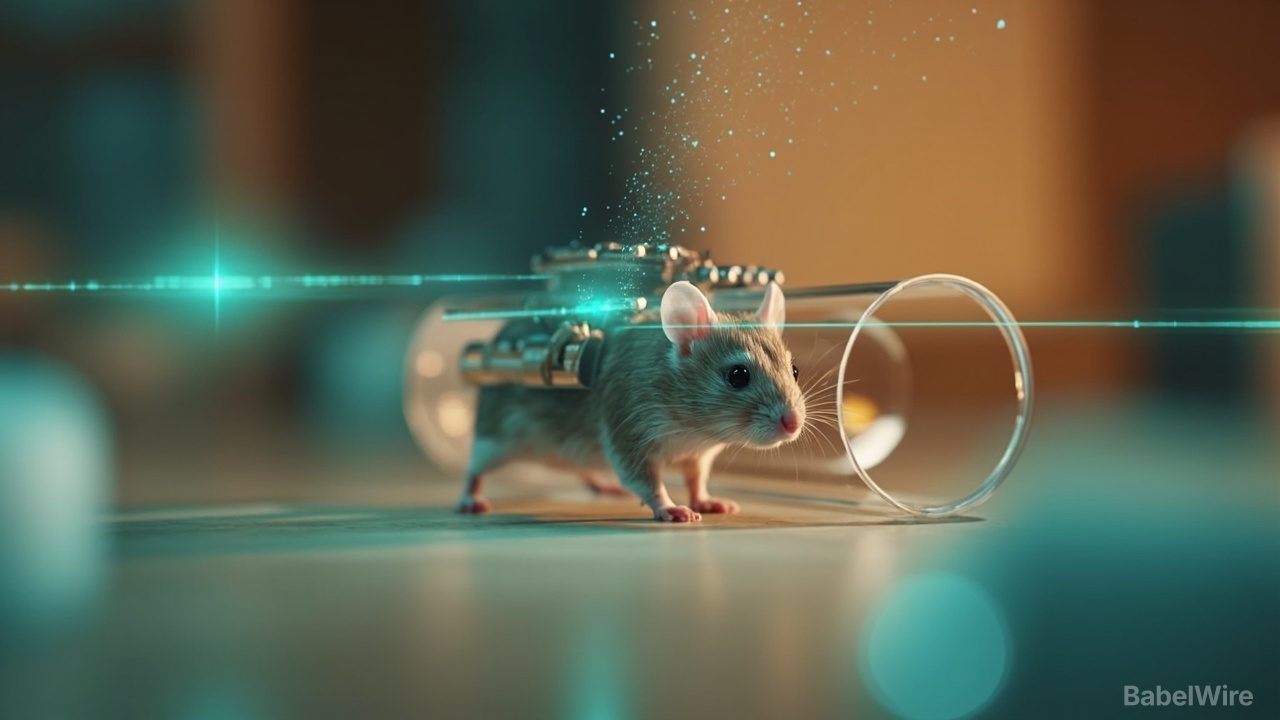
A team from Tsinghua University and the Chinese PLA General Hospital has published a mesoscope in Nature that weighs one gram without its battery and streams images wirelessly. It is called Airscope, and its real contribution is not the weight itself but what the weight buys: recordings of thousands of neurons in mice that are free to move, climb and crawl through tubes.
What it does
A 2-megapixel sensor, an optical path built from four aspherical lenses, a six-millimetre field of view and four-to-six-micrometre resolution — single cells. That reads like a spec sheet, but it is the centre of the problem: conventional head-mounted miniature microscopes usually weigh more than three grams, which constrains movement and distorts behaviour. Tethered systems do the same, more visibly.
Airscope is more than 30 percent lighter than comparable head-mounted devices, according to the team, and transmits megapixel images wirelessly, which required aggressive data compression. The battery attaches magnetically and swaps quickly, so an animal can be observed over long periods without anyone unplugging it.
The numbers that matter: more than 8,500 cortical neurons recorded simultaneously in a single mouse — 25 times the capacity of existing wireless devices, per the team — and stable recordings from the same brain region for more than 200 days, with signal quality comparable to benchtop microscopes.
What they actually did with it
The more interesting results are behavioural. The team recorded mice exploring a five-square-metre naturalistic habitat and tracked prolonged, self-directed exploration of a maze with 32 terminal arms. Cortical activity varied systematically with the type of terrain the animals crossed.
That is the point at which this kind of hardware stops being engineering and becomes science: a pattern visible only because the animal was moving while it was measured. You cannot study the neural basis of behaviour while constraining the behaviour.
Context and limits
The work, led by Dai Qionghai at Tsinghua and Dai Pu at the Chinese PLA General Hospital, was published in Nature on 19 October. The constraints are those of the method rather than the device: mesoscopy needs fluorescent indicators, delivered genetically or virally, and it images cortex, not depth. Six millimetres of field of view is a lot for a mouse and not much for a primate.
The direction is still notable. Chinese groups have pushed hard on neurotechnology and brain-computer interfaces, and a device that disturbs less while seeing more is a building block there — for basic research and for whatever later gets marketed as a BCI. Dai points to optical brain-computer interfaces as the next step, and to immunology and oncology, where miniaturised imaging could track disease progression.
The sober part
A single gram is not an end in itself. It is the difference between an animal displaying its behaviour and an animal wearing a cable. In neuroscience that difference has cost decades of data, and each generation of lighter devices has made questions answerable that previously could not even be asked. Airscope is not a leap into the unknown; it is a very good next step in that line.
Sources
- globaltimes.cnChinese scientists develop world's lightest 1-gram wireless mesoscale microscope — Global Times
- scmp.comChina builds the world's smallest wearable brain monitor — SCMP
- interestingengineering.comWorld's smallest brain monitor captures activity from 8,500 neurons — Interesting Engineering
- sixthtone.comChina Develops 1-Gram, Wireless Microscope for Lab Animal Use — Sixth Tone