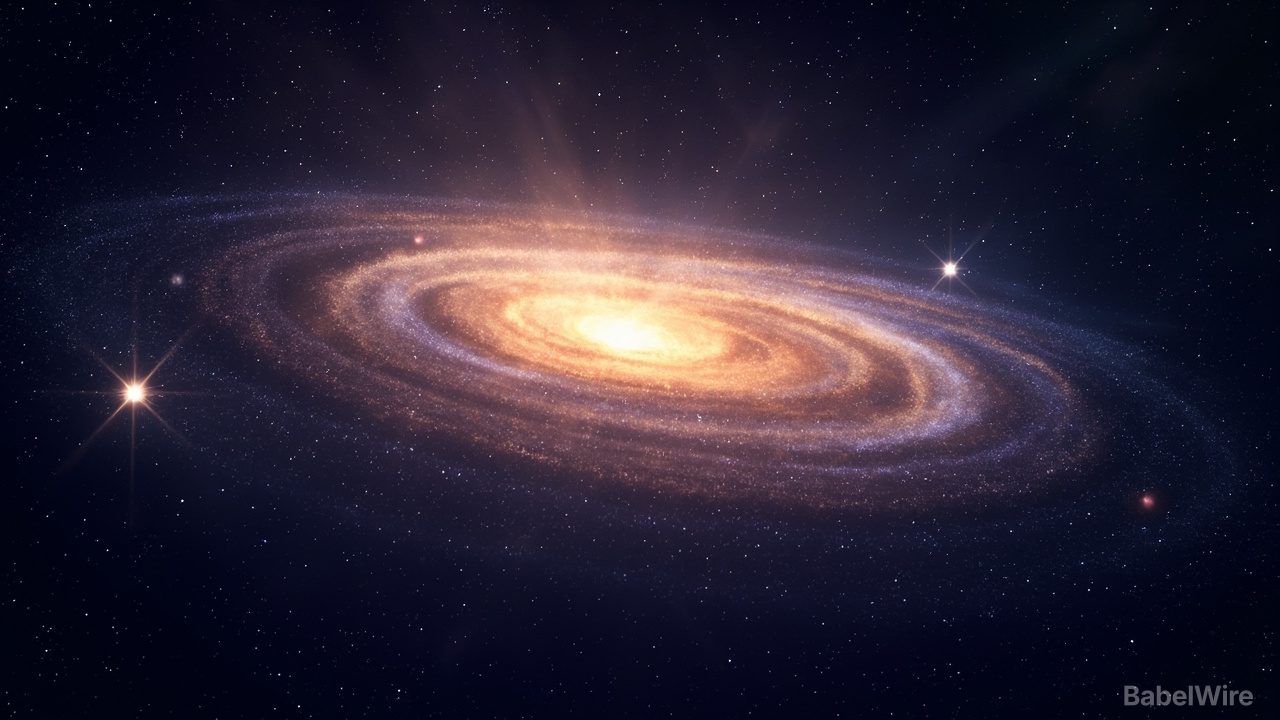
Astronomers have found three actively feeding supermassive black holes inside one galaxy, J0148-4214, more than 12.5 billion light-years from Earth. Because the light has been travelling that long, the observation shows the galaxy as it was roughly 1.2 billion years after the Big Bang — measured at redshift z = 5.02.
"This is the first evidence of three active black holes in a single galaxy in the distant Universe," said Hannah Übler, research group leader at the Max Planck Institute for Extraterrestrial Physics (MPE) and lead author of the study.
Three black holes, three very different sizes
The two central black holes are separated by a projected distance of just 620 light-years. The third sits far outside the nucleus, approximately 5,500 light-years from the centre. Their estimated masses are about 80 million, 2 million and 600,000 times that of the Sun.
The surprise is which one is eating most aggressively. It is not the giant. The roughly 600,000-solar-mass neighbour is accumulating matter at a rate that appears to exceed the Eddington limit — the point at which radiation pressure from the infalling material should push further gas away. The team also estimates the galaxy's total stellar mass at about 1.3 billion suns, meaning the black holes represent a significant fraction of everything the galaxy contains.
How you find two black holes that a telescope cannot resolve
Until recently, this would have been impossible to see. The team used JWST's Near Infrared Spectrograph in integral field spectroscopy mode (NIRSpec-IFS), which records a spectrum for every position across the galaxy rather than a single spectrum for the whole object.
Hydrogen gas near a black hole moves at extreme speeds, leaving recognisable signatures in the emitted light. In the galaxy's centre, the hydrogen emission pattern was too complicated for a single source to explain; two closely spaced black holes fit far better. To locate them individually, the researchers used spectro-astrometry — tracking subtle positional shifts in spectral features — and resolved the pair even though the telescope could not image them as two points of light. The third active black hole turned up in the galaxy's outer region.
Without that spatial detail, the team says, they would most likely have identified only one of the three.
Why this matters for how giants grew
Galaxy mergers were common in the early universe, and when galaxies combine, their central black holes can spiral toward each other and eventually coalesce. That is one of the leading explanations for how black holes reached hundreds of millions of solar masses within the first billion years — a growth rate that is awkward for models based on steady accretion alone.
Finding three in one galaxy at z = 5.02 is direct evidence that the early universe was efficient at assembling massive black holes. "It suggests that processes in the early Universe were efficient at bringing massive black holes together, setting the stage for the massive black hole mergers we expect to detect with future gravitational wave observatories," Übler said.
The two central black holes are expected to merge within the next few hundred million years. "These results are extremely exciting," added co-author Roberto Maiolino of the University of Cambridge. "They suggest that black hole merging may be an additional, fast route for their rapid growth in the early Universe."
The mystery of the third
The outlier is the one astronomers will argue about. A black hole sitting 5,500 light-years from the centre, well outside the nucleus, has two plausible explanations. It could be moving inward, on its way to join the other two. Or it could be the remnant of an earlier merger that got kicked outward — a gravitational recoil, where the merging pair radiated gravitational waves unevenly and the resulting black hole was flung in the opposite direction.
Both are testable with follow-up observations, and both would say something different about how violent the centre of this galaxy has been.
The implication that scales
If JWST's integral field spectroscopy can pull three black holes out of a single faint galaxy at z = 5.02, then multi-black-hole systems in the distant universe are probably not rare — they are under-counted. Every galaxy previously catalogued as hosting one active nucleus is a candidate for hiding more, and the census of merger candidates is likely to grow as the technique is applied more widely.