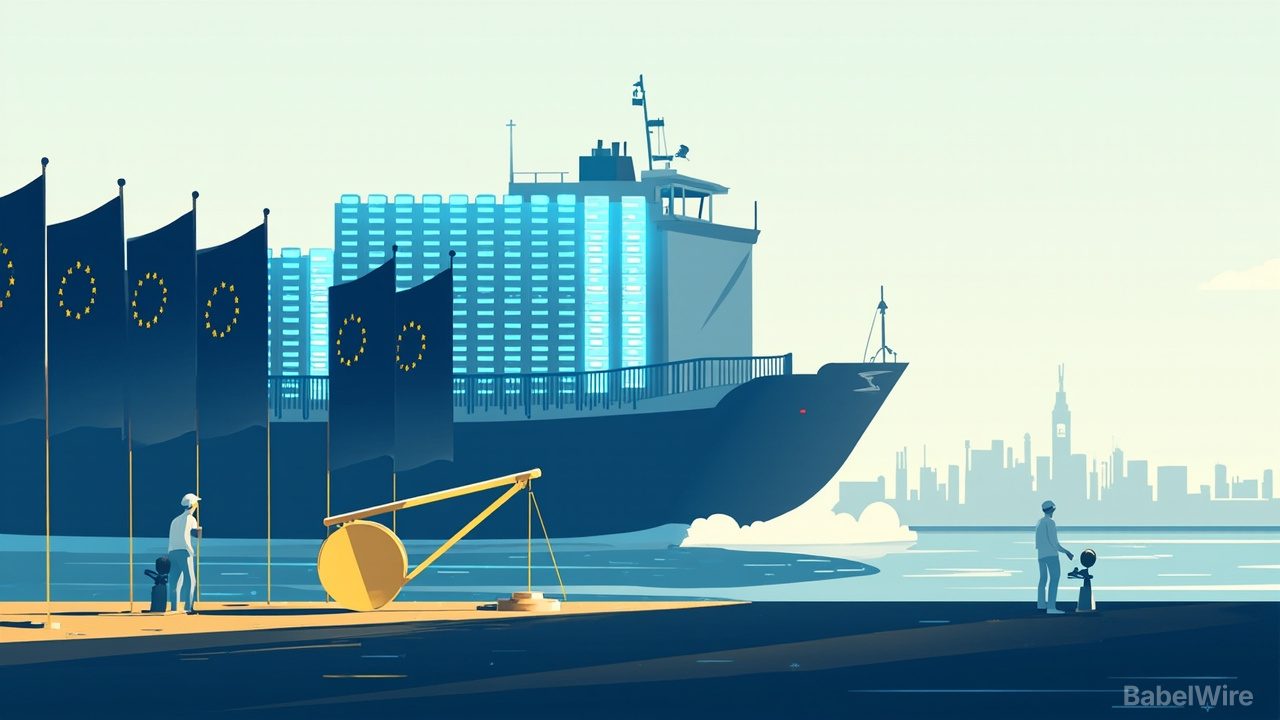
For two years the European Commission's answer to the AI race was to build: gigafactories, sovereign compute, a European frontier model. This autumn the message changed, and the people who run Europe's AI companies have noticed.
In her State of the European Union address in mid-September, Commission President Ursula von der Leyen said Europeans do not need to "be the ones who develop the frontier technology to be the ones who draw the greatest value from it". The emphasis moved to applications: deploy what others build, and capture the value on top.
The pushback started immediately. Max Junestrand, chief executive of Swedish legal-AI platform Legora, told Politico that building a competitive frontier lab right now "feels like very wishful thinking", and that Europe should spend its limited resources capitalising on existing technology instead.
This week the counter-attack arrived in the language Brussels listens to: dependency and trade. Arthur Mensch, chief executive of Mistral — valued above €21bn — published a post titled "Build or surrender", warning that giving up the frontier would "end up costing Europe what remains of its place in the world". On a livestreamed European Technology Network panel he added that Europe would be left with the "leftovers" and "a big trade balance problem" if it only built applications on foreign models.
Jarek Kutylowski, chief executive of German translation company DeepL, put the same case in narrower, more concrete terms. "We need our own models, and we need the whole value chain of AI," he told Politico. His example: software engineering budgets are shifting from engineers' salaries to AI model usage, and without European models that spending leaves the continent.
Both are arguing against a real trend rather than a straw man. Europe trails the US and China at the frontier, and closing the gap requires compute the EU has struggled to finance. At the end of July the Commission launched seven AI gigafactories backed by roughly €30bn, and an Italian-led consortium under Domyn is training a frontier model intended to be available in every EU official language.
Why it matters: the choice is not binary, but the budget is. Money spent chasing frontier models is money not spent on adoption, and the EU is making that allocation while rewriting its AI Act under industry pressure and arguing internally over liability rules. If the applications doctrine hardens, European AI policy becomes procurement and diffusion policy, and the continent's model builders become price-takers on infrastructure they do not control.
Neither side has resolved the measurement problem. The value of an application layer shows up in GDP; the strategic cost of depending on someone else's weights shows up only in a crisis — when a provider changes terms, raises prices or withholds a capability.