Two papers, one moon
Both studies appeared in Science Advances: one led by planetary scientist Frank Postberg of Freie Universität Berlin, analysing data from the Cassini mission; the other a laboratory study of whether terrestrial-style microbes could survive in the ocean beneath Enceladus's ice shell.
Plumes that pre-sort their cargo
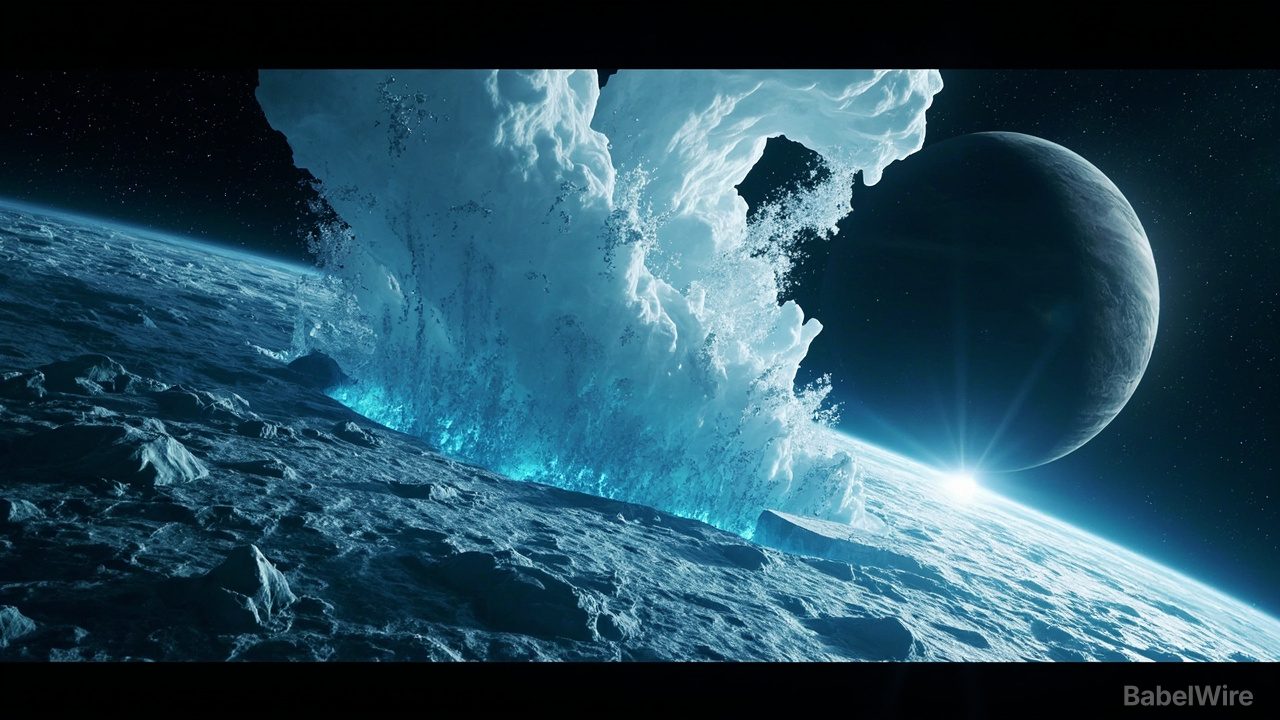
Enceladus vents ocean water through cracks in its ice crust in jets that reach hundreds of kilometres into space, where Cassini's cosmic dust analyser sampled them. Combining Cassini data, laboratory experiments and modelling, the first team found that the spray droplets freeze slowly rather than instantly — so their components separate and gather. Individual ice grains arriving in space therefore carry mostly a single substance, at far higher concentration than in the bulk ocean.
For astrobiology the implication is practical, not incidental: a grain rich in organic molecules or microbial fragments is much easier for an instrument to identify than a diluted mixture. The authors argue an instrument designed around this could fly on a planned ESA mission, pointing to the L4 concept and a possible launch in 2042.
Methanogens in an unfriendly ocean
The second team tested Methanothermococcus okinawensis, an earthly methane-producing microbe, under conditions modelled on the Enceladus ocean: nearly oxygen-free, strongly alkaline with pH values of 10 to 11, and carbonate-rich. That pH should be far too high for the organism. It grew anyway, using dissolved hydrogen as an energy source and producing methane. "We really did not expect that," researcher Nozair Khawaja is quoted as saying. Postberg adds that the moon's geochemistry could support "one of the oldest known earthly metabolic pathways" — while stressing this does not mean life is there.
What it does not mean
Neither result is evidence of life at Enceladus. Together they show that the environment could plausibly host it, and that if it did, traces could survive the trip into space in a form existing instruments can plausibly detect. The ice moon remains one of the best targets in the solar system — now with a stronger instrumentation argument attached.
Sources
- heise.deheise online — Saturnmond Enceladus: Leben in Ozean offenbar möglich – und nachweisbar
- fu-berlin.deFreie Universität Berlin — Great news from Saturn's moon Enceladus in the search for life
- science.orgScience Advances — Enceladus-like geochemistry fuels methanogenesis
- phys.orgphys.org — Enceladus ice plumes separate and sort the ocean's components