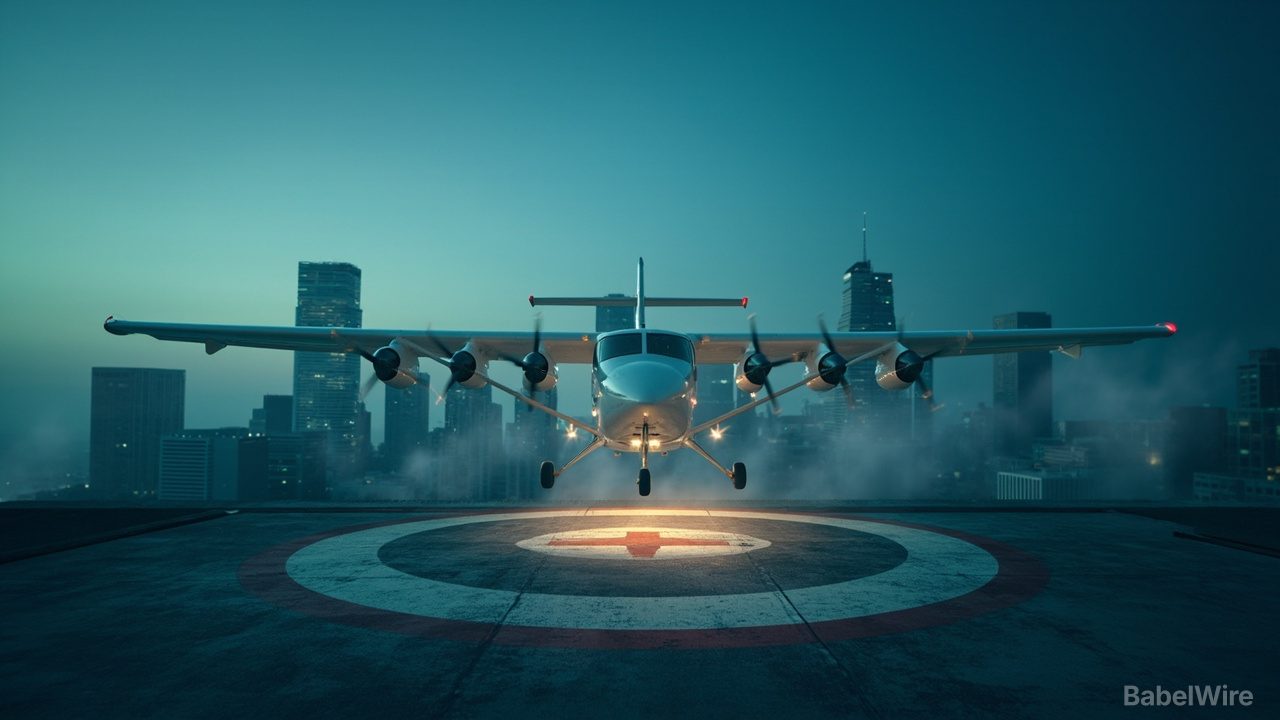
A fixed-wing aeroplane landed this week on a heliport in Lower Manhattan, on a strip about 91 metres long, between towers. That is not where aeroplanes go.
Electra flew its EL2 technology demonstrator into and out of the Downtown Skyport — a site built for helicopters and eVTOLs — to make a specific argument: you do not need complicated vertical-takeoff machinery to put small regional aircraft into cities. A wing, eight propellers and the right aerodynamics will do.
The EL2 is a two-seat demonstrator with roughly an 11-metre span and a takeoff weight near 1,400 kilograms. Its wing comes from a Cessna 172, modified for extreme slow-flight behaviour. Eight electric motors provide propulsion, drawing on a battery that a hydrogen-fuelled turbogenerator recharges. Takeoff and landing run purely on battery power, which is the point in a dense city: it is quiet.
The trick is blown lift. The propellers blow their wake across the entire upper surface of the wing, adding lift directly. That lets the aircraft approach below 25 knots — about 46 km/h — without stalling. Electra claims a ground roll of 45 metres for landing, and the same distance for takeoff.
The real audience for the demonstration is not the passenger but the infrastructure. An aircraft that needs 45 metres does not need a new runway or a new vertiport: existing helipads, ship decks, fields and parking lots with clear approach will do. That is the basis of Electra's “Direct Aviation” pitch — regional flights between cities, with departure and arrival points closer to the destination than any commercial airport.
Flight testing has been building towards this. In October the EL2 flew in Virginia under the FAA's Advanced Air Mobility integration programme, including helicopter-style point-in-space instrument procedures from small heliports, vertiports and taxiways. Earlier stops included downtown Charleston, Bader Field in Atlantic City and the Snowshoe Mountain Resort. Electra says more than 60 airlines have expressed interest in the concept.
The capability is meant to scale to the EL9, already in development: two crew and nine passengers, or about 1,360 kilograms of cargo, with a range of 480 to 500 nautical miles — roughly 890 to 926 kilometres. The EL2 itself flies about 500 nautical miles.
What the demonstration does not prove is operation. The EL2 is a demonstrator, not a certified transport aircraft. The hydrogen turbogenerator, the hybrid powertrain and the certification of an aeroplane that rolls out in 45 metres are the hard problems; the flight itself is the easy one. The FAA is engaged through a pilot programme, but there is no certification basis for routine service yet. And the noise advantage on approach should not obscure the fact that a turbogenerator is flying along with you.
Still, the burden of proof has moved. Until this week the question was whether a fixed-wing aircraft without VTOL rotors could safely use surfaces that short. Now it is how quickly anyone will let it.