The Coldest Stars in the Galaxy Might Not Be Stars at All
A new study from the University of Arkansas — published in the journal Universe and available as a preprint on arXiv — provides astronomers with the most detailed observational guide yet for detecting Dyson spheres, the hypothetical megastructures that advanced civilizations might build to harvest a star's entire energy output.
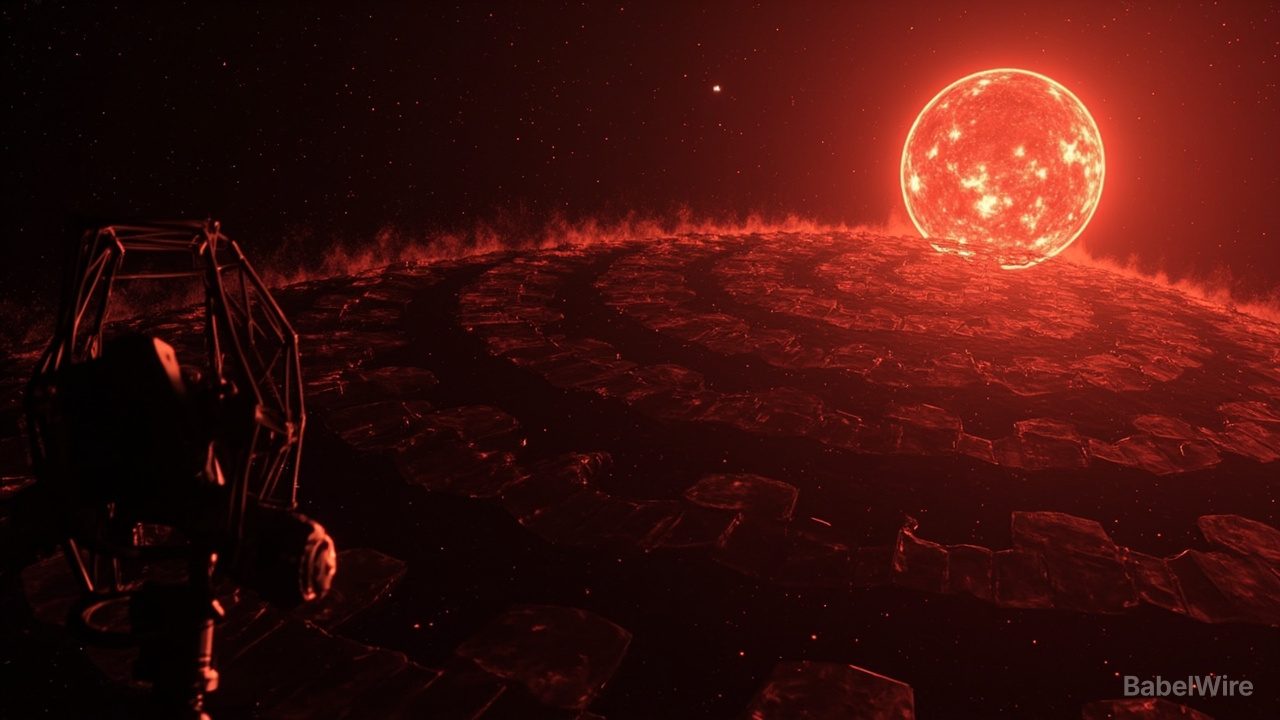
Since physicist Freeman Dyson first proposed the concept in 1960, the idea has captured the public imagination. Modern calculations show that a solid spherical shell is physically implausible — the material requirements alone would be astronomical. Instead, scientists now envision a Dyson "swarm": countless independent solar collectors orbiting a star in a dense formation, capturing its light and converting it to usable energy.
The Prime Suspects: Red and White Dwarfs
Lead author Amirnezam Amiri identifies two star types as the most promising Dyson swarm hosts:
Red dwarfs are the most common stars in the Milky Way, burning their fuel so slowly they can survive for trillions of years. Their small size means a Dyson swarm could orbit at just 0.05 to 0.3 AU — requiring vastly less construction material than a structure around a Sun-like star.
White dwarfs — the collapsed cores of dead Sun-like stars — are even more enticing. Barely 1% of their original size, a Dyson swarm could orbit just a few million kilometers above the surface, dramatically shrinking the scale of engineering required. These stellar remnants also release steady energy for billions of years.
How a Dyson Swarm Would Betray Itself
The study identifies three key signatures:
**1. The Infrared Glow** — A Dyson swarm would absorb virtually all visible light from its star and re-emit the energy as heat in the infrared. A typical red dwarf at 3,000K would appear, through the swarm, as an object with an effective temperature as low as 50K — two orders of magnitude colder. No known natural star occupies this region of the Hertzsprung-Russell diagram. Any object found there would be an immediate candidate for investigation.
**2. The Clean Spectrum** — Ordinary stars show silicate emission features from surrounding dust disks. A Dyson swarm, consisting of engineered radiator panels rather than dust, would produce an unusually "clean" spectrum — a conspicuous absence of the dusty signals astronomers expect.
**3. The Strange Flicker** — A true solid sphere is impossible, but a swarm of independent collectors with gaps between them would produce highly unusual, non-natural variations in brightness as components orbit the star at varying densities.
The James Webb Advantage
The James Webb Space Telescope is uniquely suited for this hunt because it specializes in infrared observations. Older missions like WISE are also contributing. In May 2024, Project Hephaistos reported seven promising Dyson sphere candidates among roughly 5 million stars examined — all associated with red dwarfs. One was later ruled out (a perfectly aligned supermassive black hole explained the signal), leaving five candidates still deserving closer study.
What This Means
Amiri's work provides a crucial filter: a set of observational criteria that can help distinguish genuine technosignatures from natural cosmic phenomena. If Dyson swarms exist somewhere in the Milky Way, future infrared observations may finally reveal where they have been hiding. The search for extraterrestrial intelligence has just gained a sharper pair of eyes.