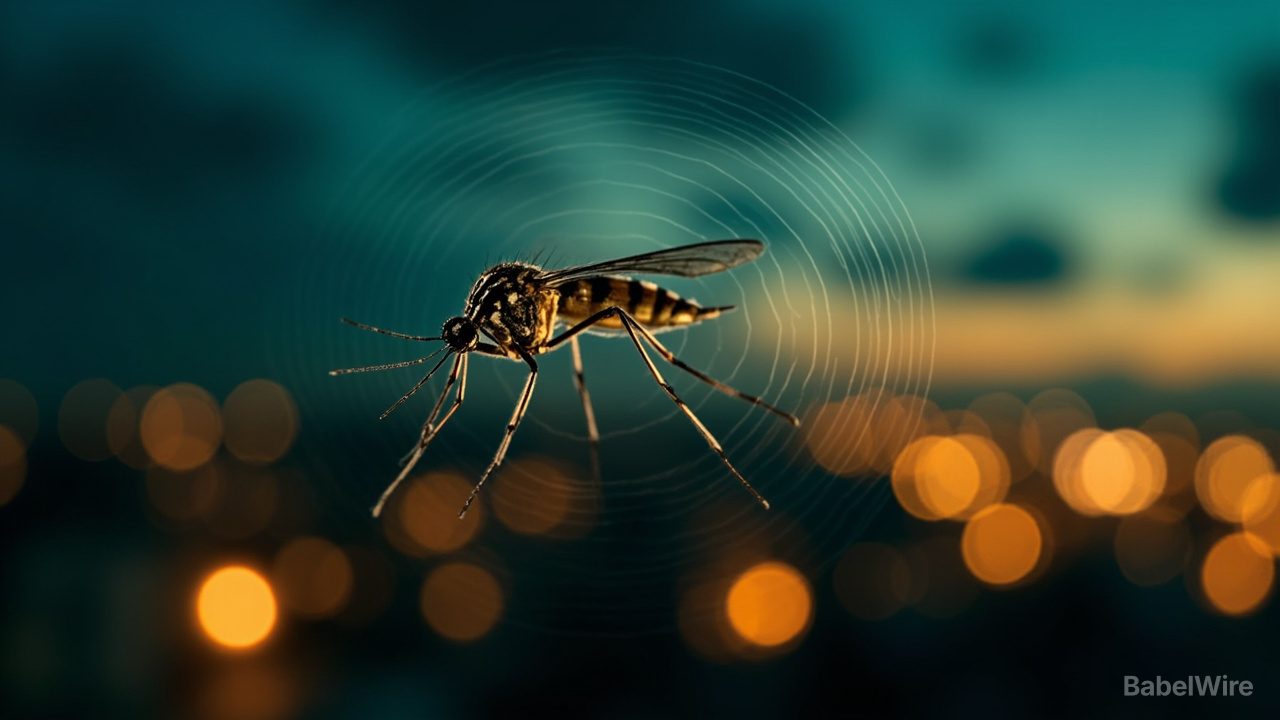
Beginning in the 1950s, malaria control programs sprayed the insecticide dieldrin on the inside walls of homes, where Anopheles mosquitoes — the insects that transmit the disease — liked to rest. Within a few years, the bugs evolved a mutation in a gene called Rdl that made them impervious to the poison. Dieldrin was eventually banned. The mutation, surprisingly, stayed.
A new preprint posted on bioRxiv in late July may explain why: the same mutation appears to make the mosquitoes more sensitive to sound, helping males home in on the faint whine of female wing beats — and giving them an edge in noisy urban environments where susceptible rivals struggle to find mates.
In lab experiments, neurobiologist Marta Andrés of the Spanish National Research Council and colleagues played sounds mimicking female flight tones at 300–550 hertz. Males carrying the resistance mutation were significantly more likely to fly toward and land on the speaker. In mating trials, resistant males maintained about 40% mating success even in incubators filled with loud white noise, while susceptible males' success fell from 42% to 33% in the noisier conditions.
Field data supported the hypothesis: across seven urban sites in Bangui, the capital of the Central African Republic, and four nearby villages, the frequency of the resistance mutation increased with environmental noise. Females lacking the mutation were also less likely to have mated at noisy urban sites than in quiet villages.
Researchers caution the study does not yet prove the mechanism — urban habitats differ from rural ones in many ways, and mosquito hearing remains poorly understood. But the work highlights a broader point: chemicals sprayed decades ago can still shape the genetics and behavior of wild animals today. As one expert put it, "You use an insecticide for a while... and you really change the genetics, and that means the physiology of an animal."