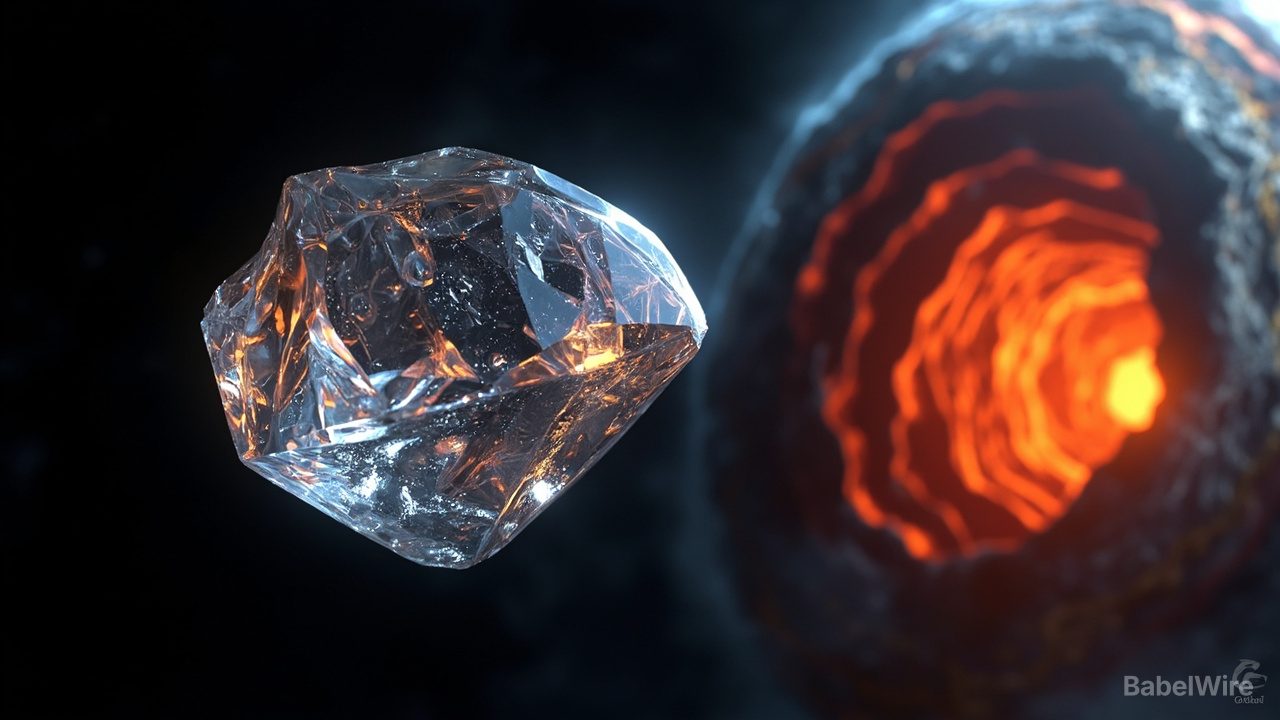
A team of Brazilian researchers has discovered the first direct evidence that goethite — the iron mineral responsible for the brown color of soils — can withstand the crushing conditions of Earth's deep interior. The proof was hidden in a microscopic impurity inside a diamond just 3 millimeters long, one of the famous ultra-deep diamonds of Juína, Mato Grosso.
Goethite forms in soil and on the ocean floor when iron-rich minerals meet water, and it incorporates some of those water molecules into its crystal structure. If it can be carried down by subduction, where oceanic plates sink beneath continents, it could transport water all the way to the lower mantle — a region between 660 and 2,900 kilometers deep where rocks exist in entirely different crystal forms.
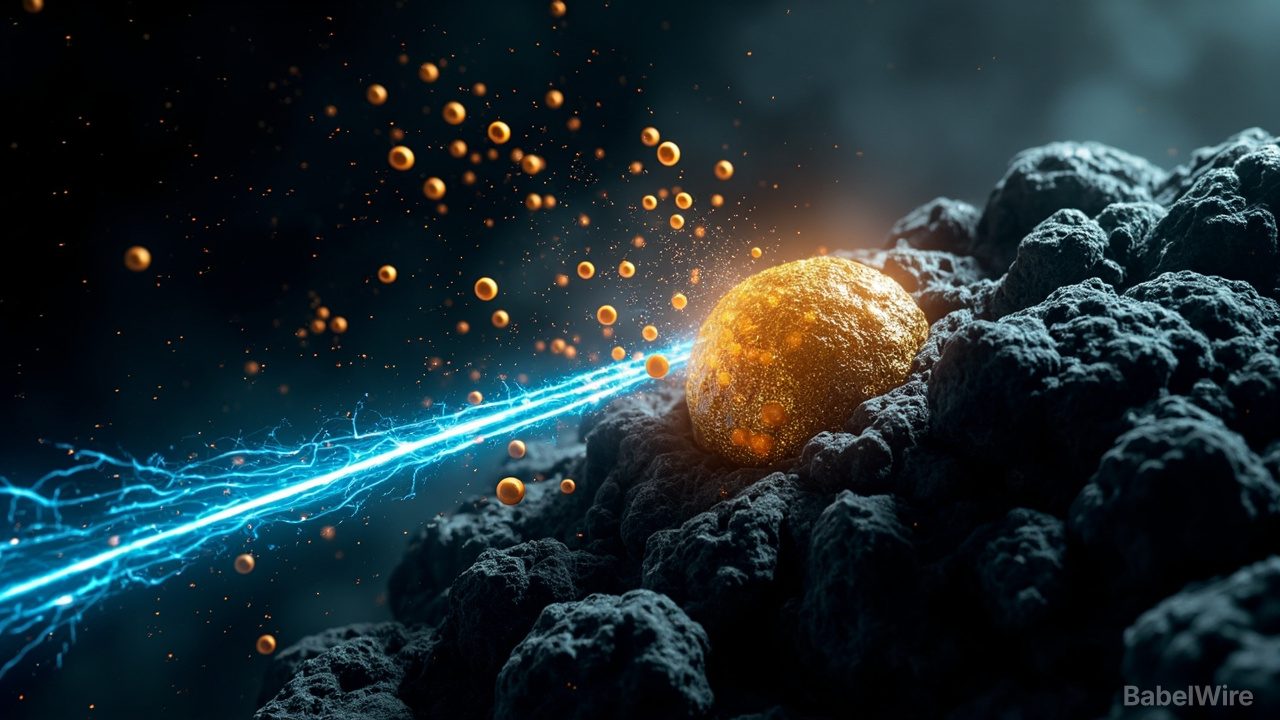
Using the Sirius particle accelerator at the Brazilian Synchrotron Light Laboratory (LNLS/CNPEM), the team mapped around one hundred mineral inclusions inside the diamond with high-resolution X-ray microtomography, then identified their chemistry with X-ray spectroscopy. One inclusion stood out: an iron hydroxide, virtually impossible to explain at surface conditions. Diffraction analysis revealed goethite (FeOOH) coexisting with hematite and magnetite — and tomography proved the inclusion was sealed from the outside, ruling out air-induced oxidation.
Previous shock-wave experiments had shown goethite can survive pressures of 35 to 57 gigapascals — about 500 times the pressure at the deepest point of the ocean — and temperatures up to 1,827 °C, conditions found at 900 to 1,250 kilometers depth. The team proposes that goethite survives subduction sheltered in deep fissures of relatively cool oceanic plates, transforming into hematite and water, or magnetite, oxygen and water, as it descends. "The release of water lowers the melting point of these rocks, potentially generating small amounts of magma," explained geologist Fernanda Gervasoni.
The study, published in Scientific Reports, is the first conducted entirely by a Brazilian team using Brazilian instruments on these celebrated diamonds, and the first anywhere to analyze a super-deep diamond with synchrotron techniques from start to finish. It deepens the picture of Earth's deep water cycle — one that began in 2014, when ringwoodite, a water-absorbing mineral, was found in another Juína diamond, suggesting vast water reserves in the mantle transition zone.
Sources
- phys.orgPhys.org — Ancient diamond preserves evidence of water-bearing mineral deep in Earth's mantle
- agencia.fapesp.brAgência FAPESP — Analysis of a super-deep diamond reveals how water travels to the Earth's interior
- nature.comScientific Reports — Iron oxyhydroxide as a water carrier to the Earth's mantle