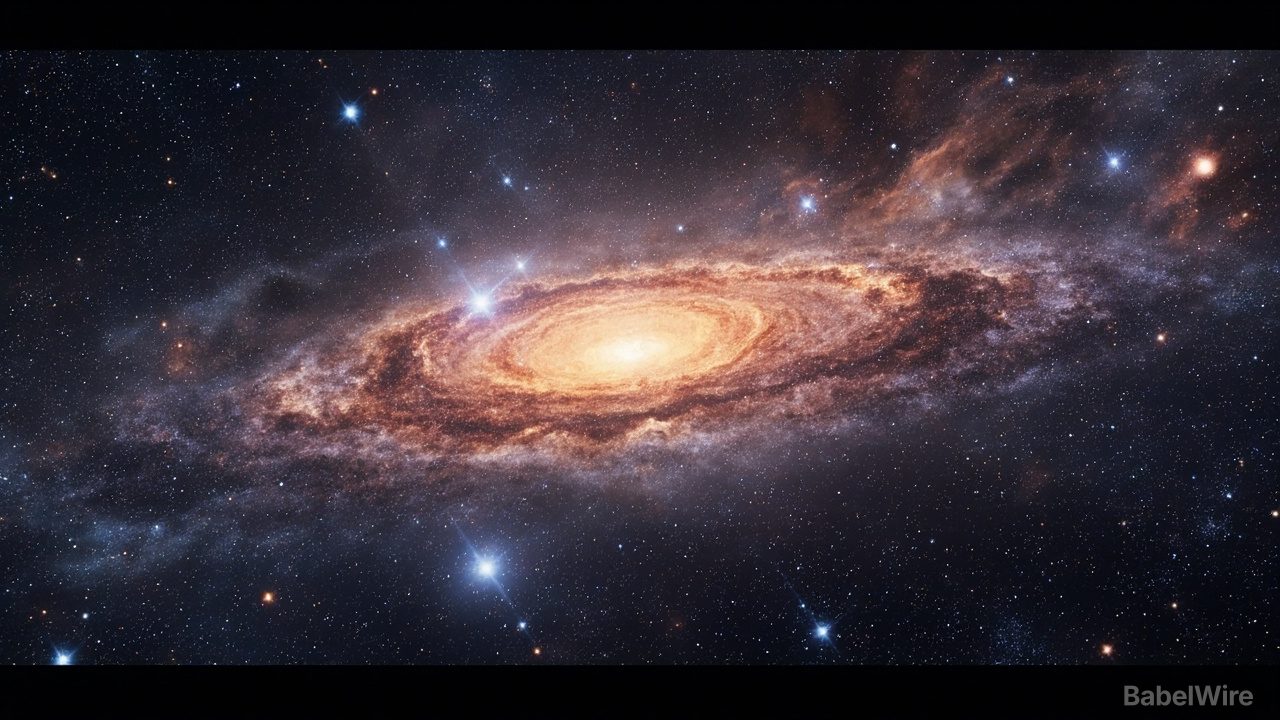
Astronomers now have a new picture of the night sky: the largest two-dimensional map of the universe ever assembled. The DESI Legacy Imaging Surveys team released the 5.6-trillion-pixel color map on Monday, built from 263,407 telescope exposures taken over 2,285 nights. It contains nearly 4 billion celestial objects — mostly stars and galaxies — and covers roughly 75% of the sky in visible and near-infrared light.
The map was 13 years in the making. It combines data from three ground-based surveys — the Dark Energy Camera Legacy Survey (DECaLS) at NSF's Cerro Tololo Inter-American Observatory, the Mayall z-band Legacy Survey (MzLS) at Kitt Peak National Observatory, and the Beijing-Arizona Sky Survey (BASS) at the University of Arizona's Steward Observatory — supplemented by years of observations from NASA's WISE infrared satellite.
Processing the mosaic was a computational marathon: roughly a year went into developing the code, followed by eight weeks of number-crunching on the Perlmutter supercomputer at Berkeley Lab's NERSC facility. More than 160 scientists contributed to the data collection, and a team of 20 produced the final dataset.
"When you're working with astronomical objects today, you often start by pulling up the Legacy Imaging Viewer to see what you're looking at," said David Schlegel, co-lead of the Legacy Surveys and scientist at Lawrence Berkeley National Laboratory.
The map is far more than a pretty picture. It is the foundation for the DESI spectroscopic survey, which measures the distances of millions of galaxies to chart the universe in 3D and probe dark energy — the mysterious force accelerating cosmic expansion. Earlier DESI results have hinted that dark energy's influence may be weakening over time, a finding that could reshape our understanding of the universe's fate.
The new map has been used to select DESI targets since June 2026, and astronomers expect it to remain the most comprehensive 2D view of the cosmos for years to come. It will also serve as a reference for upcoming facilities such as the Vera C. Rubin Observatory and NASA's Nancy Grace Roman Space Telescope, and help train AI tools to analyze vast astronomical datasets. The data are freely available through the Legacy Survey Sky Viewer.