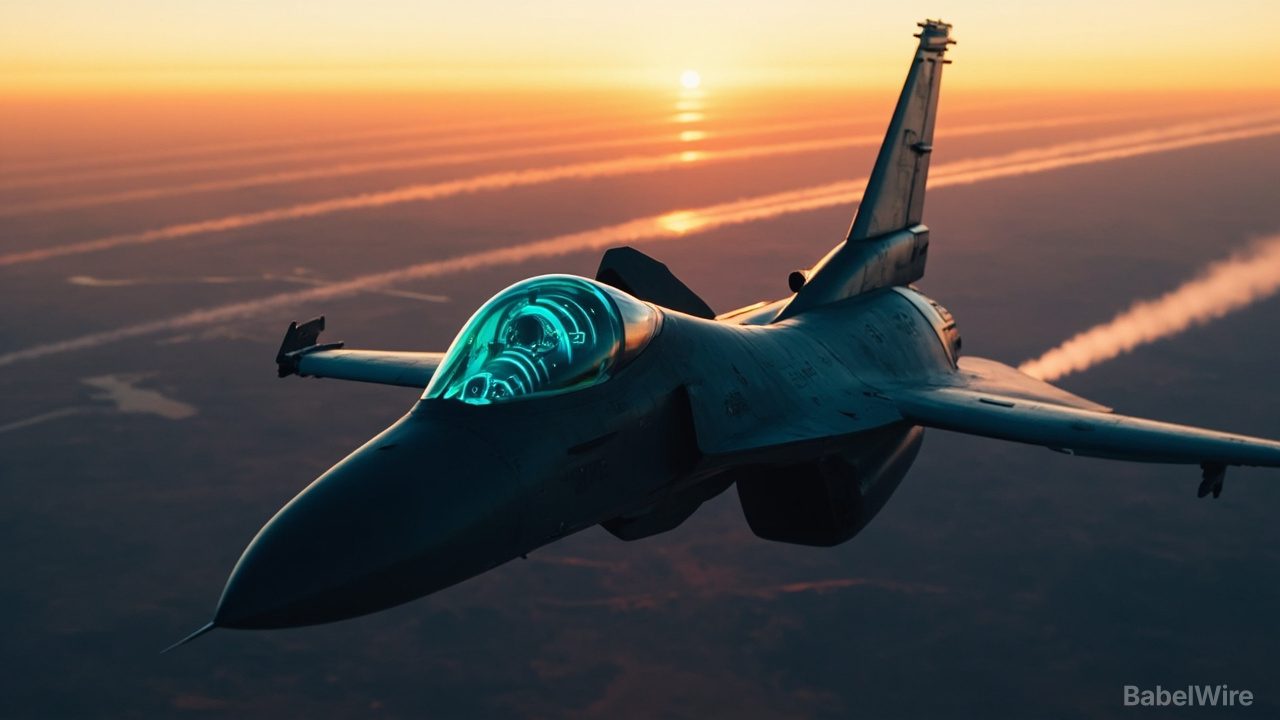
A US Air Force F-16 modified to serve as an autonomous flying testbed has flown with an artificial intelligence agent in control, DARPA announced — a milestone that moves combat AI out of simulation and into the sky.
The flights took place at Eglin Air Force Base in Florida under the VENOM program — short for Viper Experimentation and Next-generation Operations Model — a joint effort between the US Air Force and DARPA that grew out of the Air Combat Evolution (ACE) program. A group of F-16s has been converted into autonomous-capable platforms using the VENOM Autonomy Kit (VAK), a novel interface with the aircraft's flight controls and mission systems that lets a pilot flip a switch to toggle between human and AI control, keeping a human on the loop for safety.
The achievement builds on earlier ACE flights with the one-of-a-kind X-62A VISTA jet, which proved an AI agent could autonomously pilot a fighter in a dogfight. The VENOM flights demonstrate something arguably more consequential: that standard, operational fleet aircraft — not bespoke research planes — can be transformed into AI testbeds without changing the jet's core software.
"The Air Force and DARPA team has automated flight controls and sensors on a standard F-16 without changing the jet's core software," said Brig. Gen. James "Fangs" Valpiani, DARPA program manager. "This enables an efficient pipeline for developing dominant AI for aerial combat."
The VENOM aircraft will now anchor the next phase of DARPA's Artificial Intelligence Reinforcements (AIR) program, which will test multiple AI agents in live-flight scenarios and eventually let human pilots command and orchestrate teams of autonomous uncrewed aircraft — capabilities that feed into Collaborative Combat Aircraft programs and similar joint-force efforts.
The announcement comes as militaries worldwide race to integrate AI into air combat, and as questions about the trustworthiness of combat AI remain open. "The emerging threat environment, especially as it relates to aerial combat, is growing increasingly complex," Valpiani said. "Many hard questions remain concerning the performance and trustworthiness of combat AI in the extreme fog and friction of modern warfare."