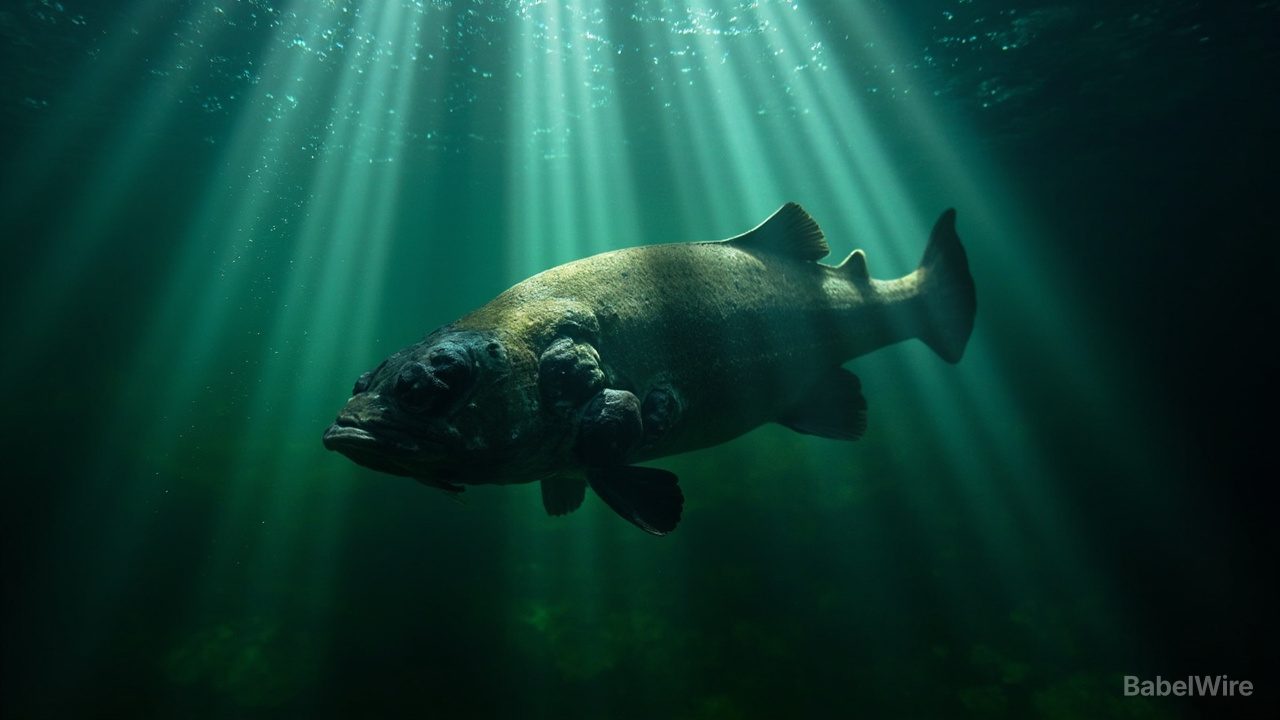
A Creeping Black Plague in a Northern Lake
In 2012, an angler pulled a brown bullhead catfish out of Lake Memphremagog — a 50-km lake stretching from Vermont into Quebec — and found its skin smeared with an inky-black substance. It was melanoma. And it was contagious.
Today, in a study published in Nature, a team from the University of Vermont confirmed: the black tumors spreading through roughly one-third of the lake's brown bullhead catfish are a transmissible cancer — the fourth ever documented in animals, and the first ever found in a fish.
The Fourth Transmissible Cancer
Cancer is supposed to die with its host. A few times in the history of life, a cancer cell has escaped that fate. Before the catfish discovery, only three were known: canine transmissible venereal tumor (CTVT) from a single dog 6,000-11,000 years ago; Tasmanian devil facial tumor disease that has wiped out 80% of wild devils since 1996; and bivalve transmissible neoplasia affecting clams, mussels and cockles.
The catfish melanoma now joins this strange club.
How It Was Discovered
Pollution was the initial suspect. Local group DUMP (Don't Undermine Memphremagog's Purity) feared a nearby landfill was leaking carcinogens. But when University of Vermont data scientist Julie Dragon sequenced tumor genomes from multiple fish, they found tumors from different fish shared hundreds of thousands of gene variants — forming a single genetic lineage distinct from their hosts. The cancer was a single clone spreading from fish to fish.
"We built these trees, and it turned out that all the tumors clustered together, and all the hosts clustered together," Dragon said.
A Centuries-Old Mystery
In 1858, Henry David Thoreau described a brown bullhead with "an inky-black kind of leprosy" on its head. In 1925, a zoologist reported "black tumor of the catfish" in a Cape Cod pond. Both match what scientists now know as transmissible melanoma.
Genetic analysis suggests the cancer may have originated elsewhere — perhaps hundreds of years ago — and invaded Lake Memphremagog relatively recently.
**How Does It Spread?**
Freshwater should kill free-floating cancer cells instantly. The leading theory is direct contact during mating: brown bullheads are solitary fish that aggregate only to breed, and have sharp spines that could scratch each other, providing a route for cancer cells.
The fish survive with the cancer even as it invades internal organs, suggesting a weak immune response.
**How Many More Are Out There?**
Bivalve cancer alone has arisen at least ten independent times. "I don't think these are as rare as we think," said Andrew Storfer of Washington State University. Detecting them requires sequencing both tumor and host genomes — rarely done in wild animals.
Sources - [Nature: Rare contagious cancer discovered in wild catfish](https://www.nature.com/articles/d41586-026-02236-7) - [Nature: Brown bullhead catfish melanoma paper](https://www.nature.com/articles/s41586-026-10828-6) - [Science.org: Contagious fish cancer overruns New England lake](https://www.science.org/content/article/contagious-fish-cancer-overruns-new-england-lake) - [Forbes: Scientists Just Discovered A Contagious Cancer In A Catfish](https://www.forbes.com/sites/johndrake/2026/07/27/scientists-just-discovered-a-contagious-cancer-in-a-catfish) - [Gizmodo: First-Ever Contagious Cancer in Fish](https://gizmodo.com/scientists-discover-the-first-ever-contagious-cancer-in-fish-2000788720)
Sources
- nature.comNature: Rare contagious cancer discovered in wild catfish
- nature.comNature: Brown bullhead catfish melanoma represents a novel transmissible cancer
- science.orgScience.org: Contagious fish cancer overruns New England lake
- forbes.comForbes: Scientists Just Discovered A Contagious Cancer In A Catfish
- gizmodo.comGizmodo: Scientists Discover the First-Ever Contagious Cancer in Fish