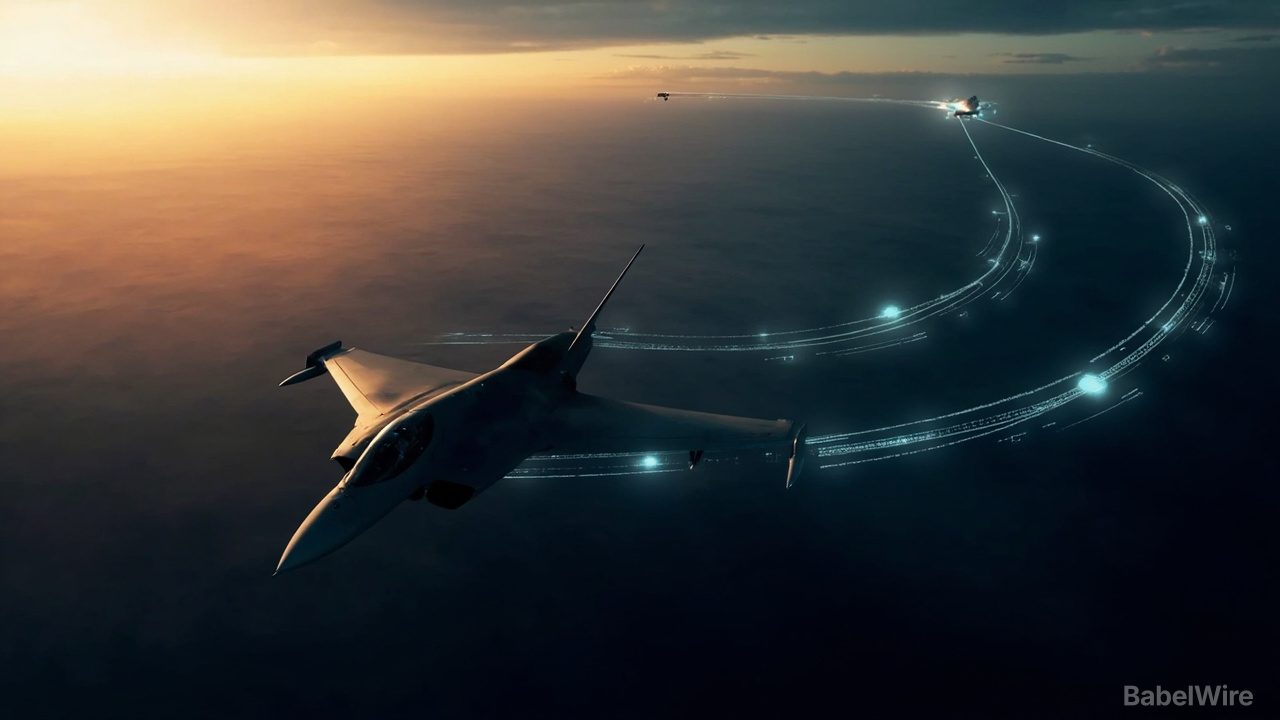
Boeing says it has begun testing communication software designed to let a crewed fighter control an uncrewed tanker aircraft — a step toward the "Manned-Unmanned Teaming" concept the U.S. Navy wants for carrier air wings.
The company said Tuesday that the first trials were flown with a Beechcraft 1900D and an E90 King Air at Eglin Air Force Base in Florida during the Emerald Flag exercise, where test pilots used the software to exercise command and control. The results are to feed integration work on the MQ-25A Stingray tanker drone and the F/A-18 Super Hornet.
The software exchanges command-and-control messages over Link 16, the tactical data link used by U.S. forces and their allies to move information between compatible platforms. Boeing says it is designed to work across different drone and aircraft types, making it broadly applicable, and that teams from its Phantom Works unit and the MQ-25, F/A-18 and F-22 programmes took part in the development, carried out with the U.S. Navy. Boeing expects the software could eventually run on numerous Navy and Air Force platforms.
More tests in military aviation and their evaluation are planned before the software is deployed on an MQ-25A and a Super Hornet. Boeing's pitch is that letting the crew of a crewed jet direct the tanker will improve coordination between fighter and drone during aerial refuelling, cut the reaction time when a tanker is requested, and reduce friction in the logistics chain. The tanker drone could also be flown by the crew, which Boeing says adds safety and flexibility to the refuelling process.
The Navy has ordered three MQ-25As for $562 million. Once the uncrewed tanker takes over the refuelling role, more Super Hornets would be free for strike missions instead of being tied up refuelling other aircraft. The drone completed its first taxi tests in late January 2026 and a first test flight in April; deliveries are due to begin in 2029.