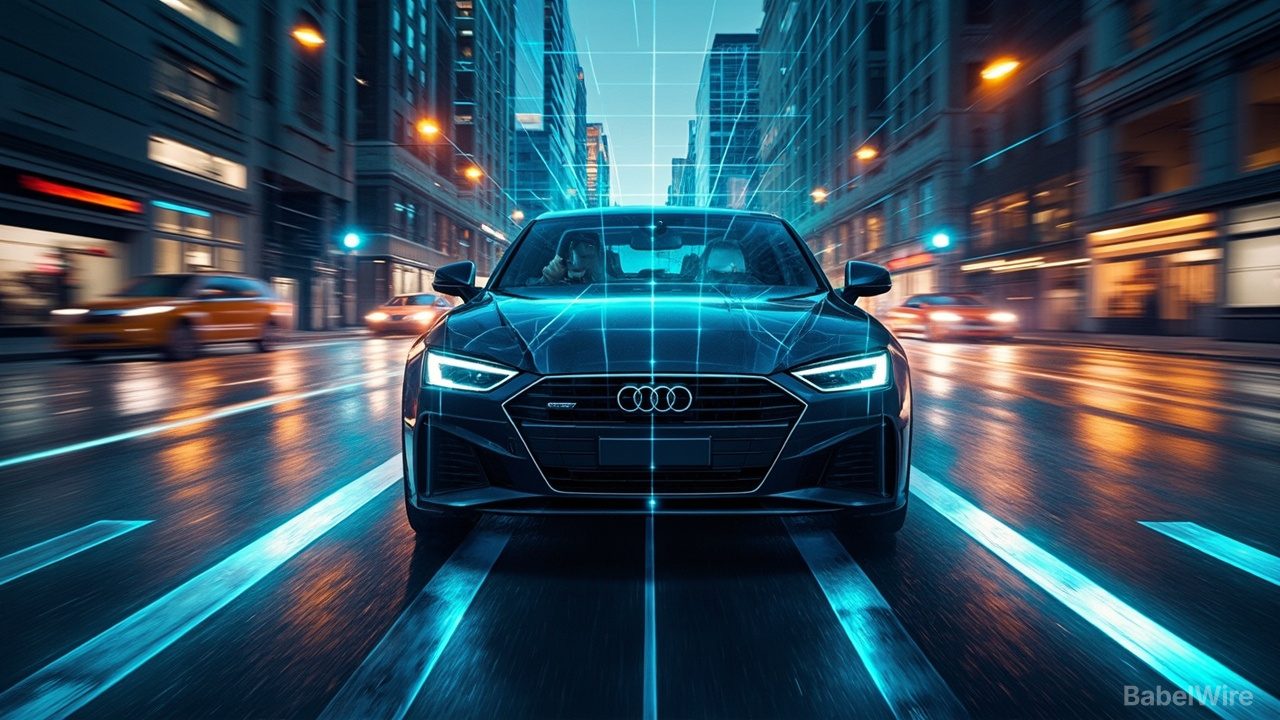
BMW will put a navigation-driven partial automation system into production in 2027, starting in Germany, and the part that matters is how modest it is. The system is SAE Level 2. On motorways the driver may take their hands off the wheel under certain conditions; in town, hands stay on the wheel while the car handles lane changes, turns, giving way and roundabouts.
The capability is the interesting bit: urban manoeuvres guided by GPS-based navigation, with the car negotiating junctions it has never specifically seen. BMW says independent experts have tested the system and that it meets the technical standards; formal regulatory approval is expected in early 2027. It relies on new European rules that for the first time permit automated driving manoeuvres on urban roads — the legal change is the precondition, not the software.
Two engineering choices are worth noting. First, the system is designed to co-operate rather than toggle: if the driver intervenes with the wheel, brake or accelerator, the assistance does not switch off — it absorbs the correction and continues. That is the opposite of the usual handover drama and much closer to how a competent passenger behaves. Second, the hardware already ships: BMW says the cameras and sensors are present in models including the 3 Series, 7 Series, X5, iX3 and iX4, so the feature can be enabled over the air.
The cockpit gets a head-up display showing what the car has perceived alongside its own manoeuvres, plus a 3D map of the surroundings on the central screen. BMW's framing is deliberate: this is a driving assistant that covers city streets, not autonomous driving, and the driver remains legally and operationally responsible.
That framing is the honest one, and it is also the awkward one. Level 2 urban assistance competes with Tesla's FSD in customers' heads while offering a fraction of the claimed scope, and the documented risk of such systems is not failure but complacency — drivers who stop supervising because the car has been right for 20 minutes. Regulators in Europe have effectively bet that a hands-on, driver-responsible system is the safe way to allow urban automation at all. BMW's 2027 launch is the first large-scale test of that bet.