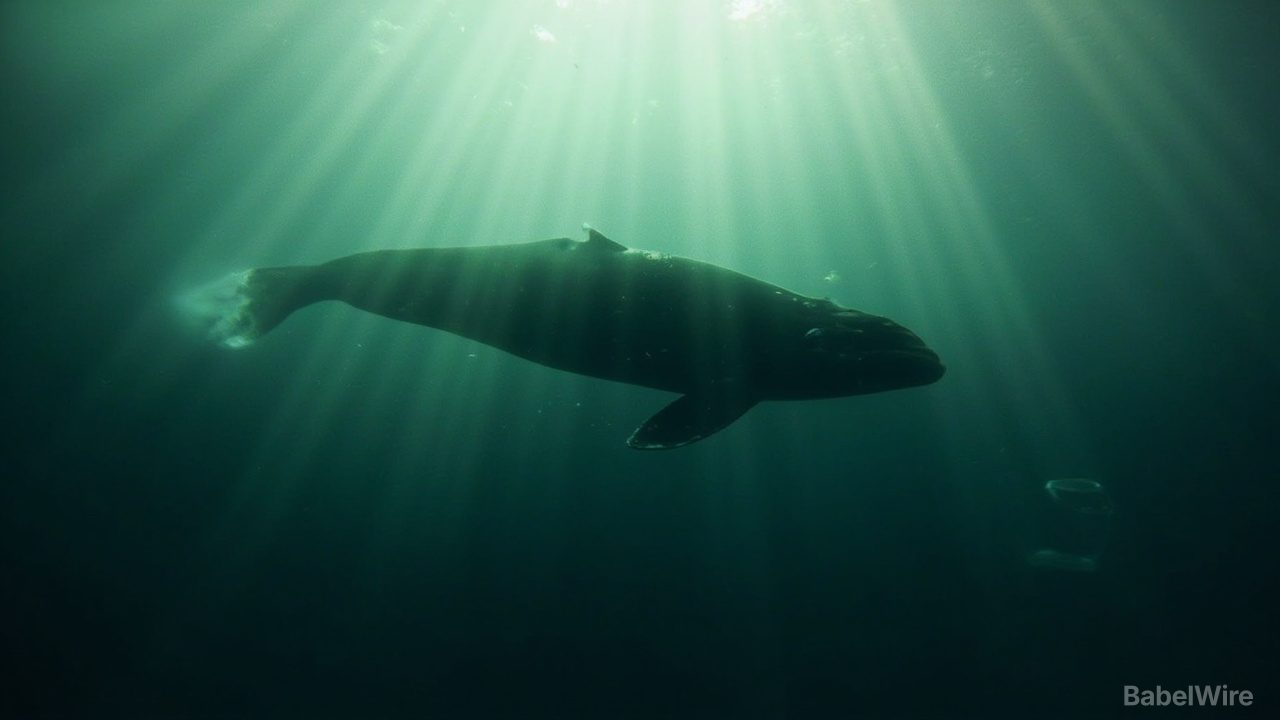
The BBC has found an unusual answer to the AI question: keep the murk.
Ahead of the series launch on 1 November on BBC One and iPlayer, the producers of Blue Planet III confirmed they deliberately left in footage that would once have hit the cutting-room floor — plankton haze in the water, a boat in frame, flat conditions. The reason is not carelessness but evidence: an audience that now reads polish as a tell for synthesis should be able to see the grain and know someone actually filmed this.
"AI makes us want to be even more authentic," executive producer Elizabeth White said. In the past, she explained, "the amount of plankton and things that are in the water" would have meant cutting a shot, or "we might have framed out a boat or a buoy or gone: 'Oh, actually … the water conditions are not really good enough for this.'" This time it stays in. They are "really leaning into that authenticity", she said, and "as AI booms we will probably lean more into the more organic".
Jack Bootle, the BBC's head of specialist factual, was blunter at a press screening: "No gen AI was used in this series. Not a single frame. It's all real photography."
Why this is more than a footnote. For a century, better technology meant more convincing pictures — sharpness, colour depth, high frame rates, low-light sensors. That equation has flipped. Sharpness is now free, and a flawless image proves nothing, because a model can produce one. So imperfection becomes the seal of authenticity, and a public broadcaster finds itself issuing an explicit negative disclosure about what it did not do. The burden of proof has changed sides.
What four years bought. The series was filmed over four years across five oceans, and the production built its own hardware to get there. The centrepiece is an underwater CCTV camera nicknamed "stonefish", developed by producer-director Yoland Bosiger and described by the production as the first of its kind. It captured dolphins plugging holes in coral with sea sponges to trap fish — a use of tools in this form not previously documented. There is also a "mini-dome" camera that follows an octopus, a "deep-sea selfie stick", camera operators on leg-mounted scooters for TikTok-style diving footage, and lasers used to film creatures in the deep.
The behaviour roster is strong: grouper communicating with another species of fish; 200,000 crabs lining up in formation to feed; sea urchins wearing shells as sun hats; and a penguin sequence the production compares to the famous iguana-and-snakes scene from Planet Earth II.
The second strand. The series does not stop at wonder. Episodes show how the climate crisis is killing the sea where anemonefish live, and what the fish do to try to repair their homes. The plastics thread from Blue Planet II continues with pollutants and forever chemicals. David Attenborough, now 100, was "very much involved" and changed scripts, according to Bosiger; White said he "hasn't lost his curiosity".
The unresolved part. Murk is only evidence for as long as it is expensive to produce. Film grain, plankton haze, a wobbling handheld pan — these are among the easiest things a generative model can add after the fact. Authenticity signals work while the cheapest way to fake them costs more than filming them, and that assumption has already failed for watermarks, metadata and camera-attestation protocols. Blue Planet III earns its credibility this autumn because the footage is real. It is not a method anyone can copy without making it worthless.