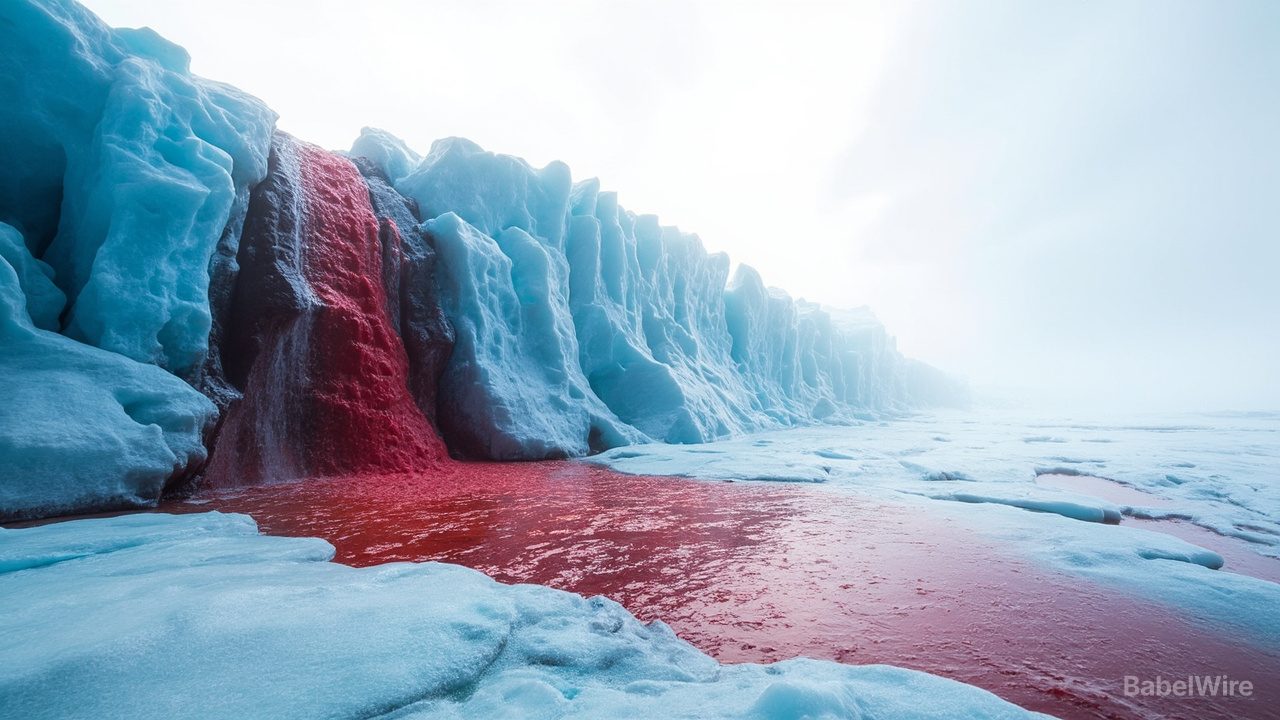
The haunting red waterfall that oozes from Taylor Glacier in East Antarctica may owe its gruesome color — and its very existence — to an ancient ocean trapped beneath the ice, new research suggests.
Blood Falls, named after Antarctic explorer Griffith Taylor in 1911, is famous for sporadic releases of iron-rich brine that turns crimson when the iron meets the air. Earlier studies proposed a seawater origin based on chemical signatures and bacteria, but the new work, published Monday in Nature Geoscience, adds molecular and genetic evidence to the picture.
Researchers analyzed 167 samples of water, sediment and air from around the falls and the wider McMurdo Dry Valleys. They found that the brine and red-stained sediments at Blood Falls share more than 9% of their microbial eukaryotes — organisms whose cells contain a membrane-bound nucleus — with nearby ocean samples, versus only about 1% for other Dry Valleys sites. Crucially, air near the falls carried just a tiny fraction of marine microorganisms, suggesting today's fierce winds cannot fully explain the community.
"Findings in this study reveal a dominance of marine eukaryotic lineages in the Blood Falls area," the authors wrote, calling the marine signal "less prominent but still detectable" among prokaryotes — the single-celled organisms whose DNA floats freely in the cell.
The most likely story: during a warm period with higher sea levels, more than a million years ago, seawater pooled where Taylor Glacier now sits. When the glacier advanced, it sealed the pool — and its microbial inhabitants — beneath the ice for eons.
The team notes that further work, including more comprehensive genetic profiling, is needed to pinpoint when the glacier sealed the brine. But the results strengthen the picture of an ancient, isolated marine world persisting beneath the Antarctic ice.
Sources
- livescience.comScientists uncover big clue as to how Antarctica's mysterious Blood Falls came to be — Live Science
- phys.orgMarine microbes point to ancient seawater source beneath Antarctica's Blood Falls — Phys.org
- doi.orgMolecular evidence for a relict marine community in an Antarctic Dry Valleys subglacial brine-fed system — Nature Geoscience